
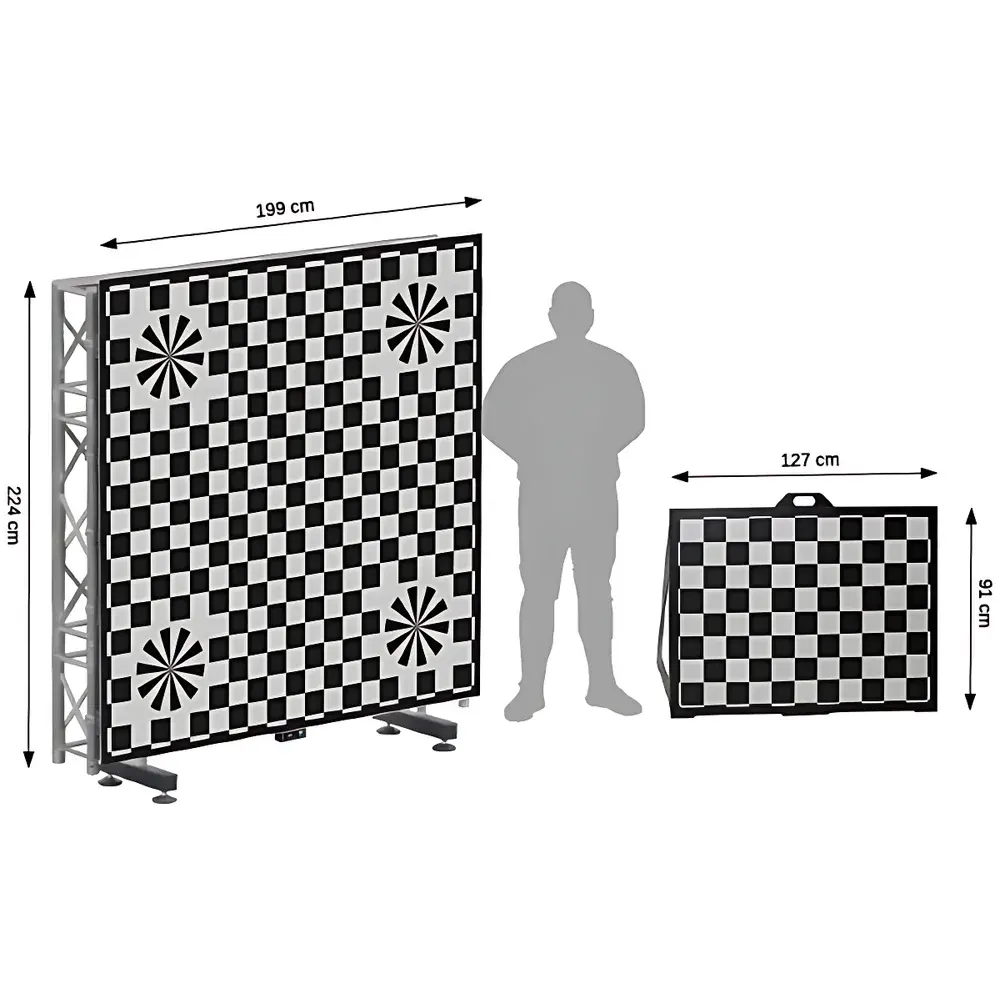
Inframet IR Target Standard for Thermal Imaging System Calibration
| Key | Brand: Inframet |
|---|---|
| Origin | Poland |
| Model | IR Target Standard |
| Target Dimensional Tolerance | ±0.012 mm (for features ≥ 0.125 mm) |
| Compliance | ISO 12233, ASTM E1212, MIL-STD-461G (EMI compatibility per system integration) |
Overview
The Inframet IR Target Standard is a precision-engineered optical reference artifact designed specifically for the calibration, performance verification, and quantitative evaluation of infrared imaging systems—including uncooled and cooled thermal cameras, infrared focal plane arrays (IR FPAs), and radiometric measurement platforms. Based on the principle of high-contrast thermal step-edge generation, the target operates by presenting well-defined geometric apertures—etched or laser-machined into a thermally stable metal substrate—against a uniform blackbody-radiated background. When illuminated by a calibrated blackbody source (typically at 50 °C to 80 °C), the target produces sharp thermal transitions at feature boundaries, enabling objective assessment of spatial resolution (MTF), modulation transfer function, minimum resolvable temperature difference (MRTD), noise-equivalent temperature difference (NETD), and geometric distortion. Its design adheres to fundamental radiometric traceability requirements, ensuring compatibility with standardized test methodologies defined in ISO 12233 (adapted for IR), ASTM E1212 (standard practice for infrared imaging system characterization), and military-grade validation protocols.
Key Features
- Precision-machined stainless steel or Invar substrate with low thermal expansion coefficient (< 2.5 × 10⁻⁶ /°C), minimizing dimensional drift across operational temperature ranges (−10 °C to +60 °C).
- 14 standardized target configurations available, including slanted-edge, bar-pattern (ISO 12233-style), Siemens star, pinhole arrays, knife-edge, multi-aperture grids, and differential temperature step targets.
- Feature tolerances certified to ±0.012 mm for apertures ≥ 0.125 mm; ±10 µm for sub-0.125 mm features; and ±0.001 mm knife-edge linearity—critical for high-fidelity MTF derivation via Fourier analysis.
- Surface finish optimized for uniform emissivity (ε > 0.95, verified per ASTM E1933) and minimal specular reflection, reducing stray radiation artifacts during thermal imaging.
- Mounting interface compatible with standard optical breadboards (M4/M6 tapped holes) and thermal chamber fixtures, supporting repeatable alignment under controlled environmental conditions.
Sample Compatibility & Compliance
The Inframet IR Target Standard is compatible with all mid-wave (MWIR: 3–5 µm) and long-wave (LWIR: 8–14 µm) infrared imaging systems, including cooled InSb and HgCdTe detectors, as well as uncooled microbolometer-based cameras. Each target is supplied with a NIST-traceable calibration certificate documenting dimensional metrology (per ISO/IEC 17025-accredited laboratory), surface emissivity mapping, and thermal edge profile characterization. The targets meet mechanical and radiometric requirements outlined in MIL-STD-461G (for EMI-resilient test environments), support GLP-compliant documentation workflows, and are suitable for use in FDA-regulated thermal imaging validation (e.g., medical fever screening systems under 21 CFR Part 11 audit trails when integrated with compliant software platforms).
Software & Data Management
While the IR Target Standard itself is a passive optical artifact, it is fully interoperable with industry-standard thermal image analysis software suites—including FLIR Tools+, ThermoAnalytics IRBIS, and MATLAB-based MTF calculation toolboxes (e.g., ISO 12233 MTF plugin). Inframet provides downloadable digital target layout files (DXF, STEP) and spectral transmittance data (in CSV format) for integration into automated test scripts. When used with calibrated blackbody sources and image acquisition systems equipped with timestamped metadata logging, the target supports full audit trail generation per ISO/IEC 17025 and FDA 21 CFR Part 11 requirements—ensuring data integrity, user authentication, and electronic signature capability in regulated environments.
Applications
- Factory acceptance testing (FAT) and periodic performance verification of thermal imagers in aerospace EO/IR sensor qualification programs.
- MTF and spatial frequency response characterization of IR optics and detector assemblies during R&D and production line testing.
- Validation of non-uniformity correction (NUC) algorithms and temporal noise metrics (e.g., NETD, temporal noise power spectrum).
- Geometric distortion mapping for wide-field thermal lenses using multi-aperture grid targets.
- Supporting third-party ISO/IEC 17025 accredited calibration labs in issuing traceable reports for end-user compliance (e.g., defense contractors, medical device manufacturers, automotive ADAS thermal camera suppliers).
FAQ
What blackbody temperature range is recommended for optimal contrast with the IR Target Standard?
A blackbody source temperature between 50 °C and 80 °C is recommended, providing sufficient thermal contrast (> 20 K ΔT) against ambient while maintaining stable emission characteristics and avoiding saturation in most LWIR systems.
Can the target be used for both MWIR and LWIR systems without modification?
Yes—the metal substrate and aperture geometry are spectrally neutral across 3–14 µm; no coating or spectral filtering is required. Performance depends solely on the imager’s spectral bandpass and pixel pitch.
Is dimensional calibration data provided with each unit?
Yes—each target ships with a manufacturer-issued calibration certificate listing measured feature dimensions, knife-edge profile deviation, and uncertainty budget, traceable to national metrology institutes via ISO/IEC 17025-accredited partners.
How often should the target be re-calibrated?
Under normal handling and storage conditions (cleanroom-class environment, < 40% RH, no mechanical shock), re-calibration is recommended every 24 months—or after any event involving physical impact, thermal cycling beyond specification, or visible surface contamination.
Does Inframet offer custom target designs?
Yes—custom aperture layouts, substrate materials (e.g., low-outgassing variants for vacuum chambers), and mounting configurations are available under NDA and subject to minimum order quantities and lead-time scheduling.





