
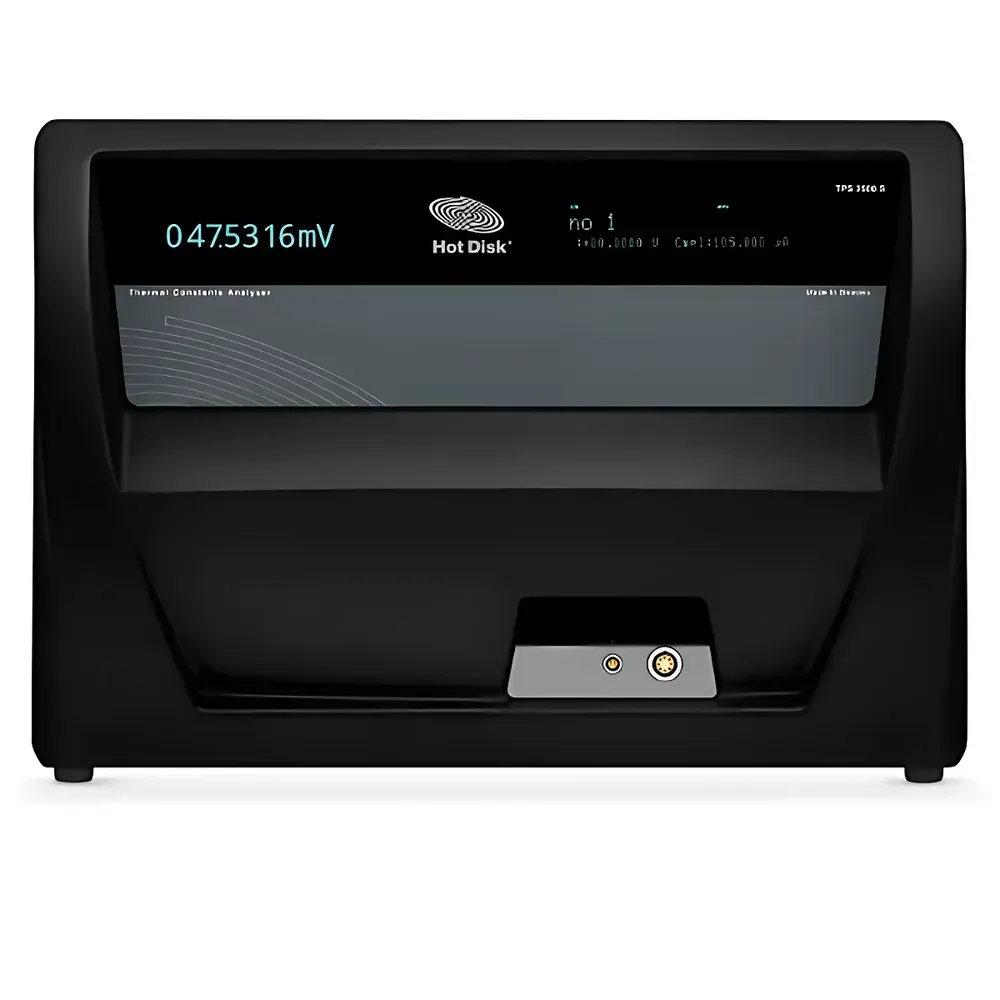
Hot Disk TPS 2500S Transient Plane Source Thermal Constants Analyzer
| Brand | Hot Disk |
|---|---|
| Origin | Sweden |
| Model | TPS 2500S |
| Measurement Principle | Transient Plane Source (TPS) Method |
| Thermal Conductivity Range | 0.005–2000 W/m·K |
| Temperature Range | 30 K to 1000 °C |
| Accuracy | < 3% |
| Repeatability | < 1% |
| Sample Forms | Solids, Liquids, Powders, Pastes, Thin Films, Coatings, Anisotropic & Composite Materials |
| Test Atmosphere | Air, Vacuum, or Inert Gas |
| Dimensions (L×W×H) | 500 × 450 × 320 mm |
| Compatible Modules | Basic, Thin-Film, Plate, Anisotropy, Single-Sided, Specific Heat |
Overview
The Hot Disk TPS 2500S is a high-precision thermal constants analyzer engineered for the simultaneous determination of thermal conductivity, thermal diffusivity, and volumetric heat capacity using the transient plane source (TPS) method. Unlike steady-state or guarded-hot-plate techniques, the TPS method applies a short-duration, constant-power electrical pulse to a sensor acting both as heater and temperature probe—embedded between two identical sample halves or placed on a single surface. The resulting transient temperature rise is recorded with microsecond resolution, enabling direct calculation of thermal properties from first-principles heat diffusion equations. This approach eliminates contact resistance artifacts common in comparative or static methods, delivers measurement times under 10 seconds per test, and supports wide-ranging material classes without requiring extensive sample machining or calibration standards. Designed for research-grade reproducibility and industrial validation workflows, the TPS 2500S meets the physical metrology requirements of advanced materials development across aerospace, energy storage, semiconductor packaging, and functional coatings.
Key Features
- True transient measurement architecture—no equilibrium waiting time; typical test duration: 1–5 s
- Integrated dual-function Kapton-based sensor with active heating and high-sensitivity RTD sensing
- Modular probe design: interchangeable sensor diameters (2–29.4 mm) optimized for bulk solids, thin films (< 100 µm), anisotropic laminates, or single-sided configurations
- Temperature-controlled test chamber supporting cryogenic (30 K) to high-temperature (1000 °C) operation with programmable ramp rates and soak stability
- Multi-atmosphere compatibility: ambient air, vacuum down to 10⁻³ mbar, or inert gas purging (N₂, Ar) for oxidation-sensitive samples
- Non-destructive, minimal-sample-prep protocol: requires only planar surface finish (Ra < 5 µm); no metallization, embedding, or interfacial grease needed
- Simultaneous extraction of thermal conductivity (k), thermal diffusivity (α), and volumetric heat capacity (ρcp) from a single transient curve
Sample Compatibility & Compliance
The TPS 2500S accommodates heterogeneous and structurally complex specimens—including metallic alloys, refractory ceramics, polymer composites, battery electrode slurries, aerogels, biological tissues, and anisotropic graphite foams—without geometric restriction beyond minimum thickness (≥2× sensor radius). Powder and paste measurements are performed using compression fixtures ensuring consistent density and interfacial contact. Thin-film mode enables k-value quantification for coatings as thin as 10 µm on substrates with known thermal properties. All hardware and firmware comply with CE marking directives and electromagnetic compatibility (EMC) Class B requirements. Data acquisition and reporting support audit-ready documentation aligned with ISO 22007-2, ASTM D5470, and IEC 60584-2 frameworks. Optional 21 CFR Part 11-compliant software modules provide electronic signatures, user access control, and immutable audit trails for regulated environments.
Software & Data Management
The proprietary Hot Disk Thermal Analyst v7.x software provides full instrument control, real-time signal visualization, automated curve fitting (using analytical solutions to the heat conduction PDE), and uncertainty propagation analysis per GUM (JCGM 100:2008). Raw voltage-time datasets are stored in HDF5 format with embedded metadata (sensor ID, ambient pressure, thermocouple readings, operator ID). Batch processing supports statistical comparison across sample sets, outlier detection via Grubbs’ test, and export to CSV, Excel, or MATLAB-compatible .mat files. Custom scripting (Python API) enables integration into automated QA/QC pipelines or LIMS systems. Calibration verification routines include reference material testing (e.g., NIST SRM 1470a Pyroceram) with deviation tracking against certified values.
Applications
- Thermal interface material (TIM) qualification for EV battery module cooling and power electronics packaging
- High-temperature thermal property mapping of ceramic matrix composites (CMCs) used in turbine blades
- Anisotropic conductivity profiling of carbon fiber-reinforced polymers (CFRPs) for structural thermal management
- Low-k dielectric film characterization in advanced IC interconnect stacks
- Thermophysical screening of phase-change materials (PCMs) for building envelope applications
- Quality control of thermal barrier coatings (TBCs) on aerospace superalloys
- Research on phonon transport mechanisms in nanostructured thermoelectrics
FAQ
How does the TPS method differ from laser flash analysis (LFA)?
Unlike LFA—which measures thermal diffusivity indirectly via rear-surface temperature rise after pulsed irradiation—the TPS method directly solves the three-dimensional heat conduction equation using a known geometry and boundary condition, yielding thermal conductivity without assumptions about optical absorption or sample opacity.
Can the system measure thermal contact resistance?
Yes—by inserting the sensor at the interface between two dissimilar materials and applying the dual-sample configuration, interfacial resistance (Rc) is extracted alongside bulk k-values using modified analytical models.
Is operator training required for compliance with ISO/IEC 17025?
Hot Disk provides documented SOPs, traceable calibration certificates, and on-site competency assessment protocols suitable for laboratory accreditation audits.
What maintenance is required for long-term accuracy?
Annual sensor resistance verification and chamber temperature uniformity mapping are recommended; no consumables or periodic recalibration of analog circuitry are necessary due to digital signal conditioning and self-diagnostic firmware.
Does the system support custom probe fabrication for non-standard geometries?
Yes—Hot Disk offers OEM probe design services including flexible substrate integration, miniature form factors (<1 mm diameter), and high-temperature metallization (Pt-Rh, Mo-Re) for specialized R&D applications.



