
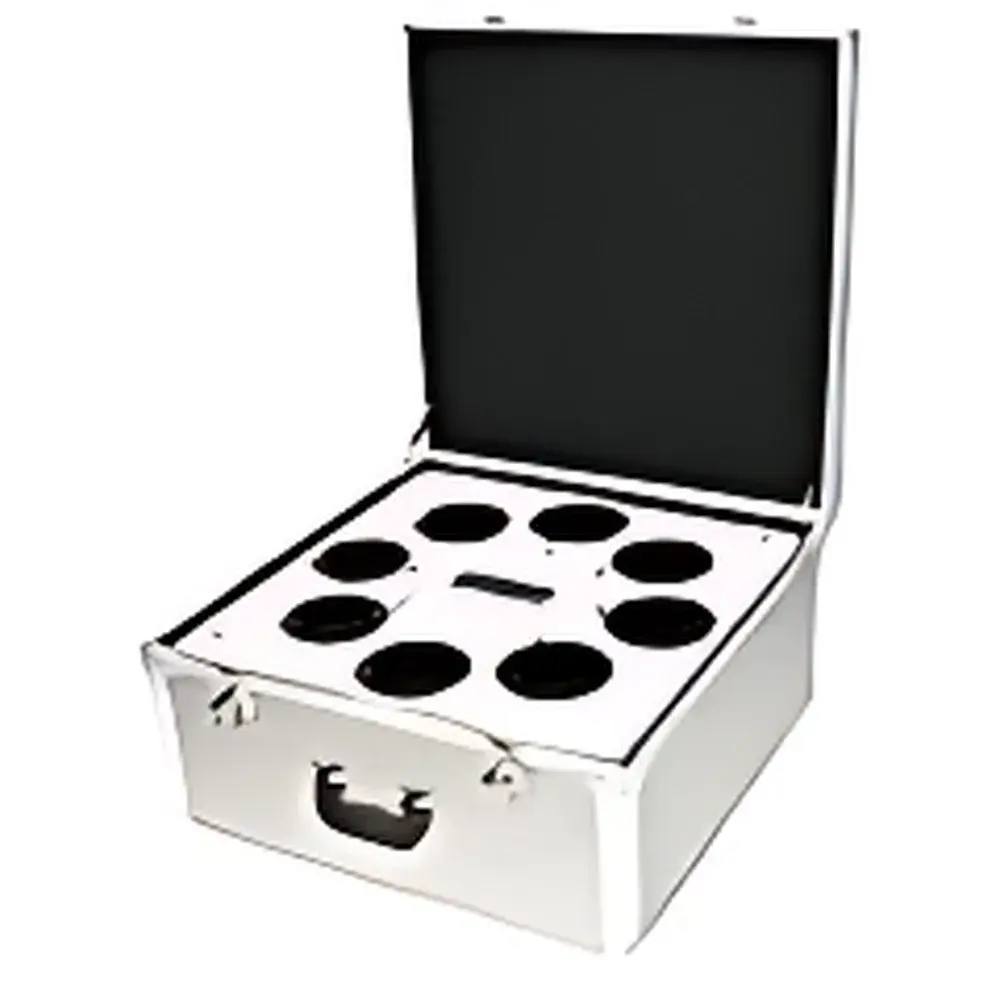
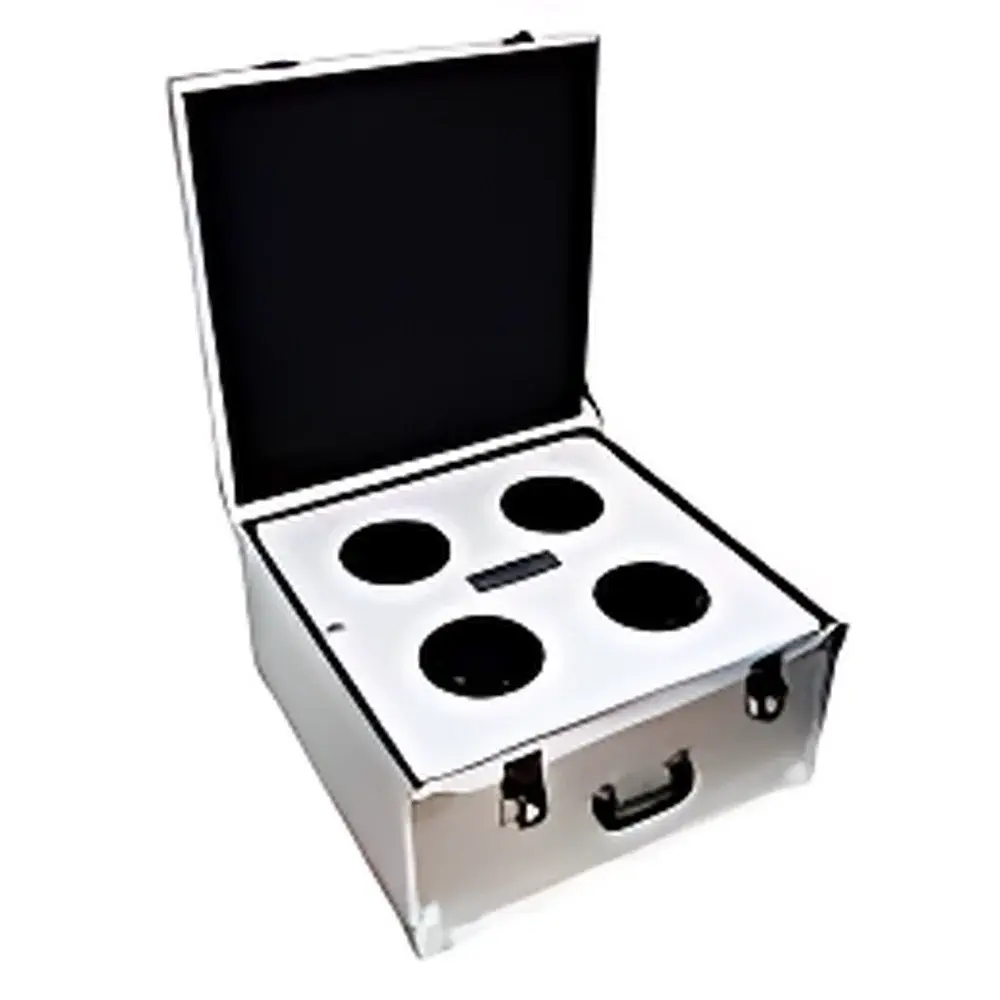
Calmetrix F-Cal 8000/4000 Field Semi-Adiabatic Calorimeters
| Brand | Calmetrix |
|---|---|
| Origin | USA |
| Model | F-Cal 8000 Field / F-Cal 4000 Field |
| Sample Capacity | 8 × Ø75 mm × 150 mm cylinders (F-Cal 8000) or 4 × Ø100 mm × 200 mm cylinders (F-Cal 4000) |
| Operating Mode | Semi-adiabatic temperature tracking with environmental temperature compensation |
| Software Included | CalCommander Suite (F/P-Cal Logger & F/P-Cal Report, 1 license) |
| Optional Add-on | Full F/P-Cal Module Suite |
Overview
The Calmetrix F-Cal 8000 and F-Cal 4000 Field Semi-Adiabatic Calorimeters are engineered for precise, long-term measurement of heat evolution in hydraulic cementitious systems under field-representative curing conditions. These instruments operate on the principle of semi-adiabatic calorimetry—maintaining near-zero thermal flux between sample and surrounding environment by dynamically adjusting the jacket temperature to match the sample’s measured temperature rise. This methodology enables high-fidelity simulation of real-world concrete placement and curing scenarios, where ambient temperature fluctuations directly influence hydration kinetics. Unlike isothermal or fully adiabatic systems, the F-Cal series replicates the thermal boundary conditions encountered during mass concrete pours, precast element curing, or early-age performance validation—making it indispensable for ASTM C1679-compliant hydration monitoring, thermal cracking risk assessment, and low-heat cement formulation development.
Key Features
- Field-deployable, ruggedized chassis with integrated environmental temperature compensation sensors and precision PID-controlled thermal jackets
- Dual-model scalability: F-Cal 8000 supports simultaneous monitoring of eight standard Ø75 mm × 150 mm (3″ × 6″) concrete/mortar cylinders; F-Cal 4000 accommodates four larger Ø100 mm × 200 mm (4″ × 8″) specimens
- High-resolution thermocouple arrays (Type T, ±0.1 °C accuracy) embedded in each sample holder, calibrated traceably to NIST standards
- Real-time differential temperature tracking with sub-millidegree resolution over durations exceeding 180 days
- Onboard data logging at user-defined intervals (1 min to 24 h), with internal non-volatile memory supporting >1 million data points per channel
- IP54-rated enclosure for outdoor or construction-site deployment, including dust and light-splash resistance
Sample Compatibility & Compliance
The F-Cal platforms accept standard cylindrical specimens prepared per ASTM C31/C192 and ISO 1920-3, including Portland cements, blended cements (e.g., slag, fly ash, limestone), alkali-activated materials, and supplementary cementitious material (SCM)-rich mixtures. Each unit maintains compliance with ASTM C1679 “Standard Test Method for Determining Early-Age Heat of Hydration of Hydraulic Cementitious Mixtures” and aligns with technical requirements outlined in ACI 207.2R for thermal modeling input generation. All hardware and firmware meet CE marking directives for electromagnetic compatibility (EMC) and low-voltage safety (LVD). Data integrity protocols support GLP/GMP-aligned workflows, with optional audit-trail-enabled software configurations compliant with FDA 21 CFR Part 11 when deployed with validated CalCommander installations.
Software & Data Management
The included CalCommander software suite provides native integration with both F-Cal models via USB or Ethernet. The F/P-Cal Logger module captures raw thermocouple voltages, applies cold-junction compensation, and stores time-stamped temperature differentials relative to ambient reference. The F/P-Cal Report module generates ASTM C1679–formatted outputs—including cumulative heat release (J/g), heat flow rate (mW/g), inflection point identification, and peak hydration timing—with export options to CSV, PDF, and XML. Data files include embedded metadata (sample ID, mixing time, ambient profile, operator tag) to ensure full traceability. Optional F/P-Cal Module Suite extends functionality with multi-curve comparative analysis, Arrhenius-based activation energy calculation, and automated report templating for QA/QC documentation.
Applications
- Early-age thermal profiling of mass concrete placements to inform thermal control plans per ACI 207.1R
- Validation of SCM reactivity and synergy in low-heat binder systems
- Quality assurance of cement conformity across production batches (ASTM C150)
- Development and verification of predictive hydration models used in finite-element thermal stress simulations
- Supporting durability assessments linked to microstructure development (e.g., pore solution chemistry, C-S-H stoichiometry)
- Field-side verification of admixture efficacy—particularly retarders, accelerators, and hydration modifiers
FAQ
What distinguishes semi-adiabatic calorimetry from fully adiabatic or isothermal methods?
Semi-adiabatic operation balances practical field deployment with thermodynamic fidelity: the system tracks sample temperature in real time and adjusts the jacket temperature to minimize heat loss/gain, unlike fixed-temperature isothermal chambers or complex vacuum-insulated adiabatic cells.
Can the F-Cal units be operated unattended for extended periods?
Yes—both models support continuous autonomous operation for up to six months on stable power, with battery-backup-ready configurations available for remote sites.
Is calibration traceable to national standards?
All thermocouples are factory-calibrated against NIST-traceable references, and a documented calibration certificate is supplied with each instrument shipment.
How does the system handle ambient temperature fluctuations during field use?
Integrated ambient sensors feed real-time corrections into the PID control loop, ensuring thermal tracking accuracy remains within ±0.15 °C even during diurnal swings exceeding 25 °C.
Does CalCommander support multi-user environments with role-based access?
In enterprise deployments, the optional CalCommander Server Edition enables centralized database management, user permissions, electronic signatures, and 21 CFR Part 11–compliant audit trails.






