
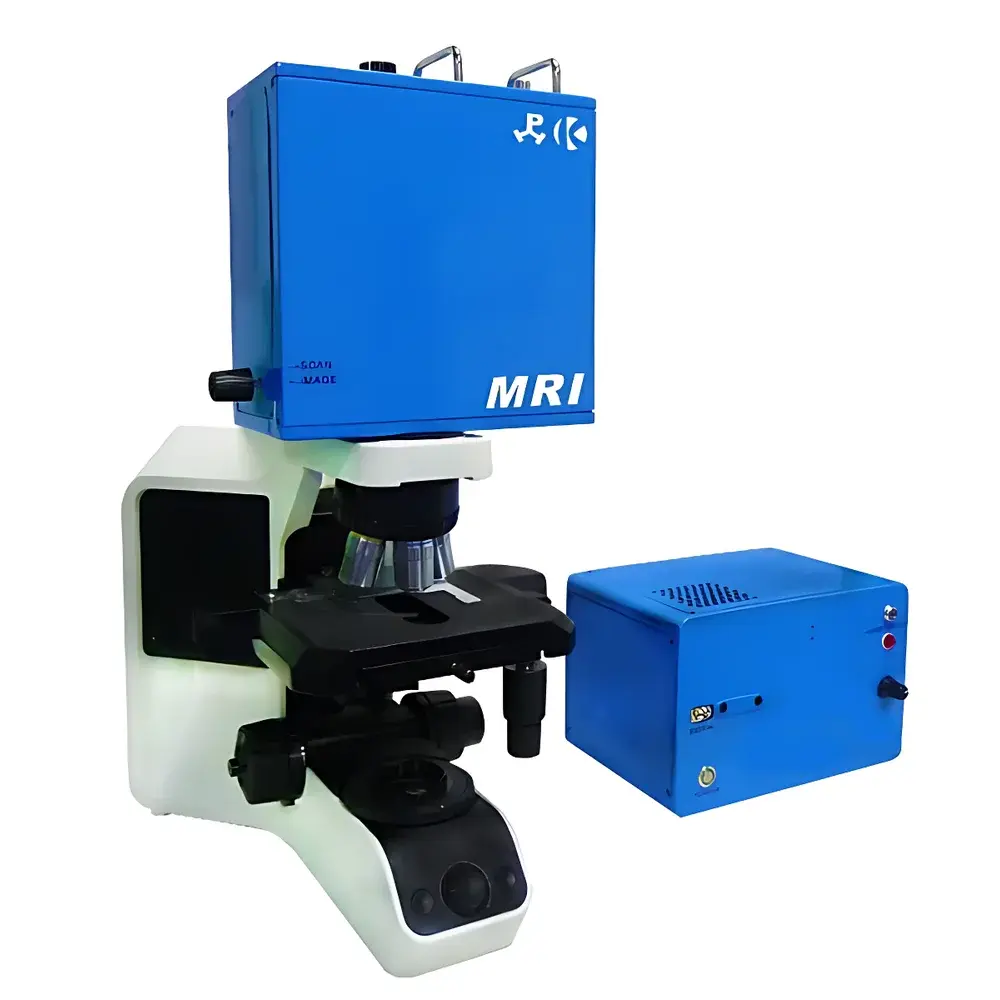
PTT-Kagaku Analys MRIX Micro Raman Portable Laser Micro-Raman Spectrometer
| Brand | PTT-Kagaku Analys |
|---|---|
| Origin | Taiwan |
| Model | MRIX |
| Instrument Type | Portable/Handheld Raman Spectrometer |
| Spectral Range | 90–3500 cm⁻¹ |
| Spectral Resolution | Standard 2.0 cm⁻¹ |
| Spatial Resolution | 1 µm |
| Minimum Wavenumber | 90 cm⁻¹ |
| Spectral Reproducibility | <1 cm⁻¹ |
| Excitation Wavelengths | 488 nm / 532 nm / 633 nm / 785 nm |
| Objective Magnifications | 10× / 50× / 100× |
| Weight | 4 kg |
Overview
The PTT-Kagaku Analys MRIX Micro Raman Portable Laser Micro-Raman Spectrometer is a compact, high-performance benchtop-to-field Raman system engineered for precision molecular fingerprinting via inelastic light scattering. Based on confocal micro-Raman spectroscopy principles, the MRIX employs laser excitation across four discrete wavelengths (488 nm, 532 nm, 633 nm, and 785 nm) to optimize resonance enhancement, fluorescence suppression, and signal-to-noise ratio depending on sample chemistry and optical properties. Its integrated microscope optics—combined with motorized objective turrets supporting 10×, 50×, and 100× magnifications—enable diffraction-limited spatial resolution of 1 µm, facilitating micro-domain analysis of heterogeneous materials without destructive sectioning. Designed around a rigid monolithic optical architecture, the MRIX achieves spectral reproducibility better than ±1 cm⁻¹ over repeated acquisitions, ensuring traceable wavenumber calibration for quantitative comparison against reference libraries. The system operates across a broad spectral range (90–3500 cm⁻¹), covering key vibrational modes from low-frequency lattice vibrations to high-frequency C–H/N–H/O–H stretching regions—critical for polymer characterization, pharmaceutical polymorph identification, carbon allotrope analysis, and geological mineral mapping.
Key Features
- True portable form factor: 4 kg total mass, fully self-contained unit housed in a ruggedized transport case for lab, cleanroom, or field deployment
- Multi-wavelength excitation platform with automatic laser line selection and power stabilization for optimal signal fidelity across diverse sample classes
- Confocal micro-optical path with motorized objective turret and XYZ manual stage for precise micro-sampling at 1 µm lateral resolution
- High-fidelity grating spectrometer with selectable resolution modes (2.0 cm⁻¹ standard, 1.3 cm⁻¹ advanced) calibrated against NIST-traceable standards
- Integrated real-time scan/view toggle interface enabling seamless transition between live microscope imaging and spectral acquisition
- Thermally stabilized detector and optical bench minimizing drift during extended acquisitions or ambient temperature fluctuations
Sample Compatibility & Compliance
The MRIX supports non-destructive, minimal-prep analysis of solids, powders, thin films, gels, pastes, and liquid samples—including aqueous solutions—without requiring vacuum environments or conductive coating. Its 785 nm excitation option significantly reduces fluorescence interference in biological and organic matrices, while 532 nm provides enhanced sensitivity for inorganic pigments and semiconductors. All optical components comply with ISO 10110 surface quality specifications, and spectral calibration protocols adhere to ASTM E1840 and ISO/IEC 17025 requirements for analytical instrument validation. System software supports audit trails, user access control, and electronic signatures compliant with FDA 21 CFR Part 11 for regulated environments operating under GLP or GMP frameworks.
Software & Data Management
The MRIX is operated via dedicated RamanSuite™ acquisition and analysis software, featuring intuitive workflow-driven interfaces for spectral acquisition, baseline correction, peak deconvolution, multivariate analysis (PCA, cluster analysis), and library matching against >20,000 reference spectra (including RRUFF, ICDD, and custom user-defined libraries). Raw data are stored in open-format HDF5 containers with embedded metadata (excitation wavelength, integration time, objective, stage coordinates, calibration parameters), ensuring full FAIR (Findable, Accessible, Interoperable, Reusable) compliance. Export options include CSV, JCAMP-DX, and ASCII formats compatible with third-party chemometric platforms such as MATLAB, Python (SciPy, scikit-learn), and Unscrambler X.
Applications
- Pharmaceutical QA/QC: Polymorph screening, API-excipient interaction assessment, counterfeit drug detection
- Materials science: Graphene layer counting, carbon nanotube chirality assignment, stress/strain mapping in thin-film devices
- Forensics: Trace evidence analysis of paints, fibers, explosives, and illicit substances at crime scenes
- Geosciences: In situ mineral phase identification in rock thin sections or drill core fragments
- Academic research: Reaction monitoring, catalysis studies, and nanomaterial synthesis validation
FAQ
Can the MRIX perform photoluminescence (PL) measurements alongside Raman?
Yes—the optical path is shared between Raman and PL modes, and the system includes spectral calibration routines optimized for both scattering and emission spectroscopy.
Is external cooling required for the CCD detector?
No—the MRIX integrates a thermoelectrically cooled back-illuminated CCD with dark current suppression down to –60°C, eliminating need for liquid nitrogen or external chillers.
Does the system support automated mapping?
Yes—via optional motorized XY stage and scripting API, users can define grid-based or ROI-driven hyperspectral Raman mapping protocols with synchronized image capture.
How is wavenumber accuracy maintained over time and temperature variation?
Through internal reference laser calibration before each session and periodic validation using polystyrene or silicon standards per ISO 21546 guidelines.
Can the MRIX be used inside a glovebox or controlled atmosphere chamber?
Yes—its compact footprint and absence of moving parts (except objectives) allow integration into inert-atmosphere enclosures with standard optical feedthroughs.




