
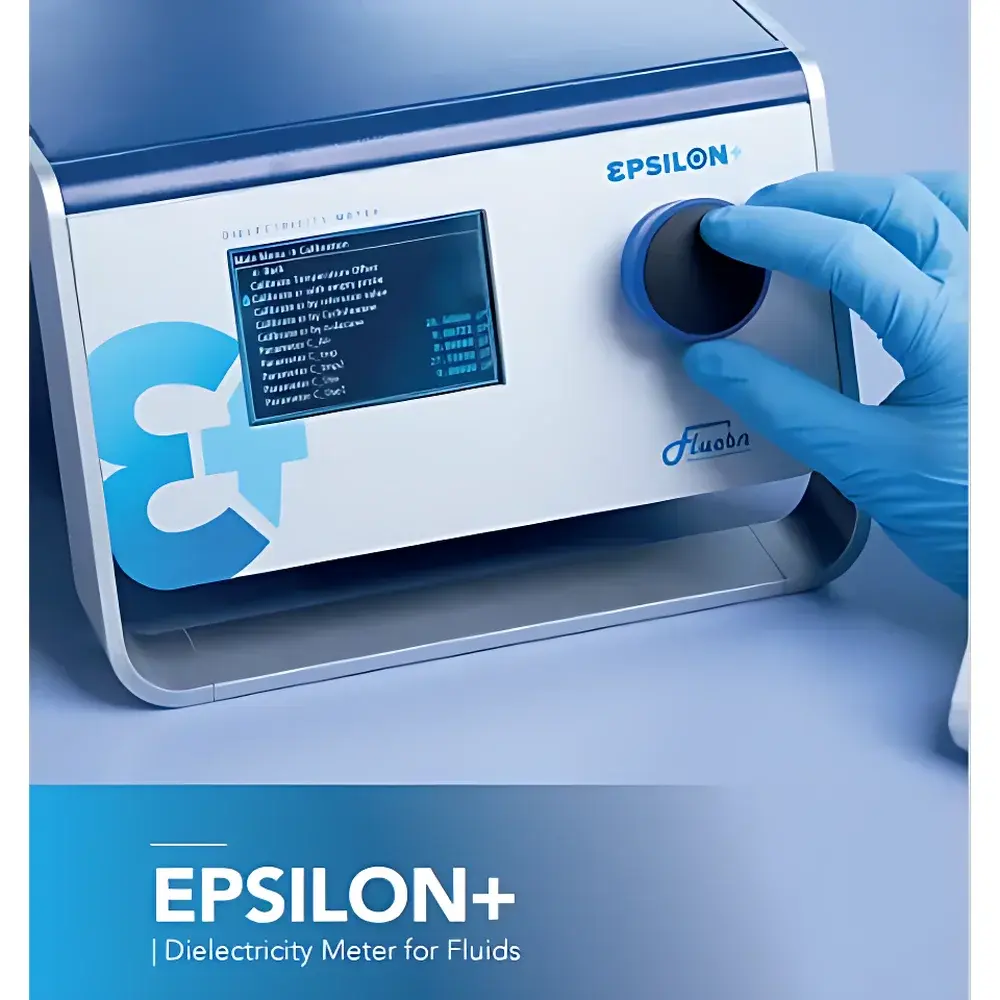
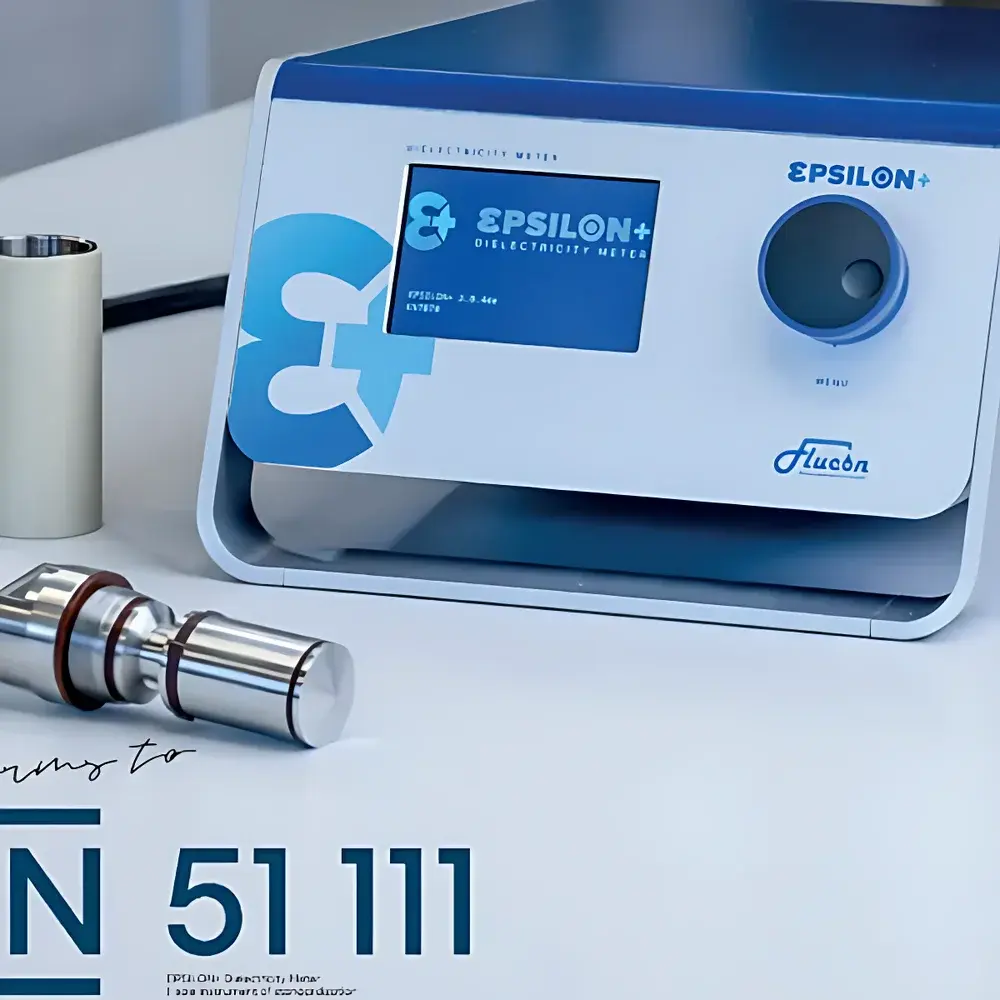
Flucon EPSILON+ Dielectric Constant Analyzer
| Brand | Flucon Fluid Control GmbH |
|---|---|
| Origin | Germany |
| Type | Benchtop Laboratory Instrument |
| Model | EPSILON+ |
| Compliance | DIN 51111 |
| Conductivity Range | 2 nS/m – 600 µS/m |
| TDS Range | 1–10 (unitless, ppm-equivalent scale) |
| Resistivity Range | 0.3 – 10,000 Ω·m |
| Temperature Range | −20 °C to +180 °C |
| Accuracy | ±1% (for κ > 20 nS/m) |
| Minimum Conductivity Resolution | 2 nS/m |
| Dielectric Constant (εᵣ) Range | 1–10 |
| Dielectric Loss Factor (tan δ) Range | 0.3–10,000 |
| Measurement Time | ~15 s |
| Sample Volume | 8 mL |
| Sensor Material | Stainless steel, PEEK, polyimide |
| Temperature Sensor | Integrated PT100 (±0.1 °C) |
| Housing Dimensions | 235 × 150 × 370 mm (W × H × D) |
| Power Supply | 110–240 V AC, max. 30 W |
| Interface | RS-232 (USB adapter included) |
| Display | 4×16-character blue-backlit LCD |
| Output Signals | 0–10 V analog or 4–20 mA (optional) |
Overview
The Flucon EPSILON+ Dielectric Constant Analyzer is a precision benchtop instrument engineered for the quantitative characterization of dielectric and conductive properties of liquid and semi-solid materials—particularly lubricants, engine oils, gear oils, greases, and battery electrolytes. It operates on the principle of complex impedance spectroscopy at a fixed frequency (typically 1 kHz), enabling simultaneous determination of specific conductivity (κ), relative permittivity (εr), and dielectric loss factor (tan δ). Designed in strict accordance with DIN 51111—the German standard governing dielectric measurements of insulating fluids—the EPSILON+ delivers traceable, reproducible results essential for quality control, formulation development, and failure analysis in high-voltage and electrochemical applications. Its relevance has expanded significantly with the rise of electric vehicle (EV) powertrain systems, where dielectric integrity of cooling fluids and dielectric oils directly impacts insulation resistance, partial discharge behavior, and long-term system reliability under elevated voltage stress.
Key Features
- Compliant measurement architecture adhering to DIN 51111 for fluid dielectric characterization
- Integrated stainless-steel screw-type sensor with wear-free design and chemical resistance (PEEK and polyimide housing)
- Onboard PT100 temperature sensor (±0.1 °C accuracy) enabling real-time thermal compensation
- Compact, self-contained unit with intuitive 4×16-character LCD interface and membrane keypad for standalone operation
- Minimal sample requirement: only 8 mL per measurement, reducing material consumption and waste
- Fast measurement cycle (~15 seconds), supporting high-throughput lab workflows
- Dual-interface capability: RS-232 serial communication (with USB adapter) for PC integration and optional analog output (0–10 V or 4–20 mA)
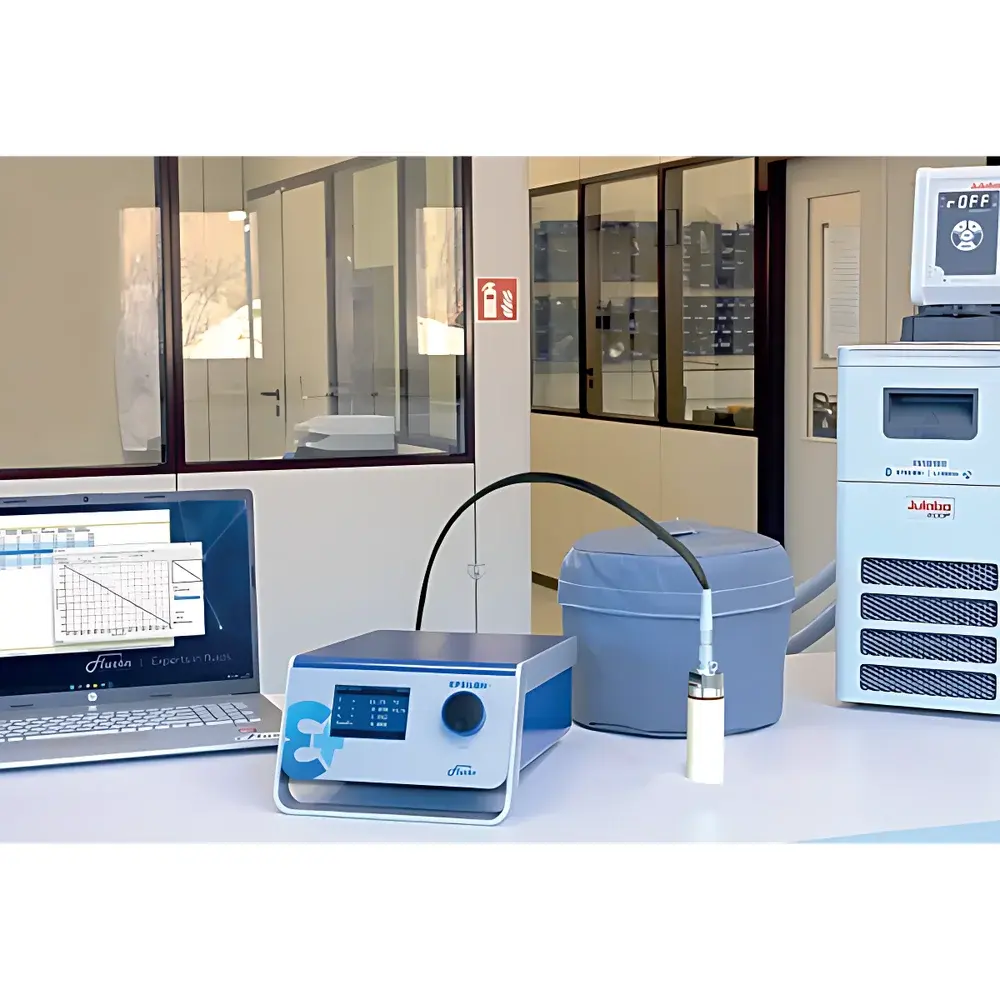
- Modular thermal control support via two certified external thermostats—dry-block (20–180 °C) or liquid-circulation (sub-ambient capable)
Sample Compatibility & Compliance
The EPSILON+ is validated for use with non-aqueous and low-conductivity fluids including mineral and synthetic lubricants, transformer oils, hydraulic fluids, lithium-ion battery electrolytes, and functional coolants. It excludes highly conductive aqueous solutions (>600 µS/m) and suspensions with particulate loading that may interfere with electrode contact or polarizability. All measurements conform to DIN 51111, ensuring metrological traceability and inter-laboratory comparability. The system supports GLP-compliant documentation when used with its dedicated software—enabling audit-ready records of calibration history, measurement parameters, operator ID, and environmental conditions. While not inherently 21 CFR Part 11 compliant, the software architecture allows configuration for electronic signatures and audit trails upon customer-specific validation protocols.
Software & Data Management
The included Windows-based EPSILON+ Analysis Software provides full remote control, automated temperature ramping, and multi-point isothermal profiling. Users define custom test sequences—including start/end temperatures, step increments, dwell times, and repetition counts per isotherm—to generate εr(T), tan δ(T), and κ(T) curves. All raw data are timestamped and stored in CSV and proprietary binary formats, with metadata embedded (sensor ID, calibration date, ambient RH, operator input). Export options include PDF reports with configurable headers, trend overlays, and statistical summaries (mean, SD, CV%). The software supports post-acquisition baseline correction and outlier detection algorithms to enhance data fidelity. For integration into LIMS or MES environments, ASCII export and COM/ActiveX interfaces are available under extended licensing.
Applications
- Monitoring oxidation-induced dielectric degradation in turbine and compressor oils
- Qualifying coolant formulations for EV traction inverters and motor windings
- Assessing moisture ingress in insulating oils via εr and tan δ shifts
- Comparative screening of bio-based lubricants against petroleum benchmarks
- Supporting ASTM D924 and IEC 60247 correlation studies through standardized sample conditioning
- Research into ionic liquid dielectric behavior under thermal cycling
FAQ
Does the EPSILON+ require annual recalibration?
Yes—flucon recommends annual factory recalibration using NIST-traceable reference fluids and certified temperature standards. On-site verification with conductivity standards (e.g., KCl solutions) is possible between intervals.
Can it measure highly viscous greases without dilution?
Yes—the screw-type sensor enables direct insertion into undiluted greases; however, homogenization and temperature equilibration time must be extended per DIN 51111 guidelines.
Is the dry-block thermostat included by default?
No—the dry-block (20–180 °C) and liquid-circulation thermostats are optional accessories ordered separately; the base unit includes only the sensor, electronics, and software.
What cleaning agents are compatible with the sensor?
Ethanol, isopropanol, and low-aromatic hydrocarbon solvents (e.g., hexane) are recommended; avoid halogenated solvents and strong acids/bases that may degrade PEEK seals.
Does the system support multi-frequency dielectric spectroscopy?
No—the EPSILON+ operates at a single fixed frequency optimized for industrial fluid screening; multi-frequency capability requires Flucon’s higher-tier EPSILON-MF platform.
Related Products






