
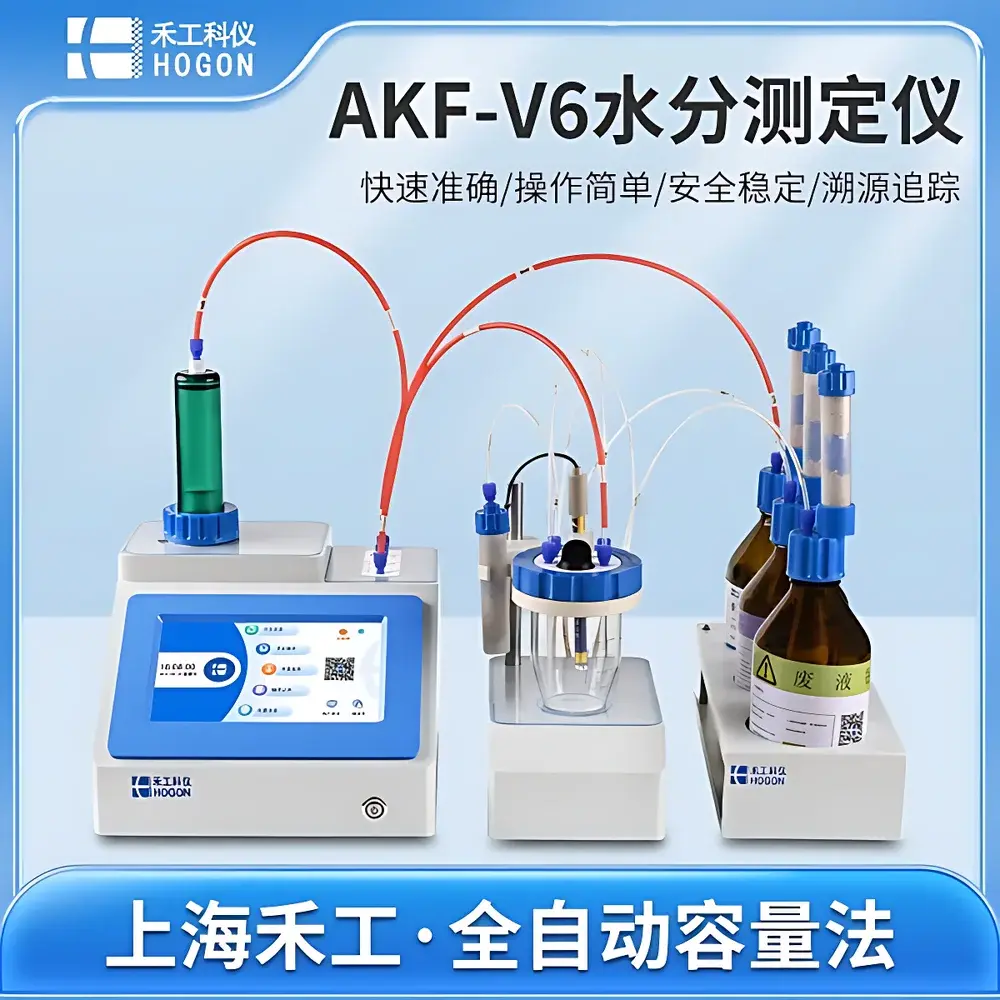
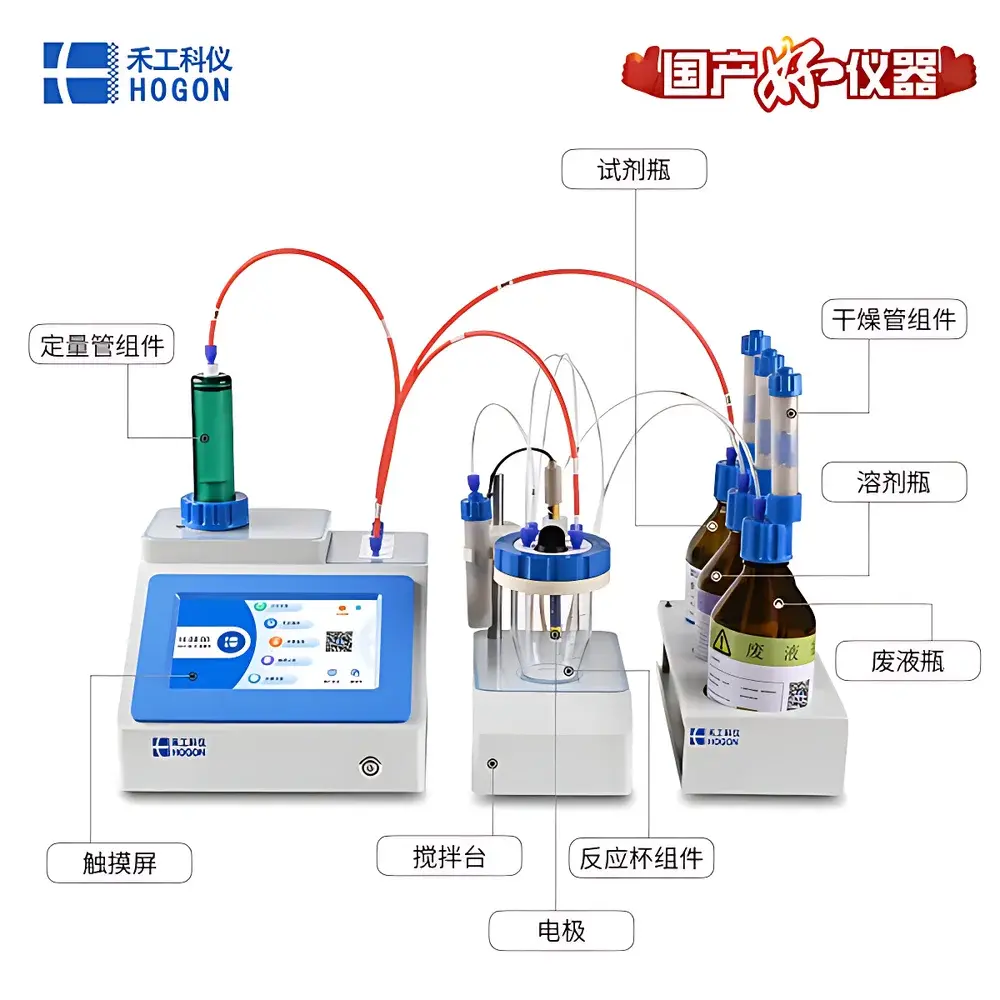
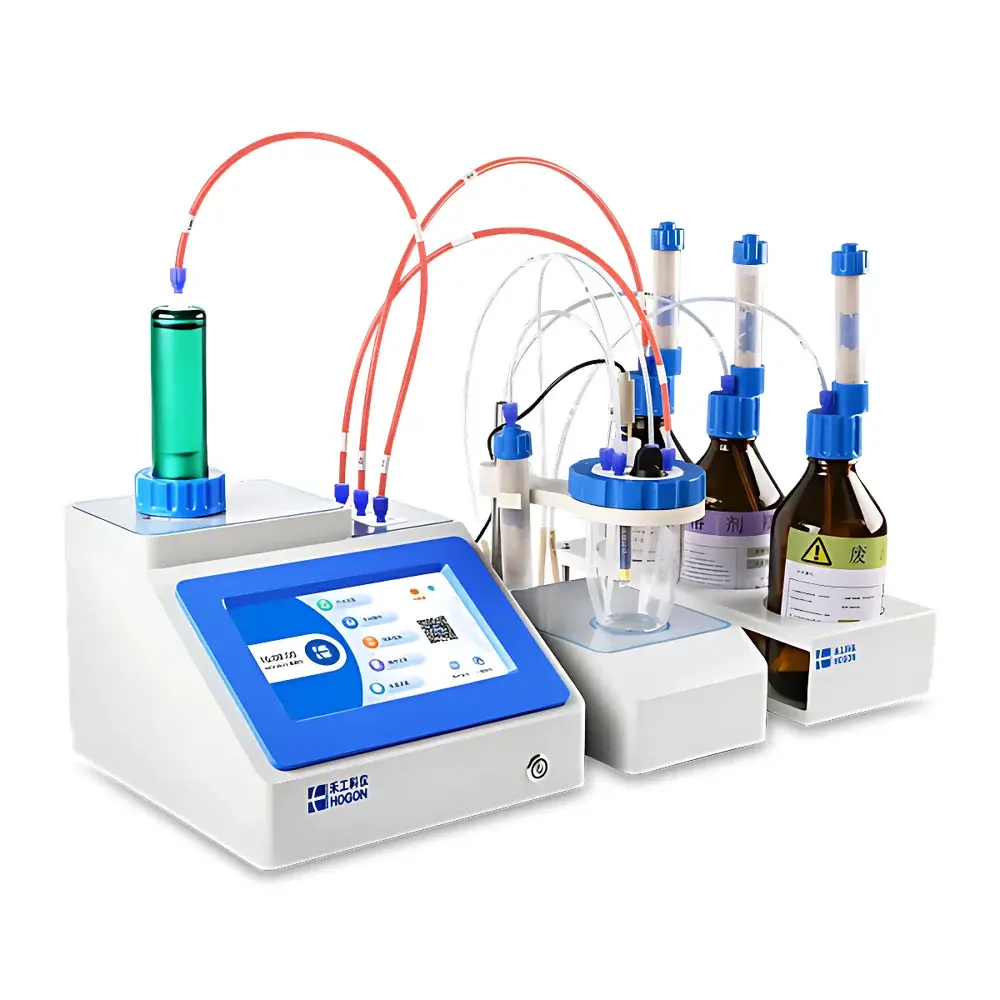
HOGON AKF-V6 Karl Fischer Moisture Analyzer for Acrylate Esters
| Brand | HOGON |
|---|---|
| Origin | Zhejiang, China |
| Manufacturer | HOGON Scientific Instruments Co., Ltd. |
| Instrument Type | Volumetric Karl Fischer Titrator |
| Moisture Range | 10 ppm – 100% (0.001–100 wt% H₂O) |
| Resolution | 0.1 ppm |
| Accuracy | RSD ≤ 0.3% (at 1500 µL reagent consumption) |
| Minimum Dispensing Volume | 0.5 µL (20 mL burette) |
| Repeatability | ±0.3% |
| Linearity (r²) | ≥0.999 |
| Polarization Voltage Adjustment Range | 0–120 mV |
| Burette Options | 20 mL / 10 mL |
| Titration Precision | ±0.5 µL (20 mL burette) |
| Power Supply | 110–240 V AC, 50–65 Hz |
| Data Storage Capacity | 200 test records |
| Sample Stirring Platform | Integrated magnetic stirrer with speed control |
| Electrode Configuration | Dual-platinum indicator electrode |
| Cell Design | Hermetically sealed titration cell with desiccant guard |
| Drift Compensation | Automatic enabled |
| Endpoint Hold Time | 10 s |
| Titration Delay | 5 s |
| Maximum Sample Volume | 50 mL |
| Maximum Titration Time | 30 min |
Overview
The HOGON AKF-V6 Karl Fischer Moisture Analyzer is a fully automated volumetric titrator engineered for high-precision water content determination in moisture-sensitive organic compounds—particularly acrylate esters and related reactive monomers used in polymer synthesis, coatings, and adhesives manufacturing. It operates on the classical coulometric-free volumetric Karl Fischer principle, where iodine generated *in situ* via stoichiometric reaction with water is quantified using standardized KF reagent (typically iodine, sulfur dioxide, pyridine or imidazole base, and methanol solvent). The instrument employs bipotentiometric endpoint detection via dual-platinum electrodes, ensuring robust and interference-resistant identification of the electrochemical equivalence point—even in low-conductivity, non-aqueous matrices typical of acrylic monomers. Its hermetically sealed titration cell minimizes ambient moisture ingress, while integrated drift compensation corrects for background moisture absorption during extended analysis cycles—a critical feature for trace-level (<100 ppm) measurements in hygroscopic samples.
Key Features
- Fully automated volumetric titration with programmable method sequences—including pre-titration dry-down, sample injection, reaction delay (5 s), endpoint stabilization (10 s), and post-analysis purge.
- Hermetically sealed titration cell with desiccant-guarded inlet and gas-tight septum access—designed to maintain <2 ppm ambient humidity inside the cell during operation.
- Dual-platinum bipotentiometric electrode system with adjustable polarization voltage (0–120 mV), optimized for low-conductivity acrylate ester solutions without signal saturation or false endpoints.
- High-precision 20 mL glass burette with ±0.5 µL dispensing accuracy and 0.5 µL minimum step volume—calibrated per ISO 8655-3 and traceable to NIST-certified standards.
- Integrated magnetic stirring platform with variable speed control (100–1200 rpm) to ensure homogeneous mixing of viscous or low-dielectric samples without splashing or emulsion formation.
- Real-time drift monitoring and automatic baseline correction, compliant with ASTM E203 and ISO 760 requirements for dynamic background subtraction.
Sample Compatibility & Compliance
The AKF-V6 is validated for direct analysis of neat acrylate esters (e.g., methyl acrylate, butyl acrylate, 2-ethylhexyl acrylate), as well as formulated resins, crosslinkers, and inhibitor-stabilized monomer batches. It accommodates sample masses from 0.1 g to 5 g (within 50 mL cell volume limit) and supports both liquid and semi-solid samples via syringe injection or solid-sample adapter kits. All measurement protocols adhere to internationally recognized standards including ASTM E203 (Standard Test Method for Water Using Volumetric Karl Fischer Titration), ISO 760 (Determination of Water—Volumetric Karl Fischer Titration Method), and USP (Water Determination). Data integrity meets ALCOA+ principles, with audit-trail-enabled operation logs, user-access controls, and electronic signature support—facilitating GLP/GMP compliance in regulated pharmaceutical and fine chemical environments.
Software & Data Management
The embedded firmware provides intuitive touchscreen navigation with preloaded method templates for acrylates, solvents, polymers, and pharmaceutical excipients. Each analysis generates a timestamped report containing sample ID, mass, reagent consumption (µL), calculated water content (ppm or wt%), RSD, drift rate (µg/min), and full titration curve (potential vs. volume). Up to 200 complete test records—including raw electrode potential data and calibration history—are stored internally with date/time stamping and user ID tagging. USB export enables seamless transfer to LIMS or Excel-compatible formats (.csv, .txt). Optional PC software (HOGON KF-Link) adds advanced features: multi-method batch processing, statistical trend analysis (X-bar/R charts), CFR Part 11-compliant electronic signatures, and automated report generation aligned with 21 CFR Part 11 Annex 11 requirements.
Applications
- Quality control of acrylate monomers prior to polymerization—ensuring water levels remain below critical thresholds (<50 ppm) that trigger premature initiator decomposition or gelation.
- Stability testing of UV-curable formulations, where residual moisture accelerates thiol-ene side reactions and compromises shelf life.
- Release testing of pharmaceutical-grade acrylic adhesives used in transdermal patches (per ICH Q5C guidelines).
- Moisture mapping across production batches to validate drying efficiency of vacuum devolatilization units.
- Method transfer between R&D labs and QC sites—supported by built-in repeatability verification (RSD ≤0.3% at 1500 µL reagent use) and inter-laboratory correlation studies.
FAQ
What sample preparation is required for acrylate esters?
No derivatization or extraction is needed; neat liquid samples are injected directly via gastight syringe. For inhibitor-containing grades (e.g., MEHQ-stabilized), pre-rinsing the electrode and cell with dry solvent is recommended to prevent passivation.
Can the AKF-V6 comply with FDA 21 CFR Part 11?
Yes—when operated with optional KF-Link software and configured with role-based user accounts, electronic signatures, and immutable audit trails, it satisfies electronic record and signature requirements for regulated environments.
How is reagent stability managed during long-term operation?
The system monitors real-time drift and automatically pauses titration if drift exceeds user-defined thresholds (default: 10 µg/min), prompting reagent replacement and cell conditioning—ensuring metrological continuity across shifts.
Is validation documentation available?
HOGON provides IQ/OQ documentation templates, as-received calibration certificates for burettes and electrodes, and performance qualification protocols aligned with ASTM E203 and ISO/IEC 17025 laboratory accreditation criteria.
What maintenance intervals are recommended?
Daily: Electrode cleaning with methanol and cell rinsing; Weekly: Desiccant replacement and seal inspection; Annually: Full system recalibration and burette piston lubrication—per manufacturer’s service manual (SOP-AKF-V6-MNT-EN).




