
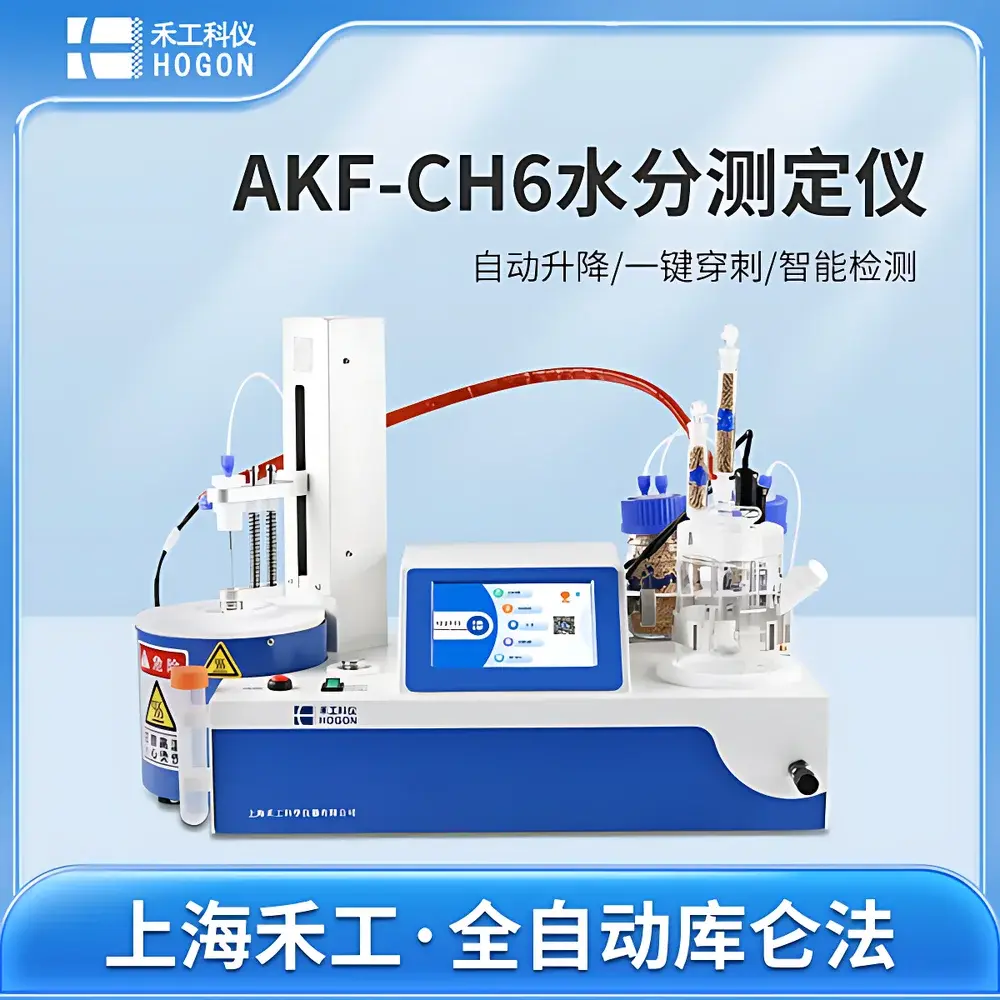
HOGON AKF-CH6 Lithium Battery Karl Fischer Coulometric Moisture Analyzer
| Brand | HOGON |
|---|---|
| Origin | Shanghai, China |
| Manufacturer Type | Direct Manufacturer |
| Instrument Type | Coulometric Karl Fischer Moisture Analyzer |
| Titration Mode | Fully Automatic |
| Measurement Resolution | 0.01 µg H₂O |
| Water Content Range | 3 µg – 199 mg H₂O |
| Accuracy | ≥99.7% (at 1000 µg H₂O) |
| Minimum Sample Injection | 3 µg H₂O |
| Repeatability | ≤0.3% RSD |
| Linearity (r²) | ≥0.998 |
| Polarization Voltage Adjustment Range | ±10% |
| Electrode Type | Electrolytic Electrode |
| Titration Control Precision | 0.01 µg H₂O |
| Power Supply | 300 W, 220 V / 50 Hz |
| Data Storage | Supported |
Overview
The HOGON AKF-CH6 Lithium Battery Karl Fischer Coulometric Moisture Analyzer is a purpose-built, integrated analytical system engineered specifically for the stringent moisture control requirements of lithium-ion battery manufacturing. Unlike conventional benchtop coulometric KF analyzers paired with external heating ovens, the AKF-CH6 embeds a precision-controlled sample evaporator directly into the instrument architecture—enabling fully automated, closed-system headspace sampling and quantitative electrochemical water determination in a single footprint. Its operational principle relies on the stoichiometric Coulometric Karl Fischer reaction: I₂ + SO₂ + 2H₂O → 2HI + H₂SO₄, where iodine is generated *in situ* via controlled electrolysis of the KF reagent. The amount of charge required to regenerate iodine is directly proportional to the water content, allowing absolute quantification traceable to Faraday’s law. This eliminates volumetric calibration drift and ensures metrological rigor across ultra-trace (ppm-level) to high-concentration (up to 100%) measurements—critical for quality assurance in cathode active materials (e.g., NMC, LFP, LCO), anode foils, separators, and electrolytes.
Key Features
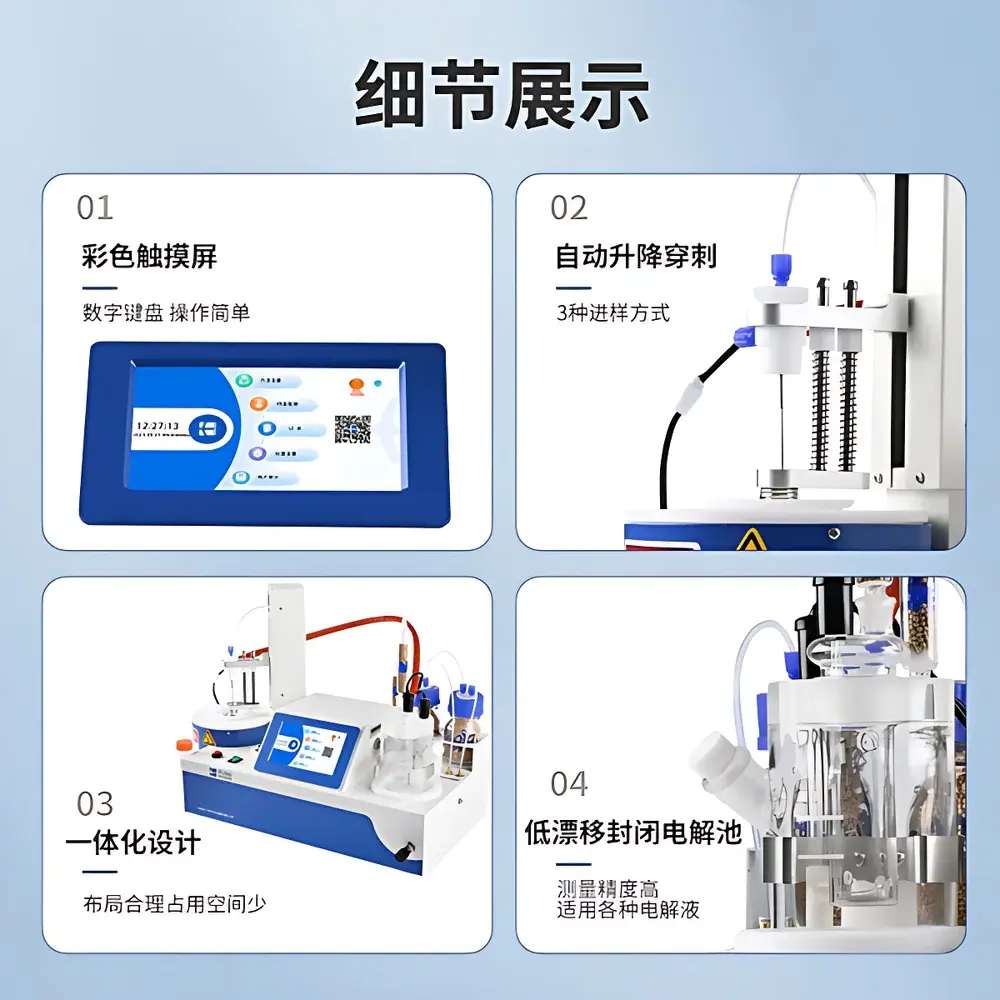
- Integrated headspace evaporator with programmable temperature ramping (ambient to 250 °C), PID-controlled stability, and intelligent overtemperature protection
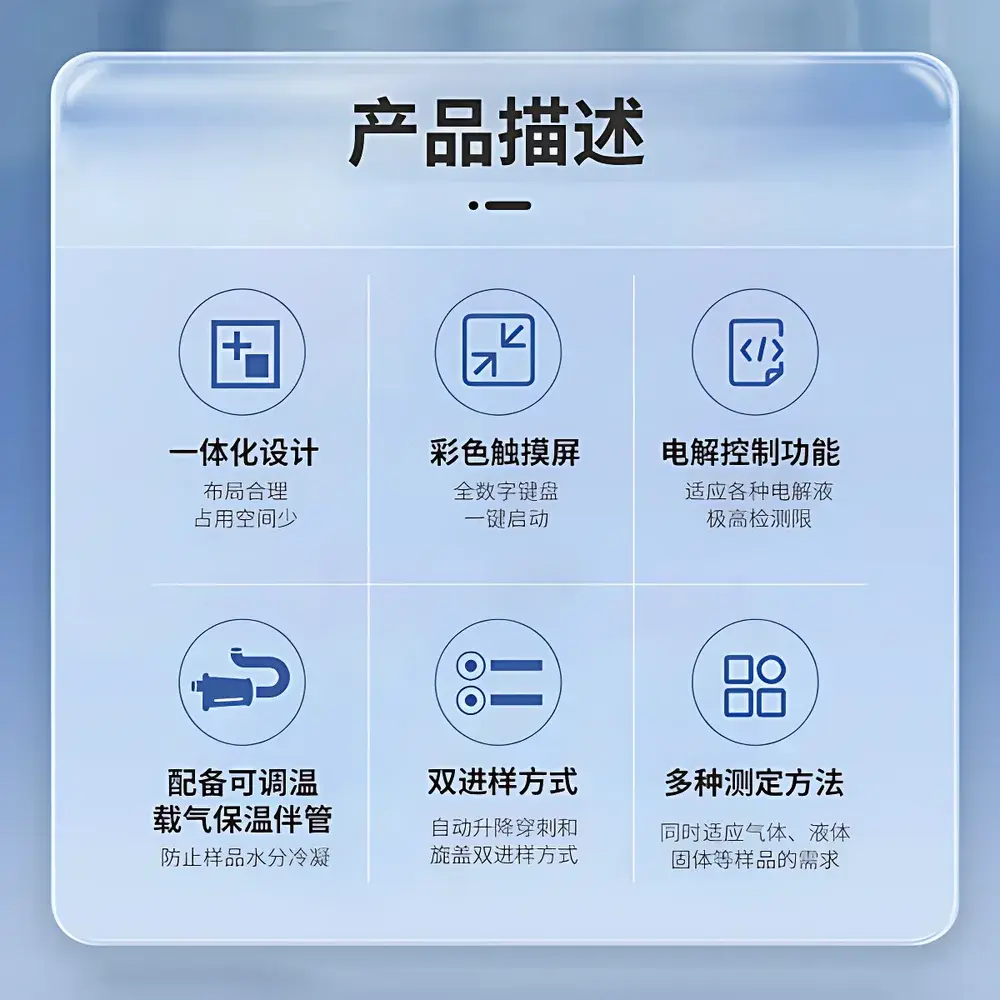
- Dual-mode sample introduction: motorized needle-puncture for sealed vials + screw-cap sealing for volatile or hygroscopic solids—both fully automated and software-synchronized
- Heated carrier gas line (adjustable up to 120 °C) with real-time electronic flow monitoring (5–100 mL/min range) to prevent condensation and ensure quantitative water transfer
- High-resolution coulometric detection with 0.01 µg H₂O resolution, <0.3% RSD repeatability, and certified accuracy ≥99.7% at 1000 µg H₂O
- Intuitive 7-inch color touchscreen interface with full numeric keypad, one-touch method launch, and embedded user management (role-based access control per GLP requirements)
- HOGON Smart Detection Algorithm: real-time baseline compensation, automatic drift correction, adaptive electrode conditioning, and dynamic polarization voltage optimization (±10% range)
- Comprehensive data handling: on-device storage of >10,000 test records with timestamp, operator ID, method parameters, raw current curves, and calculated ppm/mg results
Sample Compatibility & Compliance
The AKF-CH6 accommodates diverse lithium battery matrixes without solvent dissolution—eliminating risk of side reactions or incomplete extraction. Validated applications include solid powders (LiCoO₂, LiFePO₄, graphite), coated electrodes (anode/cathode foils), microporous polyolefin separators, and liquid electrolytes (LiPF₆ in EC/DMC). All thermal desorption protocols are customizable per ASTM E2041 (Standard Guide for Determination of Water in Solids by Karl Fischer Titration) and aligned with ISO 12937 for petroleum-derived electrolyte impurity analysis. The system supports 21 CFR Part 11-compliant audit trails when connected to HOGON’s optional LabManager Pro software, including electronic signatures, immutable method versioning, and change history logging—meeting GMP/GLP documentation standards for battery QC laboratories.
Software & Data Management
Firmware-integrated HOGON MoistureControl OS provides method-driven workflow automation: users define temperature profiles, carrier gas flow rates, equilibration times, and endpoint sensitivity thresholds per sample class. Up to 50 preconfigured methods can be stored locally, each with unique calibration curves, unit preferences (ppm, %, µg), and pass/fail criteria. Real-time graphical display includes titration current vs. time, cumulative charge integration, and moisture release kinetics curves. Export options include CSV, PDF reports (with lab logo/header), and direct USB transfer. Optional network connectivity enables centralized data aggregation via secure HTTPS API—compatible with LIMS integration for enterprise-scale battery material traceability.
Applications
- Quantification of residual moisture in cathode precursors (e.g., Ni₀.₈Co₀.₁Mn₀.₁O₂) prior to sintering—ensuring <20 ppm to prevent Li₂CO₃ formation
- Moisture screening of separator films (e.g., PE/PP trilayer) to verify <10 ppm tolerance—critical for HF generation mitigation during cell cycling
- Electrolyte batch release testing: direct injection analysis achieving ±0.5% RSD at 5–50 ppm levels per USP
- Root-cause analysis of gas evolution in pouch cells via correlation of anode foil moisture (measured at 250 °C) with CO/CO₂ off-gassing profiles
- Supplier qualification audits requiring documented measurement uncertainty budgets per ISO/IEC 17025 Annex A.2
FAQ
What distinguishes the AKF-CH6 from conventional KF oven-coupled systems?
It integrates the evaporator, carrier gas delivery, and coulometric titration cell into a single calibrated platform—reducing dead volume, eliminating inter-unit communication latency, and minimizing adsorption losses. This yields superior reproducibility (<0.3% RSD) and faster cycle times (≤8 min/sample for LiCoO₂ at 180 °C).
Can the AKF-CH6 comply with FDA or ISO 17025 requirements?
Yes—when used with LabManager Pro software, it delivers full 21 CFR Part 11 compliance (audit trail, electronic signatures, method locking) and supports uncertainty estimation per ISO/IEC 17025:2017 Clause 7.6.2.
Is method validation support available for battery-specific matrices?
HOGON provides application notes with validated parameters for 12+ lithium battery materials—including recovery studies, LOD/LOQ determination, and robustness testing per ICH Q2(R2).
How is electrode maintenance handled during high-throughput operation?
The system features automatic electrode cleaning cycles triggered by impedance monitoring; consumables (electrolyte, cathode/anode cells) are field-replaceable with <5-minute downtime and no recalibration required.
Does the instrument support remote diagnostics or firmware updates?
Yes—via embedded Ethernet/Wi-Fi, technicians can initiate secure remote diagnostics, push verified firmware patches, and monitor real-time hardware health metrics (electrode voltage, heater stability, gas flow deviation).
Related Products





