
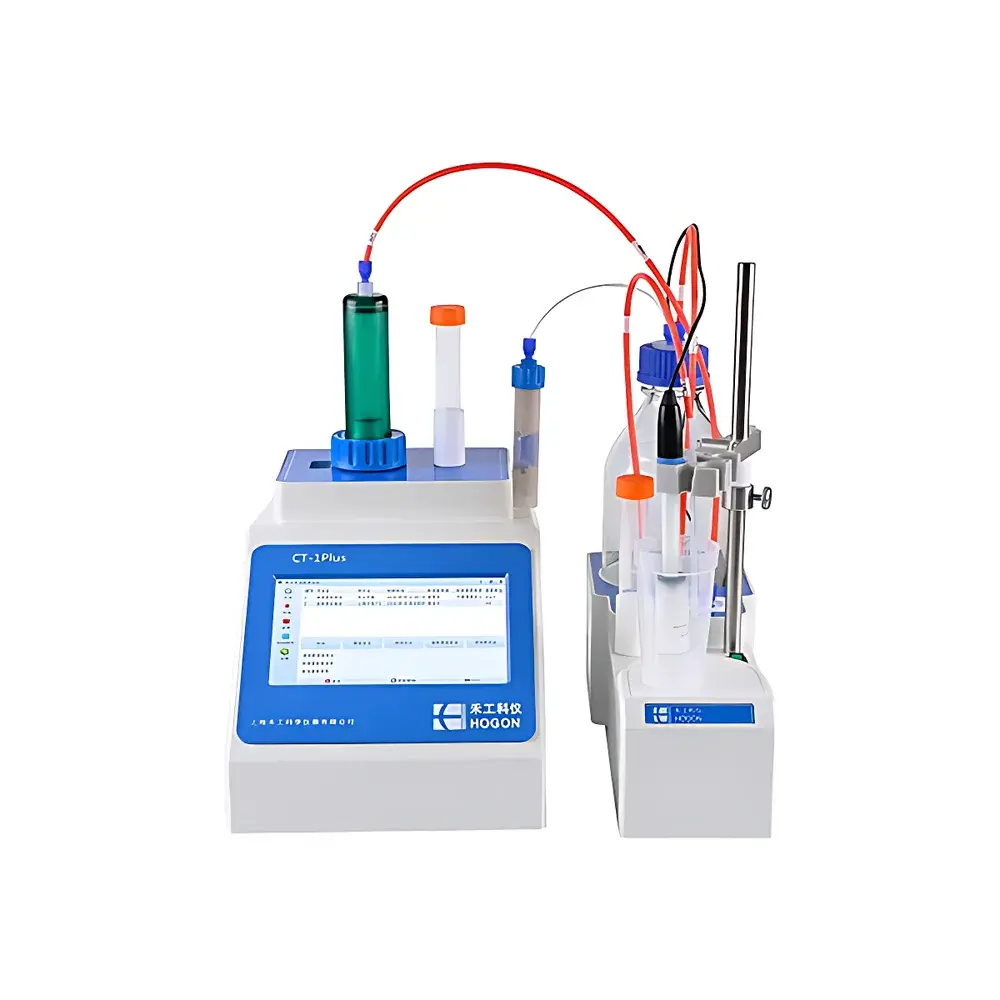
HOGON CT-1Plus Automatic Potentiometric Titrator for Chloride Ion Determination in Compound Fertilizers
| Brand | HOGON |
|---|---|
| Origin | Shanghai, China |
| Manufacturer Type | Direct Manufacturer |
| Product Category | Domestic |
| Model | CT-1Plus Automatic Potentiometric Titrator for Chloride Ion Determination in Compound Fertilizers |
| Instrument Type | General-purpose Potentiometric Titrator |
| Application Scope | Universal |
| pH Measurement Range | 1–14 |
| Meter Display Accuracy | ±0.1 mV |
| Meter Resolution & Range | ±2000 mV, 0.1 mV resolution |
| Titration Accuracy | 0.001 mL (20 mL burette, standard) |
| Titration Resolution | 0.0005 mL (10 mL burette, optional) |
Overview
The HOGON CT-1Plus is a dedicated automatic potentiometric titrator engineered for precise, standardized chloride ion (Cl⁻) quantification in compound fertilizers—directly supporting compliance with China’s mandatory GB 15063 and GB/T 17767 standards. It operates on the principle of argentometric potentiometric titration, utilizing a silver nitrate (AgNO₃) standard solution to react stoichiometrically with chloride ions in aqueous extract samples. The endpoint is determined by a sharp potential inflection detected via a high-selectivity Ag-101C composite silver/silver chloride electrode, eliminating subjective visual interpretation inherent in manual or colorimetric methods. This electrochemical detection mechanism ensures thermodynamic rigor, robustness against sample turbidity or color interference, and traceable measurement integrity—making it suitable for routine QC laboratories operating under GLP-aligned workflows.
Key Features
- High-fidelity potentiometric endpoint detection using a factory-calibrated Ag-101C electrode with optimized Cl⁻ selectivity and fast response kinetics (t₉₀ < 15 s)
- Micro-precision dosing system featuring dual-burette configuration: standard 20 mL glass burette (±0.001 mL accuracy) and optional 10 mL high-resolution burette (±0.0005 mL resolution)
- Digital meter with 0.1 mV resolution, ±0.2 mV absolute accuracy over ±2000 mV range, and integrated temperature compensation for electrode potential stability
- Pre-programmed, validated chloride determination method compliant with ISO 11260:1994 and GB/T 17767.1–2020 protocols—including automatic blank correction, sample mass normalization, and % Cl⁻ calculation
- Touchscreen interface with method library management, user-level access control (operator/admin), and audit-ready event logging
- Robust mechanical architecture designed for continuous operation in industrial QC environments—IP20-rated enclosure, corrosion-resistant fluid path materials (PTFE, borosilicate glass, PEEK)
Sample Compatibility & Compliance
The CT-1Plus is validated for use with water-soluble extracts from NPK compound fertilizers, including granular, powdered, and coated formulations. Sample preparation follows GB/T 17767.1–2020: dissolution in deionized water, filtration (0.45 µm membrane), and pH adjustment if required. The instrument meets essential metrological requirements for regulatory testing under China’s AQSIQ accreditation framework and supports traceability per ISO/IEC 17025:2017. While not FDA 21 CFR Part 11–certified out-of-the-box, its embedded data logging (timestamped results, method ID, operator ID, raw mV vs. volume curves) provides foundational elements for GMP/GLP-compliant documentation when deployed with controlled IT infrastructure and procedural SOPs.
Software & Data Management
The onboard firmware includes a secure, non-volatile memory system storing ≥10,000 test records with full metadata: sample ID, mass, titrant concentration, endpoint volume, calculated % Cl⁻, RSD across replicates, and raw titration curve data. Export options include CSV and PDF report generation (with customizable templates), USB flash drive transfer, and optional RS-232/USB-to-serial connectivity for LIMS integration. All method parameters are password-protected; critical calibration events (electrode slope verification, burette calibration) trigger automatic log entries. Audit trail functionality records user actions, time stamps, and parameter modifications—enabling retrospective review during internal audits or regulatory inspections.
Applications
- Routine QC of chloride content in compound fertilizer batches prior to packaging—ensuring compliance with the ≤3.0% Cl⁻ threshold that triggers mandatory “Contains Chloride” labeling per GB 15063
- Raw material screening of potassium chloride (KCl) or magnesium chloride (MgCl₂) additives to prevent unintentional Cl⁻ accumulation
- Method validation and inter-laboratory comparison studies under ISO 5725 guidelines
- Supporting agronomic risk assessment for chloride-sensitive crops (e.g., tobacco, potatoes, citrus, strawberries) by providing quantitative input for fertilizer recommendation systems
- Training platform for analytical chemistry education—demonstrating fundamental electrochemical titration principles, Nernst equation application, and uncertainty propagation in volumetric analysis
FAQ
What chloride detection principle does the CT-1Plus employ?
It uses potentiometric argentometric titration with AgNO₃ standard solution and an Ag/AgCl reference electrode system—detecting the equivalence point via first-derivative inflection of the E–V curve.
Is the instrument compatible with international standards beyond Chinese GB norms?
Yes—its operational protocol aligns with ISO 11260:1994 (soil chloride determination) and ASTM D512-22 (chloride in water), enabling cross-border method transfer where matrix compatibility is verified.
Can the CT-1Plus be used for other anions besides chloride?
With appropriate electrode selection (e.g., ISE for bromide, iodide, cyanide) and method reconfiguration, it supports generalized potentiometric titrations—but chloride analysis remains its factory-validated primary application.
How is measurement reproducibility verified?
RSD (relative standard deviation) is automatically calculated across ≥3 replicate injections per batch; typical performance is ≤0.8% RSD for samples within 1–5% Cl⁻ range under controlled lab conditions (23 ± 2°C, RH 40–60%).
Does the system support electronic signature and 21 CFR Part 11 compliance?
The base unit provides audit-trail-capable data storage; full Part 11 compliance requires supplementary IT governance—including network authentication, electronic signature workflows, and periodic backup validation—implemented at the organizational level.





