
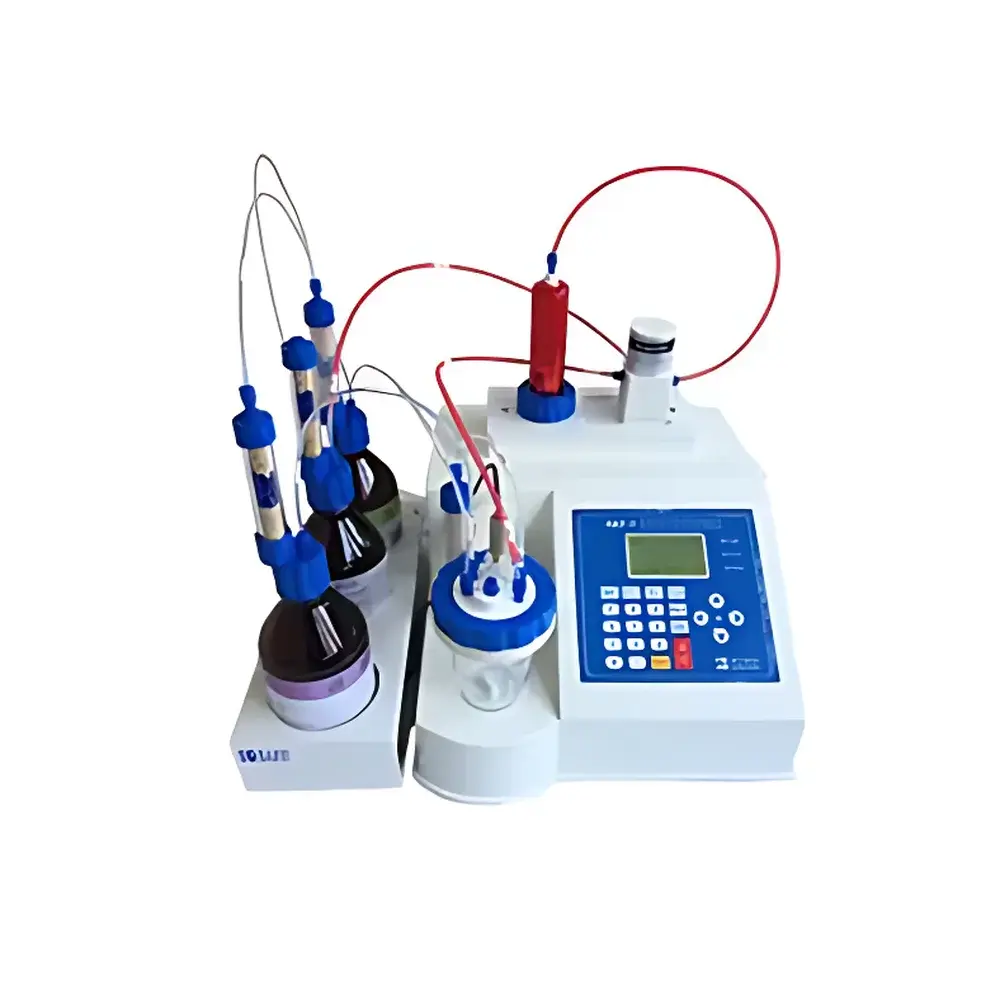
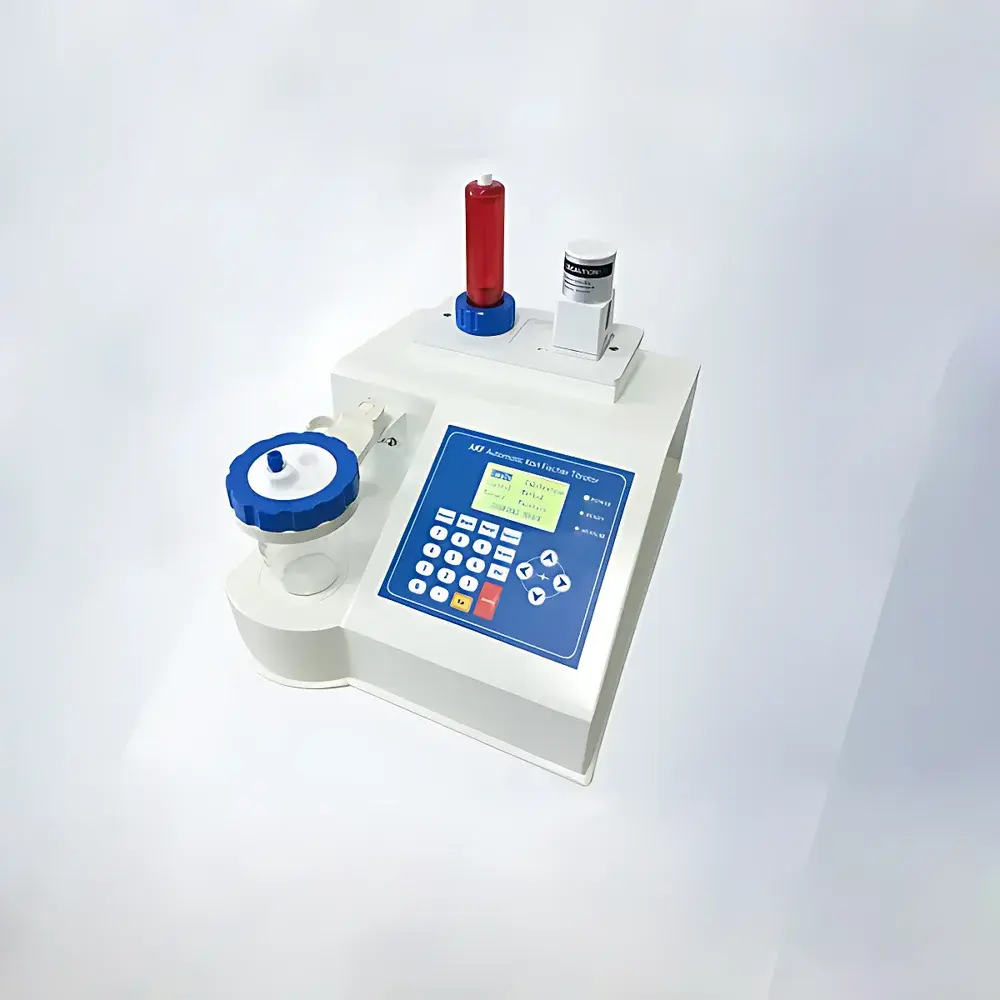
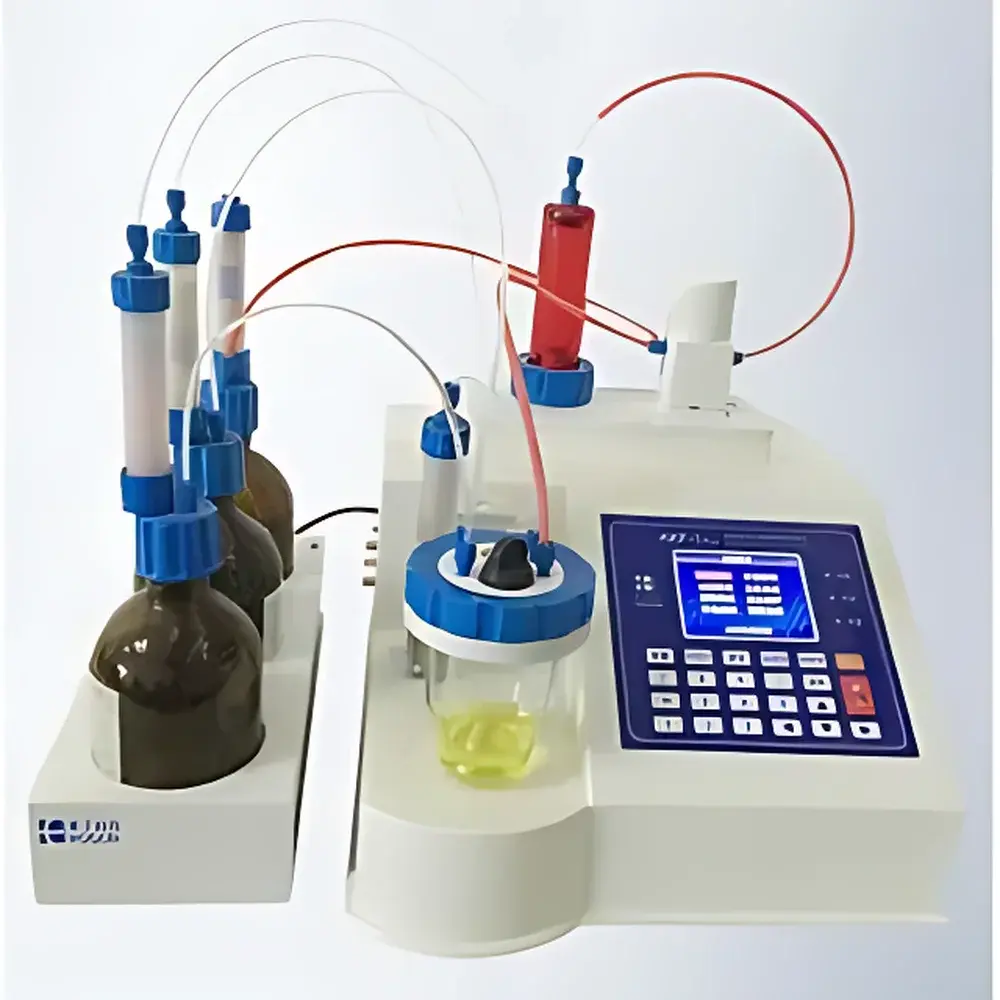
HOGON AKF-1 Pharmaceutical-Grade Automated Karl Fischer Moisture Analyzer
| Brand | HOGON |
|---|---|
| Origin | Shanghai, China |
| Manufacturer Type | Direct Manufacturer |
| Instrument Type | Volumetric Karl Fischer Titrator |
| Titration Mode | Fully Automatic |
| Measurement Resolution | 0.1 µL |
| Moisture Content Range | 0.001–100% w/w |
| Accuracy | ≤0.15% RSD |
| Minimum Dispensing Volume | 0.2 µL |
| Titration Control Precision | 1.0 µL |
| Electrode Configuration | Dual Platinum Electrode |
| Endpoint Detection | Bipotentiometric (Double-Pt) |
| Average Analysis Time | <3 min per sample |
| Data Storage Capacity | 10 method/sample records |
| Operating Ambient Humidity | ≤80% RH |
| Power Supply | 110–220 V AC, 50 Hz |
| Dimensions (L×W×H) | 320 × 240 × 410 mm |
| Net Weight | 5.5 kg |
| Auxiliary Functions | Titration Delay, Endpoint Hold Delay |
Overview
The HOGON AKF-1 is a fully automated volumetric Karl Fischer (KF) moisture analyzer engineered for precision, regulatory compliance, and routine high-throughput operation in pharmaceutical quality control laboratories, chemical R&D facilities, and raw material testing environments. It implements the classical coulometric-free, titrimetric KF principle—where iodine generated *in situ* via controlled reagent delivery reacts stoichiometrically with water in the sample matrix—and quantifies moisture content based on the volume of standardized KF reagent consumed to reach a stable bipotentiometric endpoint. Unlike coulometric systems, the AKF-1 employs pre-standardized reagents (e.g., Hydranal®-Composite 5 or equivalent), enabling direct traceability to primary standards and eliminating the need for daily reagent standardization. Its dual platinum electrode system ensures robust, drift-resistant endpoint detection across diverse sample types—including hygroscopic solids, viscous oils, and low-water-content solvents—while maintaining reproducibility under GLP/GMP-aligned workflows.
Key Features
- Fully automated titration sequence: integrated reagent dispensing, stirring, endpoint recognition, and result calculation without manual intervention.
- Bipotentiometric (dual Pt) endpoint detection with adaptive sensitivity adjustment to minimize false endpoints in redox-active or conductive matrices.
- High-precision burette drive mechanism delivering ±1.0 µL titration control accuracy and 0.1 µL volumetric resolution—critical for sub-milligram water quantification.
- Programmable delay functions: user-defined titration start delay (to allow sample dissolution or homogenization) and endpoint hold delay (to confirm stability before finalizing result).
- Dedicated pharmaceutical firmware architecture supporting audit-trail-enabled operation, user-level access control, and parameter locking per method—facilitating FDA 21 CFR Part 11 readiness when paired with compliant LIMS or ELN integration.
- Compact benchtop footprint (320 × 240 × 410 mm) and lightweight design (5.5 kg) optimized for shared lab spaces and mobile QC stations.
Sample Compatibility & Compliance
The AKF-1 accommodates solid, liquid, and semi-solid samples via optional accessories including oven samplers (for volatile-bound water release), homogenizers, and sealed vial adapters. It complies with core international standards governing moisture analysis: ASTM E203–22 (Standard Test Method for Water Using Volumetric Karl Fischer Titration), ISO 760:1978 (Determination of Water – Karl Fischer Method), and USP “Water Determination”. Its measurement range (0.001–100% w/w) supports applications from residual solvent testing in APIs (per ICH Q5C) to moisture specification verification in excipients (e.g., lactose, microcrystalline cellulose). The instrument’s ≤0.15% RSD performance at 10 mg H₂O meets the repeatability criteria outlined in EP 2.5.12 and JP 2.05.
Software & Data Management
The AKF-1 operates via an embedded LCD interface with tactile keypad navigation—designed for glove-compatible use in cleanroom and ISO Class 7/8 environments. It stores up to 10 complete method configurations, each retaining titration curve metadata, endpoint voltage profiles, and operator timestamps. While standalone operation is fully functional, the device supports RS-232 serial output for bidirectional communication with laboratory information management systems (LIMS) or electronic lab notebooks (ELN), enabling automated report generation and long-term data archiving. All stored results include full audit trail elements: user ID, date/time stamp, method version, reagent lot number (manually entered), and raw titration volume—satisfying basic ALCOA+ data integrity requirements.
Applications
- Pharmaceutical QC: Release testing of active pharmaceutical ingredients (APIs), excipients, and finished dosage forms per pharmacopoeial monographs.
- Chemical manufacturing: Moisture verification in catalysts, polymer precursors, and lithium battery electrolyte components where trace water induces hydrolysis or side reactions.
- Food & feed analysis: Quantification of free and bound water in starches, dairy powders, and pet food formulations affecting shelf-life and microbial stability.
- Electronics materials: Low-level moisture assessment in solder pastes, encapsulants, and PCB laminates where ppm-level water compromises dielectric strength.
- Research laboratories: Method development for challenging matrices such as silicone oils, ionic liquids, and highly acidic/basic solutions requiring custom titration parameters.
FAQ
What type of Karl Fischer method does the AKF-1 implement?
It is a volumetric (titrimetric) KF system using standardized iodine-containing reagents—not a coulometric generator.
Is the AKF-1 compliant with 21 CFR Part 11?
The instrument provides foundational data integrity features (user login, audit trail, electronic signatures via external LIMS); full Part 11 compliance requires validated system configuration and procedural controls.
Can it analyze samples with high salt content or strong oxidizers?
Yes—its dual Pt electrode design and adjustable endpoint threshold mitigate interference from redox-active species; however, method validation per ISO 12099 is recommended for such matrices.
What maintenance is required for long-term accuracy?
Regular calibration of the burette using certified syringes, periodic replacement of drying tubes and reagent bottles, and electrode cleaning with ethanol are essential; annual verification against NIST-traceable water standards is advised.
Does it support external sample changers or ovens?
Yes—the RS-232 port enables integration with third-party autosamplers and KF-compatible heating ovens for automated headspace moisture determination.
Related Products




