
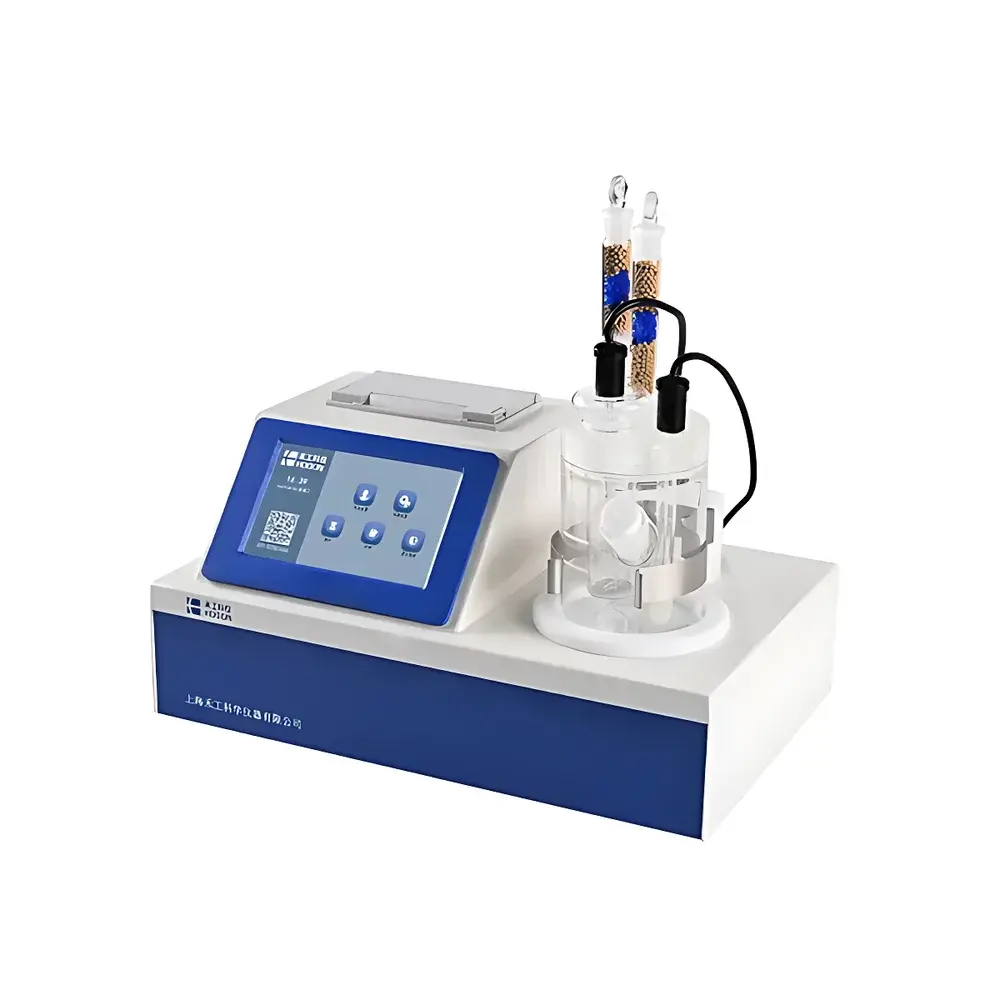
HOGON AKF-3B Bromine Number and Bromine Index Analyzer
| Brand | HOGON |
|---|---|
| Origin | Shanghai, China |
| Manufacturer Type | Direct Manufacturer |
| Product Origin | Domestic (China) |
| Model | AKF-3B |
| Power Supply | Not applicable (electrochemical analyzer) |
| Measurement Range | Bromine Number: 0–300 g Br/100 g sample |
| Bromine Index | 1–1000 mg Br/100 g sample |
| Burette Resolution | 0.01 mg Br |
| Detection Limit | 0.1 mg Br |
| Accuracy | ±3% (±0.3 mg Br when bromine index < 1 mg Br/100 g) |
| Endpoint Detection | Potentiometric |
| Compliance Standards | SH/T 0630, GB/T 11136, ASTM D1492 |
| Display | Color LCD touchscreen |
| Electrolyte Compatibility | Benzene-free electrolyte systems |
Overview
The HOGON AKF-3B Bromine Number and Bromine Index Analyzer is a dedicated electrochemical microcoulometric titrator engineered for the precise quantification of unsaturated hydrocarbons in petroleum-based samples. It operates on the principle of controlled-potential microcoulometric titration: bromine is generated *in situ* via electrolysis of bromide ions in the titration cell; this electrogenerated bromine reacts stoichiometrically with alkenes and other reactive unsaturates in the sample. The total charge consumed during the reaction—measured in coulombs—is directly proportional to the bromine content, enabling calculation of bromine number (g Br/100 g) or bromine index (mg Br/100 g) per standardized protocols. Unlike classical volumetric bromination methods, the AKF-3B eliminates manual titrant dispensing, reagent standardization, and endpoint visual interpretation—thereby removing major sources of operator variability and systematic error. Its design targets laboratories requiring regulatory-compliant, high-throughput analysis of gasoline, kerosene, diesel, lubricating oils, and aromatic feedstocks where oxidation stability, refining efficiency, and product specification adherence are mission-critical.
Key Features
- Microcoulometric Precision: Employs a dual-electrode potentiometric endpoint detection system that maintains stable baseline potential and delivers high reproducibility (<2% RSD for repeated measurements under controlled conditions).
- Benzene-Free Operation: Fully compatible with modern, low-toxicity electrolytes (e.g., methanol–LiBr–KBr mixtures), eliminating occupational exposure risks associated with benzene-based reagents and supporting ISO 45001-aligned laboratory safety practices.
- Adaptive Electrolysis Control: Features multi-step current regulation algorithms that dynamically adjust electrolytic current based on real-time reaction kinetics—accelerating titration for high-bromine samples while preserving resolution for trace-level determinations.
- One-Minute Typical Cycle Time: Achieves full sample analysis—including injection, reaction, endpoint stabilization, and result calculation—in approximately 60 seconds for routine petroleum matrices, significantly increasing daily throughput without compromising data integrity.
- Integrated Touch Interface: Equipped with a 7-inch color LCD touchscreen running embedded firmware; supports user-defined method templates, automatic unit conversion (Br# ↔ BrI), and on-device data review with timestamped audit trails.
Sample Compatibility & Compliance
The AKF-3B is validated for direct analysis of liquid hydrocarbon samples with viscosity ≤ 20 cSt at 40 °C, including but not limited to motor fuels, jet fuels, naphthas, light and heavy aromatics, and base oils. Solid or highly viscous samples require prior dissolution in suitable solvents (e.g., chloroform, xylene) per SH/T 0630 guidelines. Instrument architecture and firmware comply with the measurement principles and procedural requirements of SH/T 0630–2021 (Chinese Petrochemical Standard), GB/T 11136–2023 (National Standard of P.R. China), and ASTM D1492–22 (Standard Test Method for Bromine Index of Aromatic Hydrocarbons by Coulometric Titration). While not certified to IEC 61000-4 electromagnetic compatibility standards as a standalone claim, its analog signal conditioning and digital isolation meet typical Class A industrial laboratory EMC environments. Data output formats support CSV export for external LIMS integration.
Software & Data Management
The AKF-3B operates on deterministic real-time firmware—not PC-dependent software—ensuring consistent performance across environmental fluctuations and eliminating version conflicts. All measurement events—including cell voltage, current profile, charge integration, endpoint confirmation, and final result—are time-stamped and stored internally with immutable metadata (operator ID, method name, sample ID, ambient temperature). Audit trail functionality satisfies GLP and internal QA requirements for traceability. Data export is performed via USB flash drive in plain-text CSV format, containing raw coulombic integrals, calculated values, and QC flags (e.g., over-titration, low signal-to-noise). No cloud connectivity or remote access capabilities are implemented, preserving data sovereignty and aligning with ISO/IEC 27001-aligned information security policies common in regulated refinery labs.
Applications
- Quality control of cracked gasoline streams to monitor olefin content and predict gum formation tendency per ASTM D3228.
- Verification of hydrogenation catalyst performance in aromatic saturation units by tracking residual unsaturation pre- and post-treatment.
- Batch release testing of aviation turbine fuel (Jet A-1) against DEF STAN 91-91 limits for bromine index (≤ 5 mg Br/100 g).
- Research-grade characterization of bio-derived hydrocarbons (e.g., hydrotreated pyrolysis oil) where conventional GC methods suffer from co-elution or thermal degradation.
- Supporting ASTM D7413 implementation for oxidative stability assessment, where bromine index serves as a rapid proxy for reactive species concentration.
FAQ
What electrochemical principle does the AKF-3B use?
It applies constant-potential microcoulometric titration, generating bromine electrolytically from bromide ions at the anode and detecting endpoint potentiometrically.
Can the instrument analyze solid samples?
No—samples must be liquid or fully dissolved in compatible organic solvents prior to injection; undissolved particulates may foul the electrode surface or obstruct the reference junction.
Is calibration required before each analysis?
No external calibration is needed; the instrument relies on Faraday’s law of electrolysis, making it inherently absolute—provided the cell is clean, electrodes are functional, and electrolyte composition remains within specification.
How is data integrity ensured for regulatory submissions?
All measurements include embedded timestamps, operator identifiers, and method parameters; exported CSV files contain no hidden metadata or proprietary binary encoding, facilitating third-party validation and 21 CFR Part 11-aligned electronic record retention when paired with appropriate lab infrastructure.
Does the system support multi-user access control?
User roles are managed via password-protected login tiers (Operator, Supervisor, Administrator), with configurable permissions for method editing, data deletion, and system configuration changes—enabling segregation of duties in GxP environments.



