
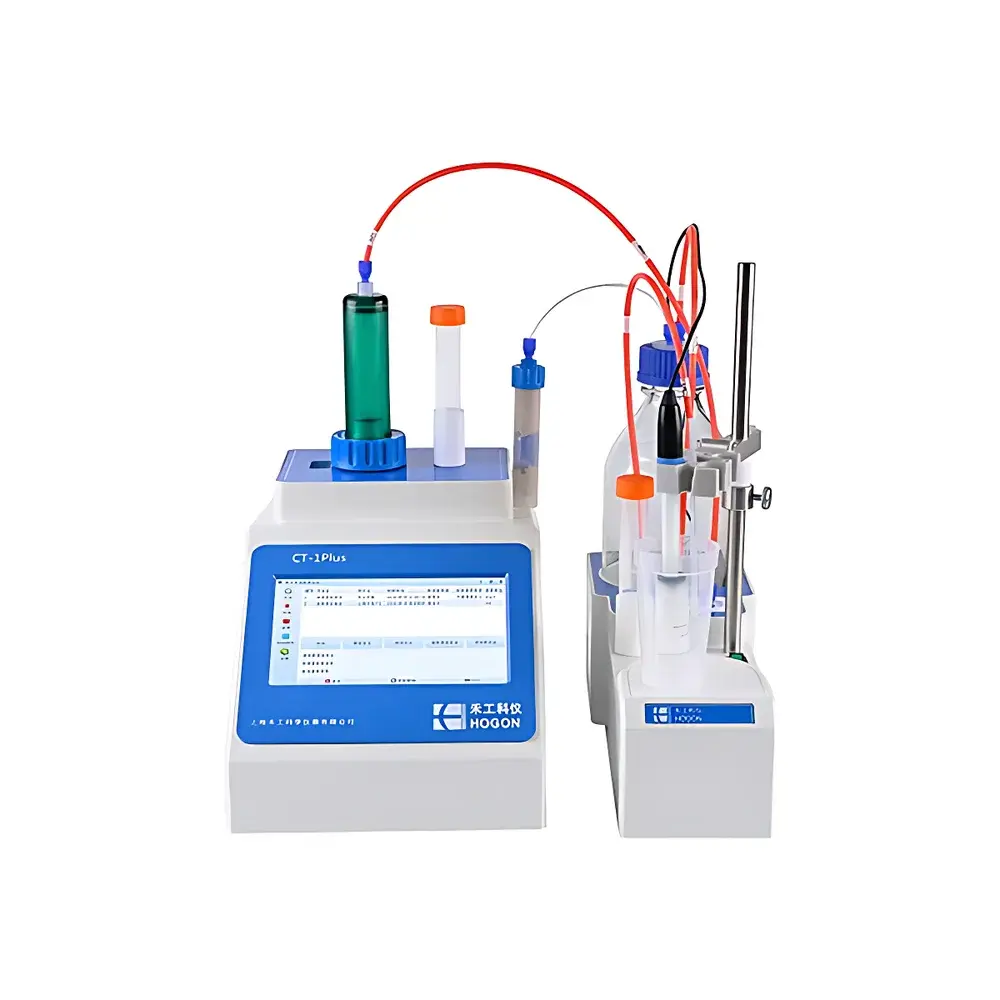
HOGON CT-1Plus Automatic Potentiometric Titrator for Acid Number Determination in Dichloromethane-Based Coolants
| Brand | HOGON |
|---|---|
| Origin | Shanghai, China |
| Manufacturer Type | Direct Manufacturer |
| Product Category | Domestic (China-Made) |
| Model | CT-1Plus |
| Instrument Type | General-Purpose Automatic Potentiometric Titrator |
| Application Scope | Universal |
| pH Measurement Range | 1–14 |
| Meter Display Accuracy | ±0.1 mV |
| Meter Resolution & Range | ±2000 mV, 0.1 mV resolution |
| Titration Accuracy | 0.001 mL (20 mL burette, standard) |
| Titration Resolution | 0.0005 mL (10 mL burette, optional) |
Overview
The HOGON CT-1Plus Automatic Potentiometric Titrator is a dedicated analytical platform engineered for high-reproducibility acid number determination in dichloromethane (DCM)-based refrigerants and industrial coolants. It operates on the fundamental principle of potentiometric titration—measuring the potential difference across a pH-sensitive indicator electrode (e.g., HOGON pH-102 glass electrode) and a reference electrode as a standardized base titrant (typically 0.01 mol/L KOH in ethanol/water) is incrementally delivered. The inflection point in the first derivative of the E–V curve (dE/dV vs. volume) is used to identify the stoichiometric endpoint with sub-microliter precision. This method eliminates subjective visual endpoint interpretation, conforms to ASTM D974 and ISO 3682 for acid number quantification in organic solvents, and is validated for trace-level acidity detection down to sub-ppm (mg KOH/kg) resolution in low-polarity matrices such as DCM.
Key Features
- Integrated high-stability pH-102 combination electrode with low-drift glass membrane and double-junction reference system, optimized for non-aqueous and biphasic solvent systems
- Standard 20 mL precision burette with 0.001 mL delivery accuracy and <0.2% volumetric repeatability (RSD), compliant with ISO 8655-3
- Optional 10 mL burette offering 0.0005 mL resolution for ultra-low-volume titrations in high-concentration or limited-sample scenarios
- Programmable titration parameters: minimum/maximum step volume (20 µL), stirrer speed (200 rpm), inter-step delay (1000 ms), and first-derivative threshold (200 mV/mL) for robust endpoint recognition
- Motorized sample handling support: compatible with 100 mL titration vessels and standard separatory funnel workflows for aqueous extraction of acidic impurities from DCM phases
- Embedded microprocessor control with real-time E–V curve visualization, automatic baseline correction, and endpoint validation via d²E/dV² zero-crossing analysis
Sample Compatibility & Compliance
The CT-1Plus is validated for direct acid number analysis in dichloromethane, chlorinated hydrocarbon blends, and related refrigerant formulations per IEC 60422 (mineral insulating oils) and ASTM D664 (acid number in petroleum products). Its electrode interface accommodates biphasic extraction protocols: samples are homogenized with deionized water (1:1 v/v), phase-separated, and the aqueous extract titrated under inert atmosphere if required. The instrument meets GLP documentation requirements with audit-trail-enabled operation logs, user-access controls, and timestamped method storage. All firmware and calibration records comply with FDA 21 CFR Part 11 principles for electronic records and signatures when paired with HOGON’s optional LIMS-integrated software module.
Software & Data Management
The CT-1Plus runs on embedded firmware supporting method-driven workflows—including preloaded templates for DCM acid number (ASTM D974 adaptation), free fatty acid (FFA), and total acid number (TAN) assays. Raw titration curves, derivative plots, and quantitative reports (ppm as HCl or mg KOH/kg) are exportable in CSV and PDF formats. Optional PC-based HOGON TitraSoft™ software provides advanced data reconciliation: batch reporting, statistical process control (SPC) charts (X-bar/R), outlier detection via Grubbs’ test, and integration with enterprise quality management systems (QMS) via OPC UA or HL7 interfaces. All data entries include immutable metadata: operator ID, environmental conditions (ambient T/RH), electrode calibration history, and reagent lot traceability.
Applications
- Routine QC testing of DCM-based refrigerants for residual HCl, phosgene hydrolysis byproducts, and oxidative degradation acids
- Process monitoring during solvent recovery and purification in HVAC manufacturing facilities
- Stability studies evaluating acid generation under thermal stress (e.g., 72 h at 60°C per IEC 61000-4-29)
- Regulatory compliance verification against GB/T 7304–2014 (Chinese standard for acid number in petroleum products) and JIS K 2501
- Research applications in solvent purity profiling, catalyst deactivation analysis, and formulation shelf-life modeling
FAQ
What electrode configuration is recommended for dichloromethane acid number analysis?
The HOGON pH-102 double-junction electrode with ethanol-compatible reference electrolyte (3 mol/L KCl in ethanol-saturated solution) is specified to prevent junction clogging and liquid-liquid potential drift.
Can the CT-1Plus perform back-titration for samples with very low acidity?
Yes—the instrument supports programmable back-titration sequences with excess standardized base addition followed by standardized HCl titration, enabling quantification below 0.5 ppm.
Is method validation data available for ISO/IEC 17025 accreditation?
HOGON provides full validation packages including linearity (0.1–10 ppm), LOD/LOQ (0.03 ppm / 0.1 ppm), intermediate precision (RSD ≤ 1.8%, n=6), and robustness testing per ICH Q2(R2).
How is carryover minimized between high-acidity and low-acidity samples?
The system includes automated rinse cycles (3× with ethanol/water 1:1, then air purge) between runs, with configurable rinse volume and dwell time.
Does the instrument support GLP-compliant electronic signatures?
When operated with TitraSoft™ and configured with role-based access control, digital signature capture, and electronic audit trails, it satisfies ALCOA+ data integrity principles for regulated laboratories.
Related Products



