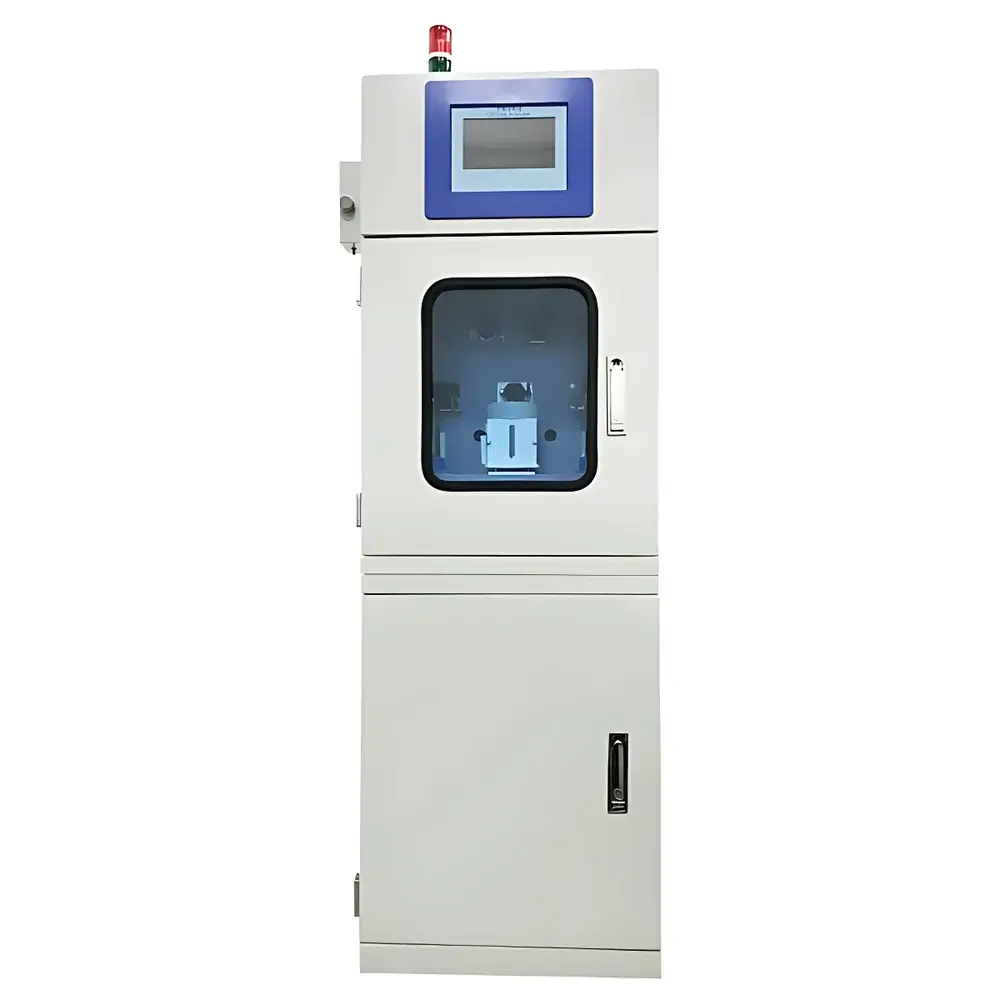
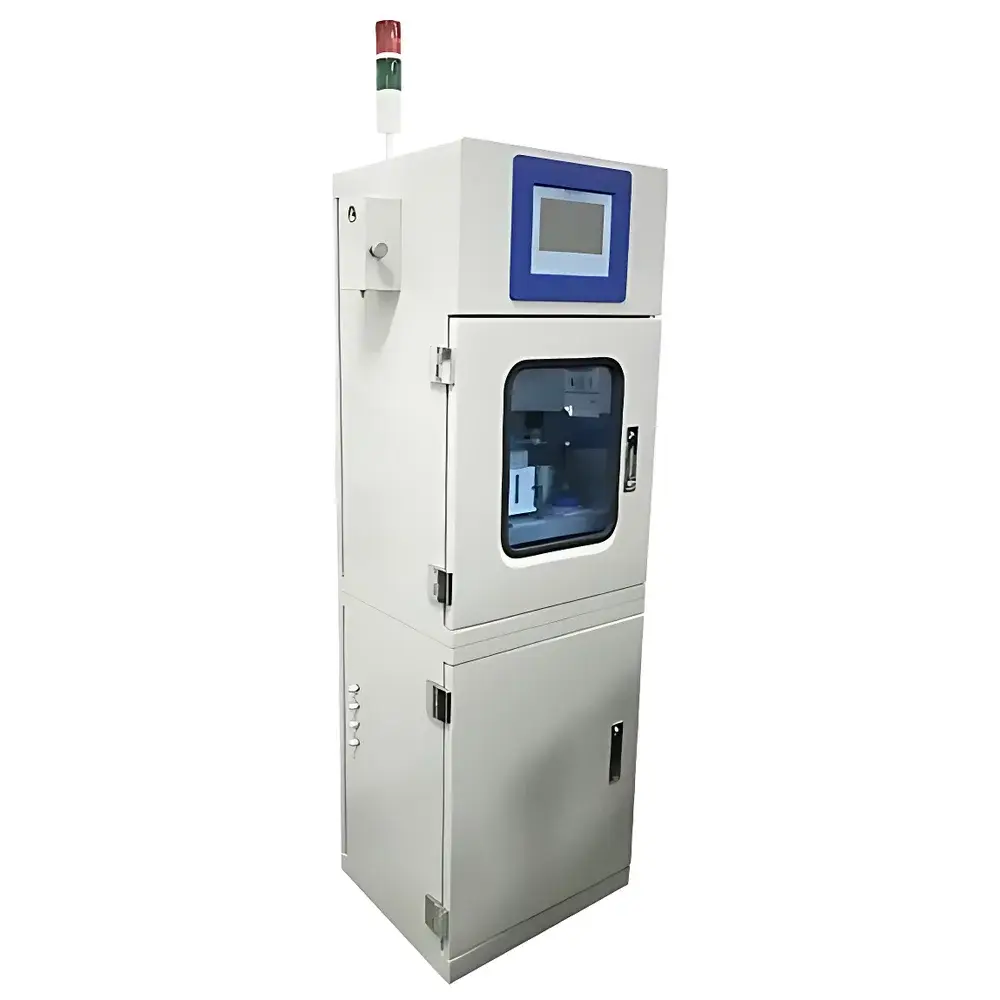
HOGON ALT-1-ORP Online Titration Analyzer with Multi-Mode Titration Capability
| Brand | HOGON |
|---|---|
| Origin | Shanghai, China |
| Manufacturer Type | Direct Manufacturer |
| Country of Origin | China |
| Model | ALT-1-ORP |
| Price | Upon Request |
| Detection Principle | Potentiometric & Colorimetric Volumetric Titration |
| Analysis Frequency | Every 20 Minutes |
| RSD | ≤1% (Potentiometric), ≤2% (Colorimetric) |
| Detection Range | 0.01–10 mol/L |
| Titration Precision | 1 µL (with 20 mL burette) |
| Operating Temperature | 5–40 °C |
| Relative Humidity | ≤90% RH (non-condensing at 10 °C) |
| Enclosure Rating | IP55/IP65 (when door locked) |
| Dimensions (W×D×H) | 500 × 400 × 1600 mm |
| Power Supply | 100–220 V AC, 50–60 Hz, 200 W |
| Wetted Materials | PTFE/FEP |
| Output Signals | Modbus TCP, RS-232/RS-485, CAN, 4–20 mA |
| Alarm Indicators | Dual-color LED for liquid level, data out-of-spec, reagent depletion, and system fault |
Overview
The HOGON ALT-1-ORP Online Titration Analyzer is an industrial-grade, fully automated process analyzer engineered for continuous redox monitoring and closed-loop chemical dosing control in electroplating, metal finishing, wastewater treatment, and chemical manufacturing environments. It implements classical volumetric titration—specifically iodometric, permanganometric, and dichrometric methods—based on standardized wet-chemistry principles defined in ASTM D129, ISO 6730, and USP . Unlike optical or electrochemical sensors that infer concentration indirectly, the ALT-1-ORP performs true stoichiometric quantification by dispensing calibrated titrant until a defined endpoint is detected—either via potentiometric shift (ORP electrode) or colorimetric transition (high-resolution CCD-based visual endpoint recognition). This dual-mode detection architecture ensures analytical robustness across variable matrix conditions, including turbid, colored, or particulate-laden process streams where single-sensor approaches fail.
Key Features
- True volumetric titration engine with 1 µL dispensing resolution using a precision syringe-driven 20 mL burette—enabling trace-level accuracy even at low analyte concentrations (down to 0.01 mol/L).
- Dual endpoint detection: ORP electrode mode for high-reproducibility redox titrations (RSD ≤1%), and colorimetric mode with auto-adjusted white-balance and glare compensation for applications requiring visual endpoint confirmation (RSD ≤2%).
- Integrated peristaltic sampling + auto-purging manifold with PTFE/FEP fluid path—resistant to strong oxidizers (e.g., KMnO₄, K₂Cr₂O₇) and acidic/alkaline electrolytes common in plating baths.
- Self-maintaining operational cycle: automatic post-analysis rinse, electrode conditioning, waste evacuation, and reagent replenishment verification—minimizing manual intervention and downtime.
- Real-time closed-loop control interface: native 4–20 mA analog output and Modbus TCP protocol support direct integration with DCS/SCADA systems for dynamic dosing pump actuation based on measured concentration deviation.
- IP55/IP65-rated enclosure with lockable front access—designed for installation in Class 1 Div 2 or ATEX Zone 2 environments without additional housing.
Sample Compatibility & Compliance
The ALT-1-ORP is validated for use with aqueous process solutions containing iodide, thiosulfate, ferrous/ferric ions, permanganate, dichromate, and hypochlorite species. It complies with GLP documentation requirements through embedded audit trail logging (user actions, calibration events, result timestamps) and supports 21 CFR Part 11–compliant data integrity when paired with HOGON’s optional secure server module. All wetted components meet FDA 21 CFR 177.1550 (fluoropolymer compliance) and EU REACH SVHC criteria. Method validation reports—including linearity (r² ≥0.999), recovery (98–102%), and inter-day precision—are available upon request for IQ/OQ/PQ protocols.
Software & Data Management
The embedded Linux-based controller runs HOGON TitraOS v3.2 firmware, featuring a web-accessible UI (HTTPS-enabled) for remote configuration, method editing, and real-time trend visualization. All analysis data—including raw titration curves, endpoint coordinates, consumed titrant volume, calculated concentration, and QC flags—are timestamped and stored locally (8 GB internal eMMC) with automatic daily backup via FTP/SFTP to network storage. Export formats include CSV, PDF analytical reports, and XML for LIMS integration. Firmware updates are delivered via signed OTA packages with SHA-256 verification to ensure system integrity.
Applications
- Electroplating bath control: Real-time monitoring of free cyanide (iodometric), total chromium (dichrometric), and nickel activator concentration in Watts nickel baths.
- Wastewater oxidation-reduction potential (ORP) management: Quantitative determination of residual chlorine, ozone, or hydrogen peroxide dosage in tertiary effluent disinfection loops.
- Chemical manufacturing QA: In-line verification of potassium permanganate titer in oxidant synthesis reactors.
- PCB etchant regeneration: Closed-loop control of CuCl₂ concentration in acidic chloride etchants using iodometric back-titration.
- Pharmaceutical water systems: Monitoring of oxidant residuals in purified water distribution networks per USP and EP 2.2.19.
FAQ
What titration methods does the ALT-1-ORP support?
It supports iodometric, permanganometric, and dichrometric titrations per standard wet-chemistry protocols—configured via method templates in TitraOS.
Can the instrument operate unattended for extended periods?
Yes—autonomous operation up to 30 days is achievable with standard reagent packs (500 mL titrant + 500 mL sample loop); optional external reagent reservoirs extend this further.
Is calibration traceable to NIST standards?
All factory calibrations use NIST-traceable reference materials (e.g., KIO₃ for iodometry, Na₂C₂O₄ for permanganometry), and user calibration logs retain full traceability metadata.
How is data security handled for regulated industries?
Audit trails are immutable, time-stamped, and digitally signed; electronic signatures, role-based access control (RBAC), and encrypted communication (TLS 1.2+) fulfill 21 CFR Part 11 Annex 11 requirements.
What maintenance intervals are recommended?
Electrode cleaning and calibration every 7 days; syringe and tubing replacement every 6 months or 5,000 cycles—automatically tracked and alerted via the onboard maintenance scheduler.
Related Products