
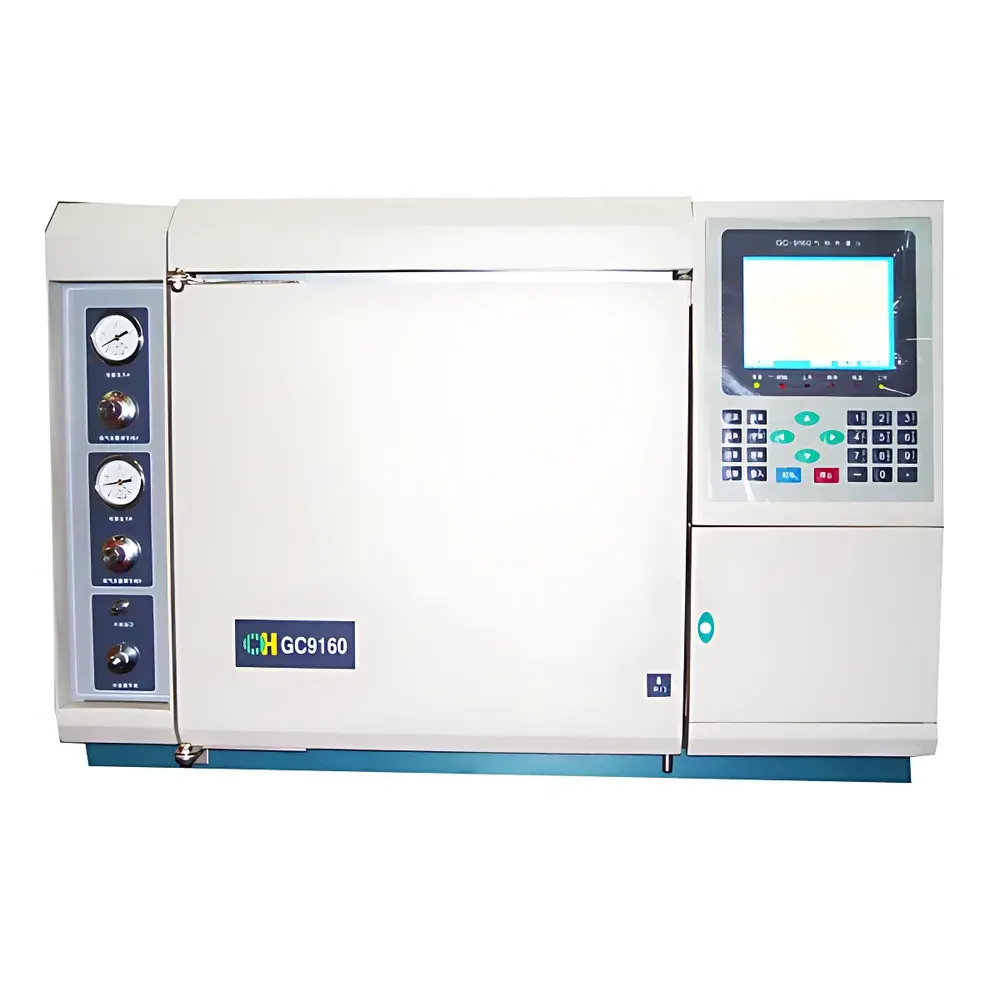
HOGON GC9160 Non-Methane Hydrocarbons (NMHC) Dedicated Gas Chromatograph
| Brand | HOGON |
|---|---|
| Origin | Shanghai, China |
| Manufacturer Type | Original Equipment Manufacturer (OEM) |
| Instrument Type | Laboratory Gas Chromatograph |
| Application Field | High-Purity Gas Analysis |
| Oven Temperature Range | 0–399 °C |
| Maximum Ramp Rate | 40 °C/min |
| Cooling Rate | 30 °C/min |
| Carrier Gas Flow Range & Control | 0–200 mL/min |
| Carrier Gas Pressure Range & Control | 0–0.4 MPa |
| Injector Maximum Operating Temperature | 399 °C |
| Injector Pressure Setting Range | 0–0.4 MPa |
| Injector Total Flow Setting Range | 0–200 mL/min |
| Detection Limit (FID) | ≤1×10⁻¹¹ g/s |
| Baseline Noise (FID) | ≤5×10⁻¹⁴ A |
| Drift (FID) | ≤1×10⁻¹³ A/30 min |
| Linear Dynamic Range | ≥10⁶ |
| Programmable Temperature Steps | 8-stage |
| Relative Humidity Limit | ≤85% |
| Operating Ambient Temperature | +5 °C to +35 °C |
| Power Supply | AC 220 V ±22 V, 50 Hz ±0.5 Hz, 10 A |
| Power Consumption | ≤1500 W |
| Dimensions (H×W×D) | 490×730×490 mm |
| Net Weight | ~48 kg |
Overview
The HOGON GC9160 is a laboratory-grade gas chromatograph engineered specifically for regulatory-compliant non-methane hydrocarbons (NMHC) analysis in ambient air, stack emissions, and industrial process gases. It implements a dual-column parallel injection architecture—comprising a methane-selective packed column and a total hydrocarbon (THC) stainless-steel empty column—to achieve simultaneous, single-injection quantification of methane and total hydrocarbons. This configuration eliminates the need for thermal desorption or multiple injections, reducing analytical cycle time and minimizing carryover risk. The system operates on flame ionization detection (FID), a universally accepted technique for hydrocarbon quantification per ISO 8573-5, EPA Method 25A, and China’s GB/T 15263–1994. Its robust oven design supports rapid heating (up to 40 °C/min) and active cooling (30 °C/min via motorized rear door), enabling precise temperature programming across eight ramp segments and stable isothermal operation down to ~10 °C above ambient.
Key Features
- Dual-column parallel flow path with factory-calibrated VICI® 10-port rotary valve for automated, reproducible column switching and zero dead-volume transfer.
- High-stability dual-pressure and dual-flow pneumatic control system, ensuring <±0.001 MPa pressure resolution and <±0.1 mL/min flow precision—critical for retention time repeatability and quantitative accuracy.
- Optimized FID detector featuring modular ion chamber design: removable jet nozzle and collector electrode enable in-lab cleaning; precision-aligned emitter assembly guarantees inter-unit performance consistency at factory certification.
- Large 6-inch TFT-LCD display with full Chinese keyboard interface—designed for routine lab operation without external PC dependency during method setup or real-time monitoring.
- Column oven accommodates two 2-m packed columns (3 mm ID) simultaneously; integrated forced-air cooling and pre-heated inlet zones minimize thermal lag and improve peak symmetry for oxygen and low-carbon alkanes.
- Comprehensive hardware-level safety interlocks: over-temperature cutoff, flame-out detection, and carrier gas failure alarm compliant with IEC 61010-1 requirements.
Sample Compatibility & Compliance
The GC9160 is validated for gaseous samples containing C₁–C₈ hydrocarbons, including methane, ethane, propane, butanes, and aromatic VOCs, in matrices with up to 21% O₂ (e.g., ambient air, flue gas, biogas). Oxygen co-elution with THC is resolved via baseline subtraction using a dedicated “oxygen blank” run with hydrocarbon-free air—a procedure explicitly defined in GB/T 15263–1994 and aligned with ASTM D6420-18 Annex A1. All wetted parts are electropolished stainless steel or fused silica, minimizing adsorption artifacts. The instrument meets electromagnetic compatibility (EMC) Class B per CISPR 11 and carries CE marking for laboratory use within the EU. Data integrity features—including user-access logging, method versioning, and audit-trail-enabled chromatogram archiving—support GLP and ISO/IEC 17025 laboratory accreditation requirements.
Software & Data Management
The included chromatography data system (CDS) provides full method development, acquisition, integration, calibration (external standard, multi-point linear/regression), and report generation. Raw data files (.cdf) are stored in open Agilent-compatible format for third-party reprocessing. Audit trail functionality records all parameter changes, sequence edits, and result modifications with timestamps and operator IDs—fully traceable for FDA 21 CFR Part 11 compliance when deployed with Windows OS configured for electronic signatures. Batch processing supports automatic oxygen peak subtraction, NMHC calculation (NMHC = THC – CH₄ – O₂ contribution), and export to CSV, PDF, or LIMS-ready XML. Remote monitoring via Ethernet enables centralized instrument fleet management across multi-site environmental labs.
Applications
- Ambient air quality monitoring for NMHC compliance with national emission standards (e.g., China’s HJ 604–2017, US EPA NAAQS).
- Stack emission testing from petrochemical plants, paint booths, and semiconductor fabrication facilities.
- Validation of catalytic oxidizer efficiency and carbon adsorption bed breakthrough detection.
- Calibration gas verification and reference material certification in metrology institutes.
- Method development and teaching applications in university environmental engineering and analytical chemistry curricula.
FAQ
What regulatory methods does the GC9160 support?
It is fully compatible with GB/T 15263–1994, HJ 604–2017, EPA Method 25A, and ISO 11841–1 for NMHC determination in gaseous samples.
Can the instrument quantify individual hydrocarbons beyond methane?
No—it is optimized for total hydrocarbon and methane group separation only. For speciated VOC analysis, a capillary GC–MS or PLOT column configuration is required.
Is nitrogen the only acceptable carrier gas?
Yes. Helium or hydrogen would alter retention times and compromise NMHC calibration linearity per standard protocols; nitrogen is mandated for method equivalence.
How is oxygen interference corrected?
By injecting 1 mL of hydrocarbon-free air and measuring the integrated area of the oxygen peak under identical conditions; this value is subtracted from each THC measurement.
Does the system include validation documentation?
Each unit ships with a Factory Performance Verification Report (FPVR), including FID sensitivity, noise/drift measurements, temperature uniformity mapping, and dual-column retention time RSD (<0.5%) across three consecutive injections.





