
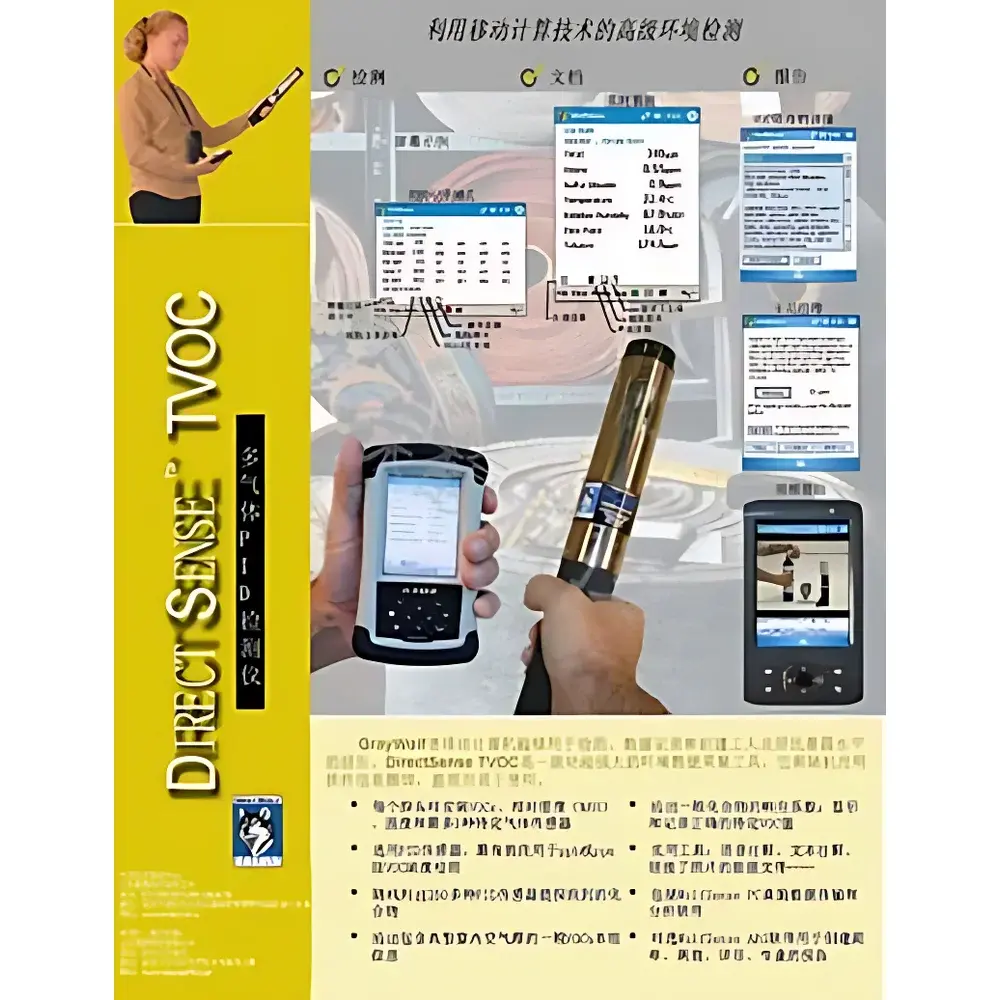
Graywolf DirectSense TG-502/TG-503 PID-Based Multi-Gas VOC Detector
| Brand | Graywolf |
|---|---|
| Origin | USA |
| Model | TG-502 / TG-503 PID Sensor Probe |
| Detection Principle | Photoionization Detection (PID) |
| Target Analytes | Volatile Organic Compounds (VOCs), selected inorganic gases (e.g., NH₃, H₂S, SO₂) |
| Ionization Energy | 10.6 eV lamp standard |
| Measurement Range | 0–5,000 ppb (TG-502), 0–20,000 ppb (TG-503) |
| Resolution | 1 ppb |
| Response Time (T90) | <3 seconds |
| Operating Temperature | 0–50 °C |
| IP Rating | IP54 |
| Power | Rechargeable Li-ion battery (up to 24 h continuous operation) |
| Data Logging | Internal memory (≥100,000 records) + real-time Bluetooth/Wi-Fi sync to mobile device |
Overview
The Graywolf DirectSense TG-502 and TG-503 are portable, high-sensitivity photoionization detection (PID) instruments engineered for real-time, quantitative measurement of volatile organic compounds (VOCs) and select inorganic gases in occupational and environmental air monitoring applications. Unlike broad-spectrum metal oxide or electrochemical sensors, the TG-502/TG-503 utilizes a fixed-energy 10.6 eV ultraviolet lamp to ionize gas molecules with ionization potentials below this threshold—enabling selective, interference-resistant detection of aromatic hydrocarbons (e.g., benzene, toluene, xylene), aliphatic solvents (e.g., hexane, acetone), chlorinated compounds (e.g., TCE, PCE), and certain inorganics including ammonia and hydrogen sulfide. Designed as modular sensor probes, they integrate seamlessly with Graywolf’s DirectSense platform—turning iOS and Android tablets or smartphones into calibrated, field-deployable data acquisition terminals compliant with industrial hygiene best practices.
Key Features
- True PID architecture with factory-calibrated 10.6 eV UV lamp and temperature-compensated detector cell, ensuring long-term stability and repeatability across varying ambient conditions.
- Dual-range models: TG-502 (0–5,000 ppb) optimized for low-level exposure assessment near regulatory action levels (e.g., OSHA PELs, ACGIH TLVs); TG-503 (0–20,000 ppb) suited for leak detection, confined space entry verification, and remediation site screening.
- Sub-second response (T90 < 3 s) and 1-ppb resolution support dynamic profiling of plume dispersion, source identification, and time-weighted average (TWA) calculation during personal monitoring.
- Ruggedized probe housing rated IP54 for dust and water resistance; operating temperature range of 0–50 °C supports deployment in HVAC ducts, industrial facilities, and outdoor ambient monitoring stations.
- Integrated rechargeable lithium-ion battery provides ≥24 hours of continuous logging at 1-second intervals, eliminating dependency on external power during extended surveys.
- Bluetooth 5.0 and Wi-Fi 802.11n enable wireless configuration, live data streaming, and over-the-air firmware updates without physical docking.
Sample Compatibility & Compliance
The TG-502/TG-503 is validated for use with ambient air, indoor air, and compressed gas streams (with optional flow regulator). It complies with ISO 16000-22 (indoor air—determination of VOCs using PID), ASTM D5197 (standard test method for ambient air analysis by direct-reading instruments), and NIOSH Method 0010 (for benzene and other VOCs). When used within Graywolf’s validated DirectSense software ecosystem, the system supports audit-ready data integrity per FDA 21 CFR Part 11 requirements—including electronic signatures, immutable timestamps, and full change history for calibration and configuration events. All units undergo NIST-traceable calibration prior to shipment and include certificate of conformance.
Software & Data Management
DirectSense mobile application (iOS/Android) serves as the instrument’s native interface—providing real-time graphing, customizable alarm thresholds (TWA, STEL, ceiling), geotagged logging, and one-touch report generation in PDF or CSV format. Data files retain raw sensor output, GPS coordinates, operator ID, and environmental metadata (temperature, humidity, barometric pressure when paired with optional environmental module). Exported datasets are compatible with industry-standard analysis tools including Microsoft Excel, MATLAB, and EPA’s AERMOD pre-processors. Firmware and calibration libraries are centrally managed via Graywolf Cloud Console, enabling fleet-wide consistency and remote compliance verification for multi-site EHS programs.
Applications
- Occupational health monitoring: Personal exposure assessment for maintenance technicians, painters, chemical handlers, and remediation crews.
- Indoor air quality (IAQ) investigations: Source identification in offices, schools, and healthcare facilities following complaints of odor or irritation.
- Environmental site assessments: Rapid screening of soil vapor, landfill gas, and groundwater plume boundaries during Phase I/II ESAs.
- HVAC commissioning and troubleshooting: Verification of ventilation efficacy, duct contamination, and post-remediation clearance testing.
- Regulatory compliance reporting: Generation of OSHA 1910.120, EPA Region 4, and EU REACH-compliant exposure documentation.
FAQ
What gases does the TG-502/TG-503 detect?
It detects VOCs with ionization potentials ≤10.6 eV—including benzene, styrene, formaldehyde (with optional humidity compensation), isopropyl alcohol, and many chlorinated solvents—as well as ammonia, hydrogen sulfide, and sulfur dioxide. Specific compound sensitivity varies; full interferent list available in Graywolf Application Note AN-017.
Can the probe be used with third-party data loggers?
No. The TG-502/TG-503 communicates exclusively via Graywolf’s proprietary BLE protocol and requires the DirectSense app or certified Graywolf host devices (e.g., DP-500 series controllers) for configuration and data retrieval.
Is field recalibration possible?
Yes—using certified 100 ppb isobutylene standard gas and the built-in zero/span routine accessible through the DirectSense app. Full calibration verification is recommended every 30 days or after exposure to >10× full-scale concentration.
Does the system meet GLP or GMP requirements?
When deployed with enabled audit trail, user access controls, and electronic signature workflows in DirectSense v4.2+, it satisfies core GLP (OECD 1998) and pharmaceutical GMP (ICH Q9) data integrity expectations for environmental monitoring programs.
Related Products







