
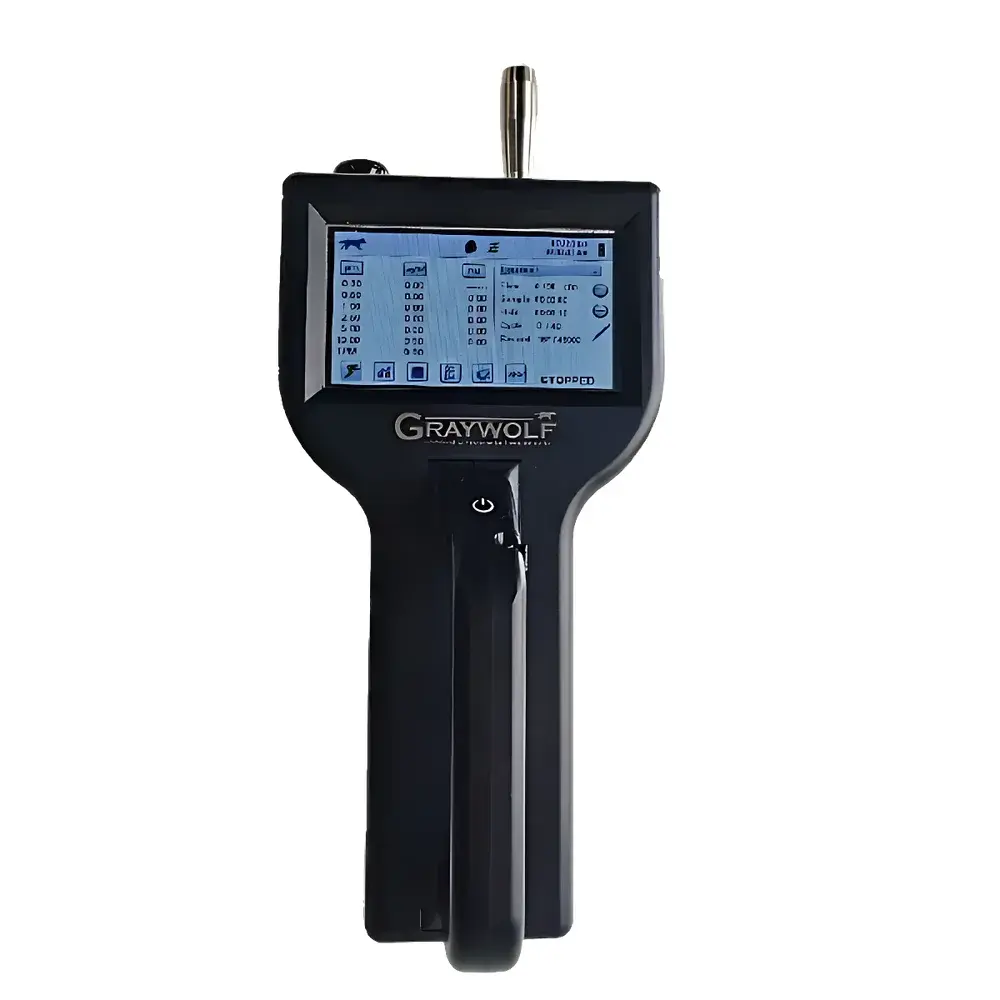
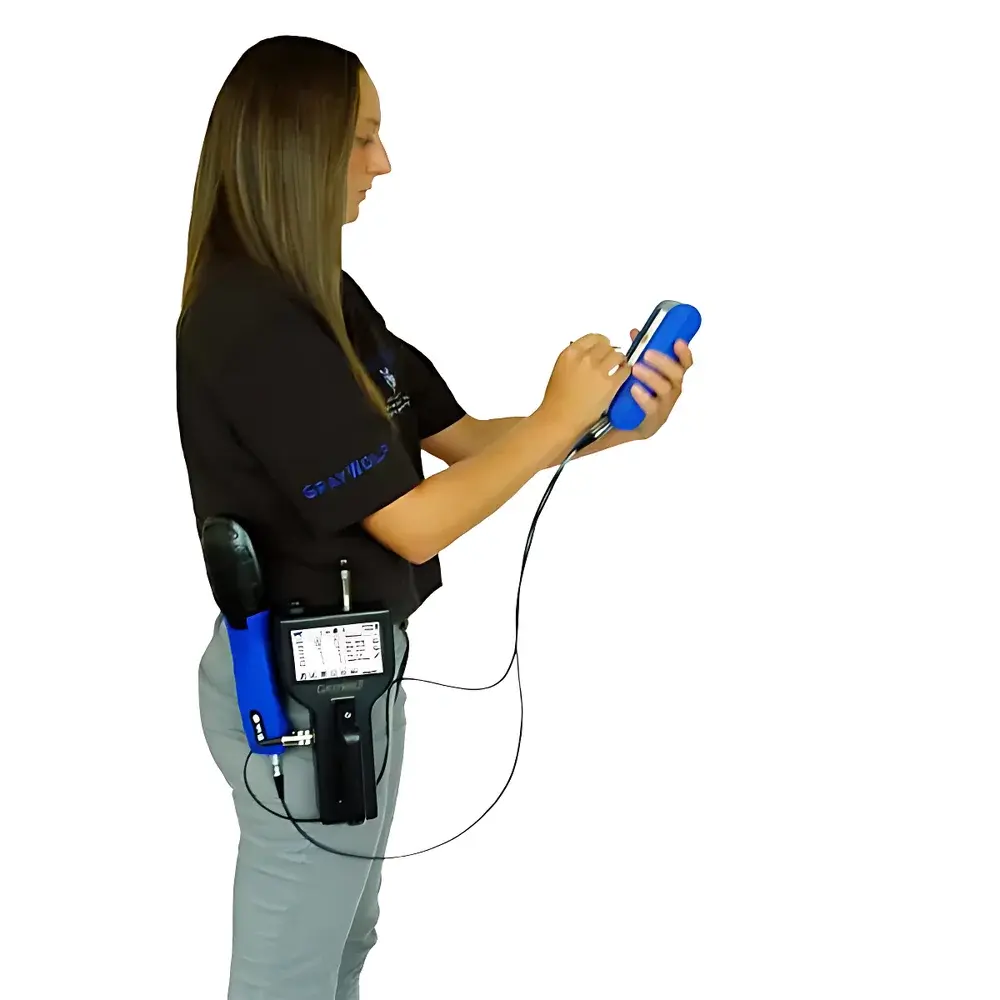
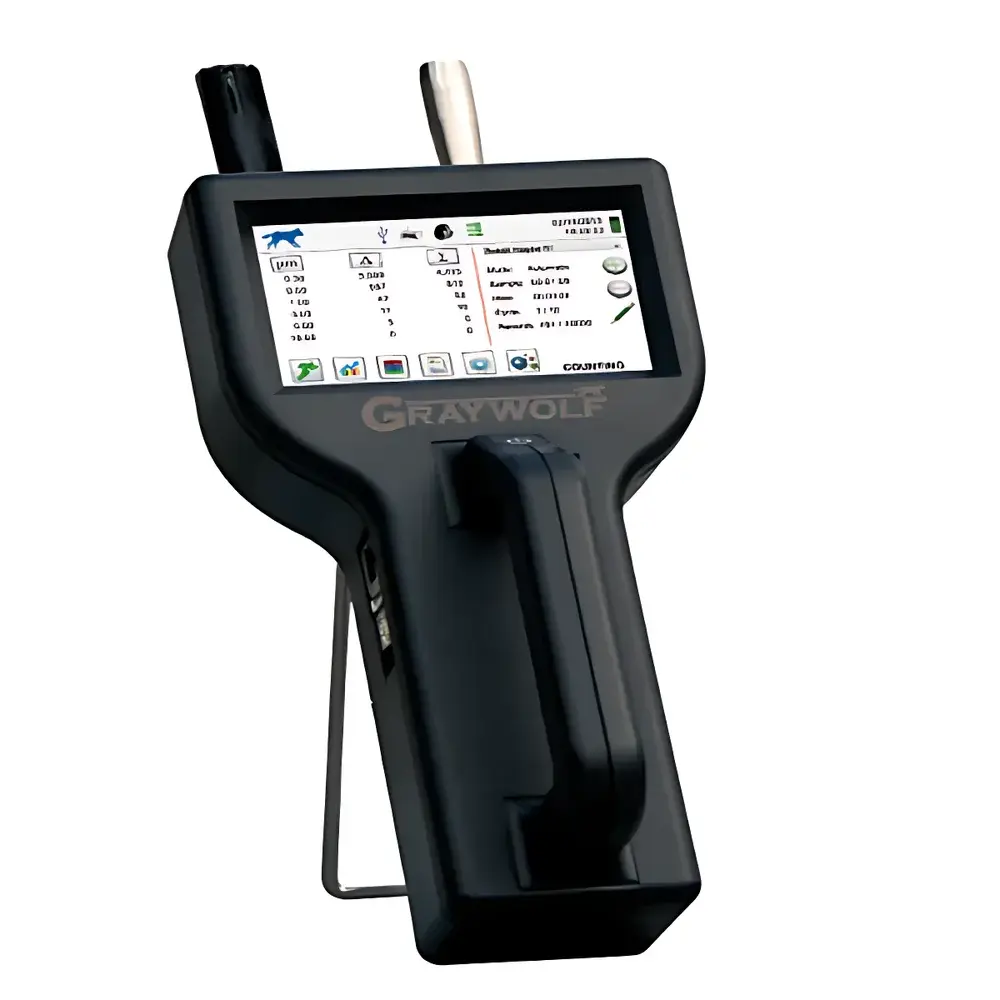
Graywolf PC-3500 Portable Laser Particle Counter
| Brand | Graywolf |
|---|---|
| Model | PC-3500 |
| Type | Handheld |
| Sampling Flow Rate | 2.83 L/min |
| Particle Size Range | 0.3–25 µm |
| Channel Count | 6 |
| Laser Pulse Rate | 250,000 pulses/sec |
| Max. Concentration | 15,000,000 particles/ft³ |
| Battery Life | >10 h continuous operation |
| Operating Temperature | 5–40 °C |
| Relative Humidity | 20–95 % RH (non-condensing) |
| Dimensions | 25.4 × 12.9 × 11.4 cm (with handle) |
| Weight | 1.0 kg |
| Compliance | ISO 21501-4 |
Overview
The Graywolf PC-3500 is a research-grade, handheld laser particle counter engineered for high-fidelity airborne particulate characterization in dynamic field and laboratory environments. It operates on the principle of single-particle light scattering—where a collimated 650 nm laser diode illuminates individual particles suspended in an air stream, and the intensity of scattered light is quantified via photodetector arrays coupled with a built-in pulse height analyzer (PHA). This architecture enables direct correlation between scattering amplitude and particle aerodynamic diameter, supporting both number-based counting and mass concentration estimation when calibrated with user-defined optical properties (refractive index) and physical parameters (particle density). Designed to meet the metrological rigor of ISO 21501-4, the PC-3500 delivers traceable, repeatable measurements across six independent size channels—from 0.3 µm to 25 µm—with programmable thresholds that allow researchers to align channel boundaries precisely with regulatory or application-specific cutpoints (e.g., PM₁, PM₂.₅, PM₁₀, coarse mode). Its compact form factor, integrated vacuum pump with automatic flow control, and 2.83 L/min volumetric sampling rate satisfy both ISO 14644-1 cleanroom certification protocols and EPA-compliant indoor air quality (IAQ) assessment workflows.
Key Features
- User-configurable six-channel sizing: Define arbitrary lower and upper bounds for each of six detection channels within the 0.3–25 µm range—enabling alignment with health-based aerosol fractions or industrial hygiene standards.
- Optical property calibration: Adjust refractive index (1.0–2.5) and particle density (0.5–5.0 g/cm³) to improve mass concentration accuracy for non-spherical, hygroscopic, or compositionally heterogeneous aerosols (e.g., bioaerosols, combustion soot, mineral dust).
- Dual-mode real-time processing: A dedicated multi-threaded embedded processor concurrently manages particle detection, serial/USB communication, annotation logging, and on-device statistical computation—eliminating sampling latency during active data transfer or metadata tagging.
- Integrated PHA architecture: One of the few handheld instruments featuring a hardware-level pulse height analyzer, ensuring linearity correction across the full dynamic range and compliance with ISO 21501-4 Annex B for resolution validation.
- Advanced power management: Combines low-power laser diode design, intelligent sleep mode activation, and adaptive pump duty cycling to sustain >10 hours of continuous operation on a single charge—critical for extended environmental monitoring campaigns.
- Comprehensive alarm and annotation system: Programmable audible/visual alerts based on concentration thresholds; time-stamped field notes stored directly with measurement records; GPS-ready location tagging (via optional external module).
Sample Compatibility & Compliance
The PC-3500 is validated for use with ambient air, HVAC duct streams, cleanroom laminar flow hoods, and controlled laboratory enclosures. Its isokinetic sampling probe (optional) ensures representative aspiration across variable airflow velocities (0.1–3 m/s), while the internal HEPA-filtered exhaust prevents cross-contamination and meets OSHA and NIOSH ventilation safety guidelines. All firmware and calibration routines are traceable to NIST-traceable reference aerosols (e.g., PSL, DEHS) and conform to ISO 21501-4:2018 requirements for resolution, counting efficiency, false count rate, and size calibration uncertainty. The instrument supports GLP-compliant audit trails when paired with Graywolf’s compliant data export tools—including timestamped raw pulse data, configuration logs, and operator ID fields—facilitating FDA 21 CFR Part 11 readiness in regulated pharmaceutical or biotech settings.
Software & Data Management
Graywolf’s proprietary CloudLink™ Desktop Suite (v5.2+) provides full bidirectional synchronization with the PC-3500 via USB or Bluetooth 5.0. The software enables batch calibration updates, spectral deconvolution of mixed aerosol populations, and automated report generation aligned with ISO 16000-27, ASTM D6628, and EN 13274-1 templates. Raw PHA histograms and per-pulse metadata are exportable in CSV and HDF5 formats for third-party analysis in MATLAB, Python (NumPy/Pandas), or R. Audit logs record all configuration changes, firmware revisions, and user-initiated calibrations—supporting 21 CFR Part 11 electronic signature and retention requirements when deployed under GxP frameworks.
Applications
- Cleanroom qualification and routine monitoring per ISO 14644-1 Class 1–9 and EU GMP Annex 1
- Indoor air quality assessments in schools, hospitals, and office buildings per ASHRAE 62.1 and WHO IAQ guidelines
- Source identification and emission profiling during construction, remediation, or industrial process audits
- Field validation of HEPA and ULPA filtration efficiency in real-world operational conditions
- Research on atmospheric aerosol dynamics, including nucleation, coagulation, and hygroscopic growth
- Educational laboratories requiring hands-on instruction in aerosol science, environmental engineering, and occupational hygiene
FAQ
Does the PC-3500 require annual recalibration?
Yes—Graywolf recommends annual factory recalibration using NIST-traceable PSL standards to maintain ISO 21501-4 conformance. Field verification with check aerosols is advised before each critical measurement campaign.
Can the instrument measure mass concentration directly?
It calculates estimated mass concentration by applying Mie theory-derived conversion factors based on user-input density and refractive index—not gravimetrically. For regulatory reporting, users must document assumptions and validate against reference methods (e.g., beta attenuation or TEOM) where required.
Is the PC-3500 compatible with existing building management systems (BMS)?
Via Modbus RTU over RS-485 (using optional interface module), it supports integration into BMS platforms for continuous IAQ dashboarding and alarm escalation.
What is the minimum detectable particle size under high-humidity conditions?
At RH >80%, the lower detection limit may shift upward to ~0.4 µm due to Mie scattering enhancement and droplet growth effects; users should apply hygroscopic correction models or operate with desiccant-dried sample lines for sub-0.3 µm fidelity.
How does the built-in PHA improve measurement reliability compared to standard counters?
PHA resolves overlapping pulses from coincident particles and corrects for signal saturation at high concentrations—reducing coincidence error to <5% at 10⁶ particles/ft³ and enabling accurate sizing even during transient plume events.







