
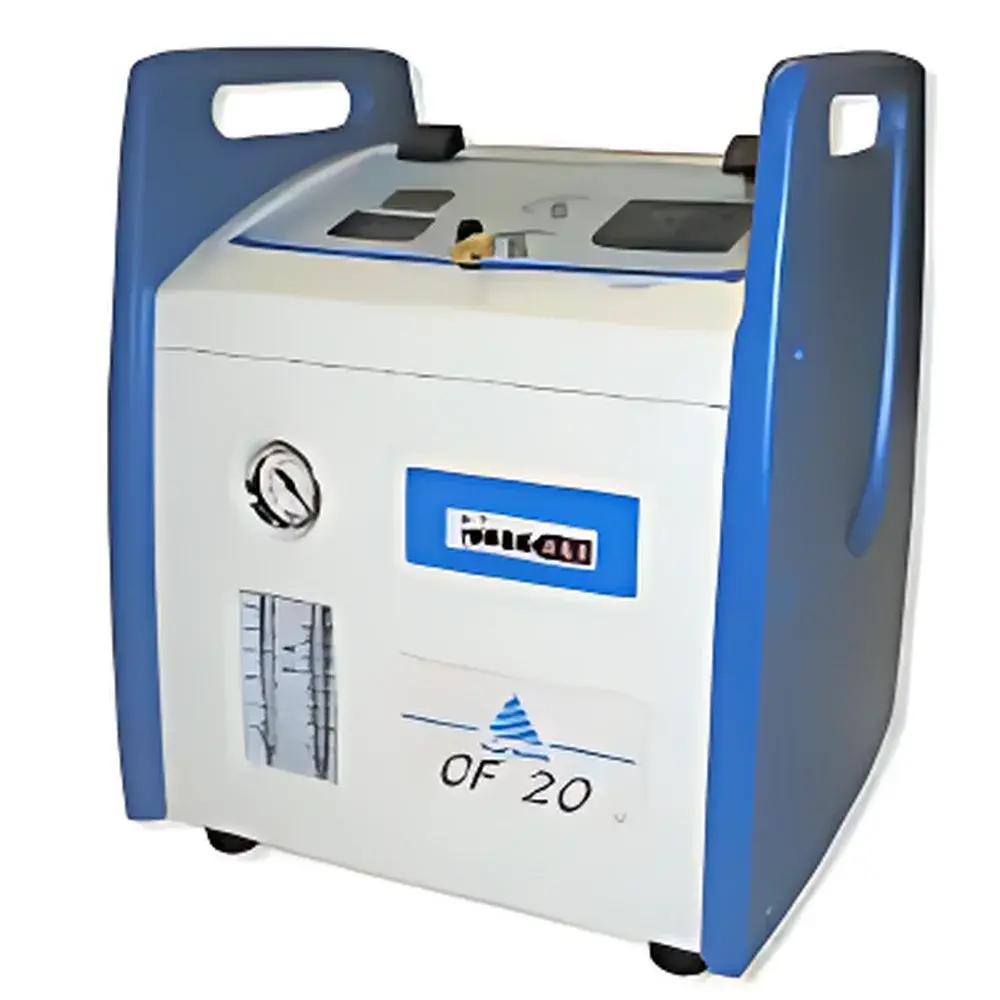
Aquaria CF20 α Continuous Air Sampler
| Brand | Aquaria |
|---|---|
| Origin | Italy |
| Model | CF20 α |
| Compliance | UNI EN 12919 |
| Cabinet Material | Front & Sides – High-Density Polyurethane |
| Viewing Panel | Lockable Transparent Acrylic |
| Vacuum Gauge | Integrated for System Leak Detection & Diaphragm Integrity Verification |
| Volumetric Measurement | Barometric Pressure-Compensated Flow Integration (±0.2 L accuracy) |
| Temperature Monitoring | Real-Time Digital Thermometer |
| Drain Port | Rear-Mounted Condensate Drain |
Overview
The Aquaria CF20 α Continuous Air Sampler is a robust, field-deployable instrument engineered for long-term, unattended atmospheric particulate sampling in compliance with European regulatory frameworks. It operates on the principle of constant-flow volumetric aspiration, utilizing a precision diaphragm pump coupled with real-time barometric pressure and temperature compensation to maintain traceable, metrologically sound air volume measurement. Designed specifically for gravimetric and chemical analysis of airborne particulate matter—including PM10, PM2.5, and respirable aerosols—the CF20 α ensures stable flow rates across variable ambient conditions, minimizing sampling bias due to thermal drift or pressure fluctuations. Its mechanical architecture prioritizes operational resilience: vibration-damped mounting, sealed electronics compartment, and reinforced structural geometry enable reliable performance in roadside, industrial fence-line, and indoor monitoring environments where mechanical stress and environmental exposure are persistent concerns.
Key Features
- Vibration-resistant chassis constructed from high-density polyurethane (front/sides) and lightweight aluminum (rear), providing thermal insulation and mechanical damping without compromising portability.
- Lockable transparent acrylic front panel—fully sealed against dust and moisture—grants visual access to control interfaces while safeguarding internal electronics and user safety.
- Integrated vacuum gauge enables in-situ verification of system integrity prior to and during sampling, confirming both gas-tightness of the sampling train and functional isolation of the diaphragm pump.
- Barometric pressure-compensated volumetric integration delivers air volume measurements with ±0.2 L accuracy, traceable to national meteorological standards and aligned with EN 12341 and ISO 7708 methodologies.
- Real-time digital thermometer continuously logs ambient temperature at the inlet manifold, supporting post-acquisition correction of flow rate and mass concentration calculations per ISO 12103-1 and EPA Method 201A protocols.
- Rear-mounted condensate drain facilitates passive removal of humidity-induced water accumulation, preventing filter clogging and preserving sample integrity during extended high-humidity deployments.
Sample Compatibility & Compliance
The CF20 α supports interchangeable sampling heads—including PM10 and PM2.5 cyclones, dichotomous virtual impactors, and custom inertial separators—enabling configuration flexibility for regulatory-grade monitoring networks. All configurations adhere to UNI EN 12919:2021 (“Ambient air — Standard method for the determination of suspended particulate matter”), ensuring equivalence with reference methods under EU Directive 2008/50/EC. The instrument’s flow stability, temperature compensation, and leak-check capability satisfy data quality objectives outlined in ISO 5725 (accuracy, repeatability, reproducibility) and support GLP-compliant reporting for accredited laboratories. It is compatible with standard 47-mm and 8-inch quartz fiber, Teflon, or PVC filters used in subsequent gravimetric, ICP-MS, or ion chromatography analysis.
Software & Data Management
While the CF20 α operates as a standalone hardware platform, its analog and digital I/O ports (RS-232, 4–20 mA, pulse output) allow seamless integration into SCADA systems or centralized environmental data acquisition platforms. Field calibration logs, cumulative volume, temperature, and vacuum status are stored internally with timestamping. When paired with Aquaria’s optional AQS-Link software (Windows-based), users can generate audit-ready reports compliant with ISO/IEC 17025 documentation requirements, including full traceability of calibration events, operator IDs, and environmental metadata. Data export formats include CSV and XML, facilitating ingestion into LIMS environments that enforce FDA 21 CFR Part 11 electronic record controls.
Applications
- Regulatory ambient air quality monitoring networks targeting PM10 and PM2.5 compliance under EU Air Quality Directives and national implementation statutes.
- Indoor air quality (IAQ) assessment in schools, hospitals, and office buildings—particularly where respirable fraction characterization supports occupational exposure limit (OEL) evaluation per EN 689.
- Fence-line monitoring at industrial facilities for fugitive particulate emissions, supporting EHS reporting and community air toxics programs.
- Research-grade aerosol studies requiring continuous, low-maintenance sampling over multi-week campaigns—especially in remote or unmanned stations.
- Validation of low-cost sensor networks through co-located reference-grade sampling and intercomparison exercises aligned with AQ-Bench and GAW-WMO protocols.
FAQ
Does the CF20 α meet U.S. EPA equivalency requirements for PM2.5 monitoring?
The CF20 α is not currently listed on the U.S. EPA’s Reference or Equivalent Method (RFEM) database; however, its design and performance characteristics align with the technical criteria outlined in 40 CFR Part 53 for Class I samplers when configured with an EPA-certified PM2.5 cyclone and operated within specified environmental envelopes.
Can the instrument operate unattended for extended periods?
Yes—designed for continuous operation up to 30 days with scheduled filter changes, it includes battery-backed clock, non-volatile memory for event logging, and alarm outputs for flow deviation or power interruption.
Is firmware upgrade supported in the field?
Firmware updates are performed via RS-232 connection using Aquaria’s certified AQS-Config utility; all versions undergo ISO 13485-aligned validation and are documented in the device’s change control log.
What maintenance intervals are recommended?
Diaphragm pump inspection every 1,500 operating hours; vacuum gauge calibration annually or after 500 sampling cycles; inlet filter replacement before each deployment; full system leak test prior to every regulatory campaign.
How is traceability ensured for volume measurements?
Volumetric integration incorporates real-time barometric pressure input from a calibrated digital transducer (NIST-traceable), with internal compensation algorithms validated per ISO 9001 Clause 7.1.5 and documented in the instrument’s Type Examination Report (TER).







