
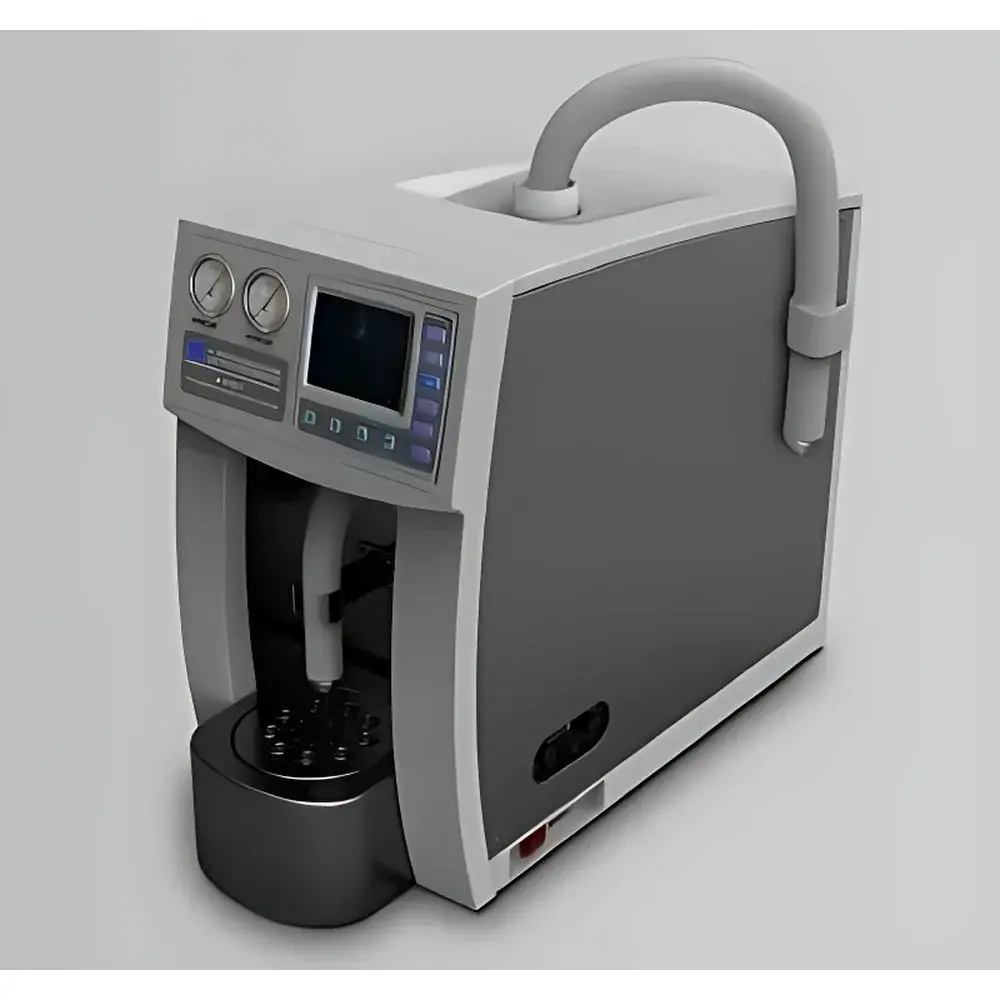
Zhenxinghuiyi DK3001B Semi-Automatic Headspace Sampler
| Brand | Zhenxinghuiyi |
|---|---|
| Origin | Beijing, China |
| Model | DK3001B |
| Instrument Type | Static Headspace Sampler |
| Sample Vial Capacity | 20 mL (optional 10 mL) |
| Heating Zone Temperature Range | 10 °C above ambient to 200 °C (1 °C increments) for vial oven and valve/loop |
| Sample Position | 9-place rotary carousel |
| Loop Volume | 1 mL |
| RSD | ≤1.5% (ethanol in water, 0.02% w/w, n=5) |
| Communication Interface | GC synchronization trigger + RS-232/USB for workstation integration |
| Method Storage | 10 user-defined methods |
| Safety | Overtemperature cutoff, thermal runaway protection |
| Compliance | Designed for GLP/GMP-aligned workflows |
Overview
The Zhenxinghuiyi DK3001B Semi-Automatic Headspace Sampler is a precision-engineered static headspace sampling system designed for reliable, reproducible volatile organic compound (VOC) analysis in conjunction with gas chromatography (GC). It operates on the principle of phase equilibrium partitioning—where analytes in a liquid or solid sample migrate into the overlying vapor phase at controlled temperature and pressure—enabling quantitative extraction without matrix interference. Unlike dynamic headspace (purge-and-trap) systems, the DK3001B maintains closed-vial equilibration, minimizing analyte loss and ensuring high method robustness for regulated applications including residual solvent testing, environmental screening, and pharmaceutical quality control. Its thermally isolated architecture, zero-dead-volume pneumatic design, and fully independent temperature zones eliminate condensation artifacts and baseline disturbances during injection—critical for low-level detection and long-term method stability.
Key Features
- Static headspace sampling with dual operational modes: pressure-balanced and high-pressure injection—both implemented without electromagnetic valves to prevent elastomer-derived contamination and ensure leak-tight integrity.
- Three independently controlled heating zones: 9-position vial oven (10–200 °C), valve/loop assembly (10–200 °C), and heated transfer line (10–220 °C), all adjustable in 1 °C increments for precise method optimization.
- Human-centered mechanical layout: front-lower vial loading position reduces operator fatigue; radial symmetry of heating positions minimizes inter-vial thermal gradients, improving inter-bottle precision (RSD ≤1.5% demonstrated with 0.02% ethanol standard).
- Integrated anti-contamination safeguards: programmable backflush of sampling needle and injection valve; replaceable stainless-steel injection needle for universal GC interface compatibility (Agilent, Thermo, Shimadzu, PerkinElmer, etc.).
- Embedded microcontroller with large LCD display showing real-time status—vial placement prompt, equilibration countdown, purge cycle indicator, and method execution progress—reducing operator dependency and training overhead.
- Thermal safety architecture: automatic power cutoff upon sensor fault or temperature excursion beyond set limits; redundant thermal monitoring prevents hardware damage and sample degradation.
Sample Compatibility & Compliance
The DK3001B accommodates standard 20 mL crimp-top headspace vials (with optional 10 mL support), compatible with common septa materials (PTFE/silicone, BTO, etc.) and widely used internal standards (e.g., deuterated solvents). Its inert flow path—constructed from electropolished stainless steel and high-temp PTFE—meets extractables and leachables requirements for pharmaceutical testing per USP . The instrument supports method validation protocols aligned with ICH Q2(R2), and its deterministic timing, fixed loop volume (1 mL), and traceable thermal calibration enable full compliance with GLP and GMP documentation practices. While the DK3001B itself does not embed audit trail or electronic signature functionality, its RS-232/USB output and GC synchronization trigger allow seamless integration with validated chromatography data systems (CDS) compliant with FDA 21 CFR Part 11 when deployed in regulated laboratories.
Software & Data Management
The DK3001B operates as a hardware controller rather than a standalone software platform. All method parameters—including vial equilibration time, oven temperature ramp profiles, pressurization duration, loop fill time, and backflush sequence—are stored locally in non-volatile memory (10 methods maximum). Configuration is performed directly via the front-panel interface; no PC driver or proprietary software installation is required. For data traceability, each unit ships with a factory-generated chromatographic verification report—including annotated GC-FID chromatograms and RSD calculations (n=5) using a certified 0.02% ethanol-in-water reference standard—serving as initial performance qualification (IQ) evidence. When interfaced with third-party CDS platforms (e.g., OpenLab CDS, Chromeleon, Empower), the DK3001B triggers acquisition start and injects timestamped event markers, enabling full chain-of-custody alignment within validated workflows.
Applications
- Residual solvent analysis in APIs and excipients per ICH Q3C and USP .
- VOC profiling in food packaging migration studies (EU 10/2011, FDA 21 CFR 170–189).
- Environmental water and soil testing for chlorinated hydrocarbons, BTEX, and trihalomethanes (EPA 502.2, ISO 15681-1).
- Forensic toxicology screening for ethanol, acetone, and isopropanol in biological matrices.
- Quality assurance of consumer products including cosmetics, adhesives, and coatings where volatile impurities affect odor, stability, or regulatory acceptance.
FAQ
Does the DK3001B support dynamic headspace (purge-and-trap) mode?
No. The DK3001B is exclusively a static headspace sampler. It does not include a purge gas manifold, trap column, or thermal desorption module.
Can the instrument be integrated with Agilent GC systems using LAN or Ethernet?
No. Communication is limited to RS-232 serial and USB virtual COM port for method parameter relay and GC start triggering. Ethernet or LAN connectivity requires an external protocol converter or CDS-level integration.
Is calibration certificate included with shipment?
A factory verification report—including temperature uniformity test data across all 9 vial positions and RSD validation chromatograms—is provided. NIST-traceable external calibration is recommended annually and must be performed by an accredited third-party lab.
What maintenance intervals are recommended for routine operation?
Valve seals and septa should be replaced every 500 injections or quarterly, whichever occurs first. Transfer line and needle should be inspected monthly for carbon buildup; cleaning with methanol followed by baking at 250 °C for 30 minutes is advised.
Does the DK3001B meet CE or UL safety certification requirements?
The unit complies with GB/T 14710–2009 (Chinese industrial electrical safety standard) and has passed EMC testing per GB/T 18268.31–2017. CE or UL listing is not currently held; users deploying in EU or North America must conduct local conformity assessment per applicable directives (e.g., Machinery Directive 2006/42/EC, UL 61010–1).





