
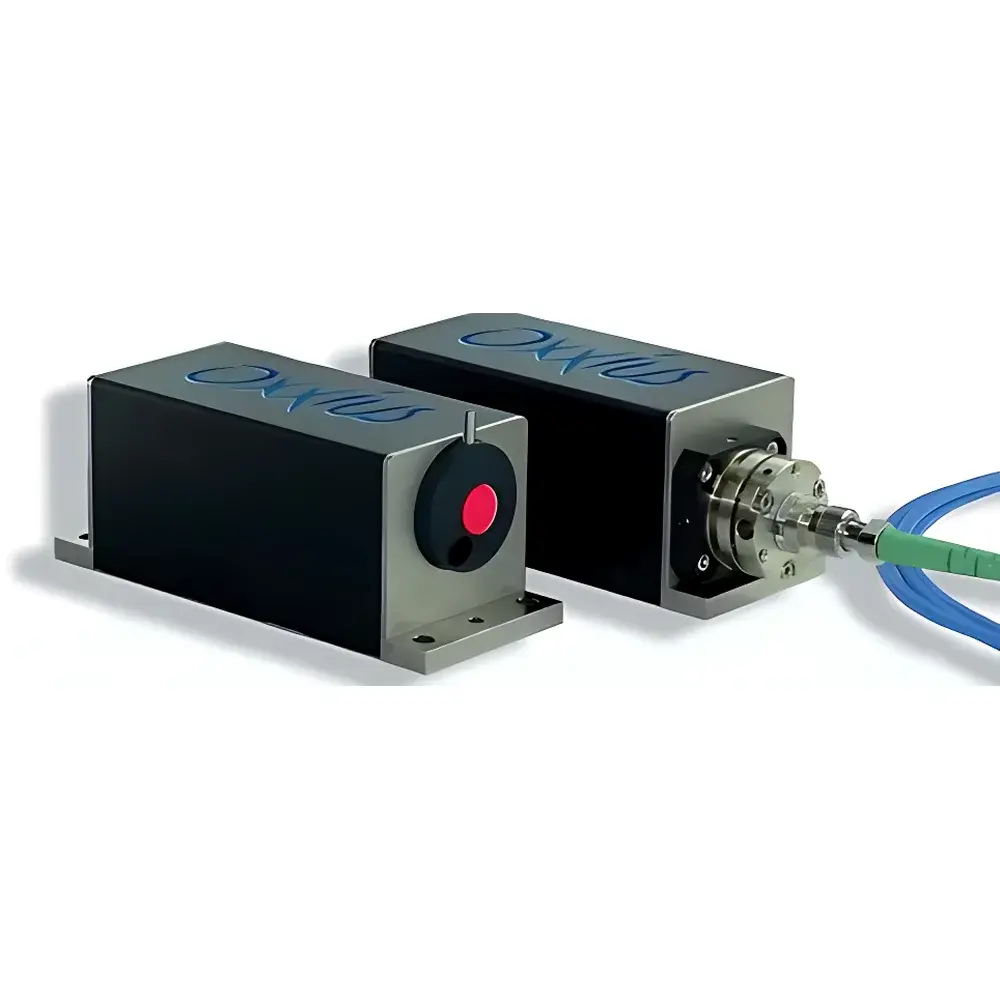
Oxxius LBX Series High-Speed Modulated CW Laser Systems
| Origin | France |
|---|---|
| Manufacturer Type | Authorized Distributor |
| Product Origin | Imported |
| Model | LBX Series (CW Semiconductor & Solid-State Lasers for Low-Power Detection) |
| Output Configuration | Free-Space or Fiber-Coupled Options Available |
| Modulation | TTL up to 150 MHz, Analog up to 3 MHz |
| Wavelength Options | 375, 405, 445, 488, 638, 642, 660, 785, 830 nm |
| Control Interface | USB + RS232 |
| Compliance | CE, RoHS, IEC 60825-1:2014 Class 3B/4 (wavelength- and power-dependent) |
Overview
The Oxxius LBX Series represents a class of continuous-wave (CW) semiconductor and solid-state lasers engineered specifically for applications demanding ultra-high-speed optical modulation without compromising beam stability or spectral fidelity. Unlike conventional diode lasers limited by carrier lifetime and parasitic capacitance, the LBX platform integrates proprietary driver architecture and optimized laser cavity design to achieve TTL modulation bandwidths up to 150 MHz and analog modulation bandwidths up to 3 MHz—among the highest commercially available for compact, air-cooled CW laser sources. These lasers operate on fundamental electro-optic principles: TTL modulation enables precise on/off switching synchronized with external digital logic signals (e.g., from FPGA or DAQ systems), while analog modulation allows linear intensity control via voltage input, critical for quantitative photoluminescence decay profiling or closed-loop feedback in interferometric setups. Designed for integration into OEM instrumentation and advanced research platforms, the LBX Series serves as a core excitation source in time-resolved spectroscopy, confocal fluorescence lifetime imaging (FLIM), holographic data storage read/write heads, and high-throughput biosensing assays where temporal resolution and signal-to-noise ratio are governed by laser modulation fidelity.
Key Features
- Ultra-high modulation bandwidth: TTL up to 150 MHz; analog up to 3 MHz—validated per IEC 61228 modulation response testing protocols
- Multi-wavelength portfolio spanning UV to NIR: 375 nm (UV), 405–488 nm (visible blue), 638–660 nm (red), and 785–830 nm (NIR), enabling broad compatibility with fluorophores, quantum dots, and semiconductor bandgap excitation
- Flexible output delivery: factory-configurable free-space collimated beams (M² < 1.3) or SMA/FC fiber-coupled variants (SMF-28 or HI1060, depending on wavelength)
- Embedded intelligence: real-time thermal monitoring, automatic power stabilization (±0.5% over 8 hours), over-current/over-temperature shutdown, and remote diagnostic logging via USB/RS232
- Low relative intensity noise (RIN): typically < –145 dB/Hz at 10 MHz offset, essential for heterodyne detection and low-light-level measurements
- Compact OEM-ready housing: 120 × 70 × 35 mm footprint, aluminum alloy chassis with EMC-shielded electronics, compliant with EN 55032 Class B emission limits
Sample Compatibility & Compliance
The LBX Series is routinely deployed in regulated analytical environments requiring traceable performance and operational reliability. Its optical output stability and modulation linearity support compliance with ASTM E2968 (standard practice for laser-based fluorescence instrumentation) and ISO 17025-accredited calibration workflows. When integrated into medical device subsystems (e.g., flow cytometers or point-of-care diagnostics), the lasers conform to IEC 62304 software lifecycle requirements for embedded control firmware. Full documentation—including EC Declaration of Conformity, laser safety classification reports (per IEC 60825-1:2014), and RoHS 2011/65/EU substance declarations—is provided with each unit. No user-serviceable parts; maintenance intervals defined per Oxxius Technical Bulletin TB-LBX-07 (recommended recalibration every 24 months under continuous operation).
Software & Data Management
Oxxius provides the LBX Control Suite—a cross-platform application (Windows/macOS/Linux) supporting full parameter configuration via USB virtual COM port or RS232. The suite enables real-time monitoring of diode temperature, output power, modulation status, and fault registers. All control commands adhere to SCPI (Standard Commands for Programmable Instruments) syntax, ensuring seamless integration with LabVIEW, Python (PySerial), MATLAB, or EPICS-based control systems. Audit trails—including timestamped modulation settings, power adjustments, and error events—are exportable as CSV or SQLite databases, satisfying FDA 21 CFR Part 11 requirements for electronic records when deployed in GLP/GMP-compliant laboratories. Firmware updates are delivered via signed binary packages with SHA-256 hash verification.
Applications
- Time-correlated single-photon counting (TCSPC) for fluorescence lifetime analysis in biological tissues and polymer films
- Confocal and multiphoton microscopy excitation where pulse jitter 50 dB minimize background scatter
- Holographic memory readout systems requiring phase-stable, high-repetition-rate illumination at 445 nm or 660 nm
- Photoluminescence quantum yield (PLQY) measurement using integrating sphere setups with synchronized lock-in detection
- Industrial inline material inspection: defect mapping in silicon wafers (785 nm) or OLED emissive layer uniformity testing (488 nm)
- Quantum optics experiments involving heralded photon generation via spontaneous parametric down-conversion (SPDC), where pump laser amplitude noise directly impacts coincidence visibility
FAQ
What is the maximum achievable extinction ratio under TTL modulation at 150 MHz?
Typical extinction ratio is ≥45 dB at 100 MHz; measured values decrease gradually above 120 MHz due to impedance matching limitations—consult Oxxius Application Note AN-LBX-Mod-03 for waveform integrity guidelines.
Can the LBX laser be integrated into a vacuum environment?
No—the unit is not vacuum-rated; internal thermoelectric coolers and sealed optics housings are designed for ambient air operation only.
Is analog modulation linearity certified across the full 0–5 V input range?
Yes; linearity deviation is ≤±1.2% FS per IEC 61228 Annex D test methodology, with calibration certificate available upon request.
Does the laser support external clock synchronization for multi-laser timing alignment?
Yes—TTL modulation accepts external clock inputs (LVCMOS compatible, 3.3 V logic) with jitter < 200 ps RMS, enabling sub-nanosecond inter-channel synchronization in multi-wavelength FLIM systems.
What is the recommended warm-up time to achieve specified power stability?
15 minutes under active temperature control; full specification compliance requires thermal equilibrium confirmed via internal sensor telemetry (accessible via LBX Control Suite).




