
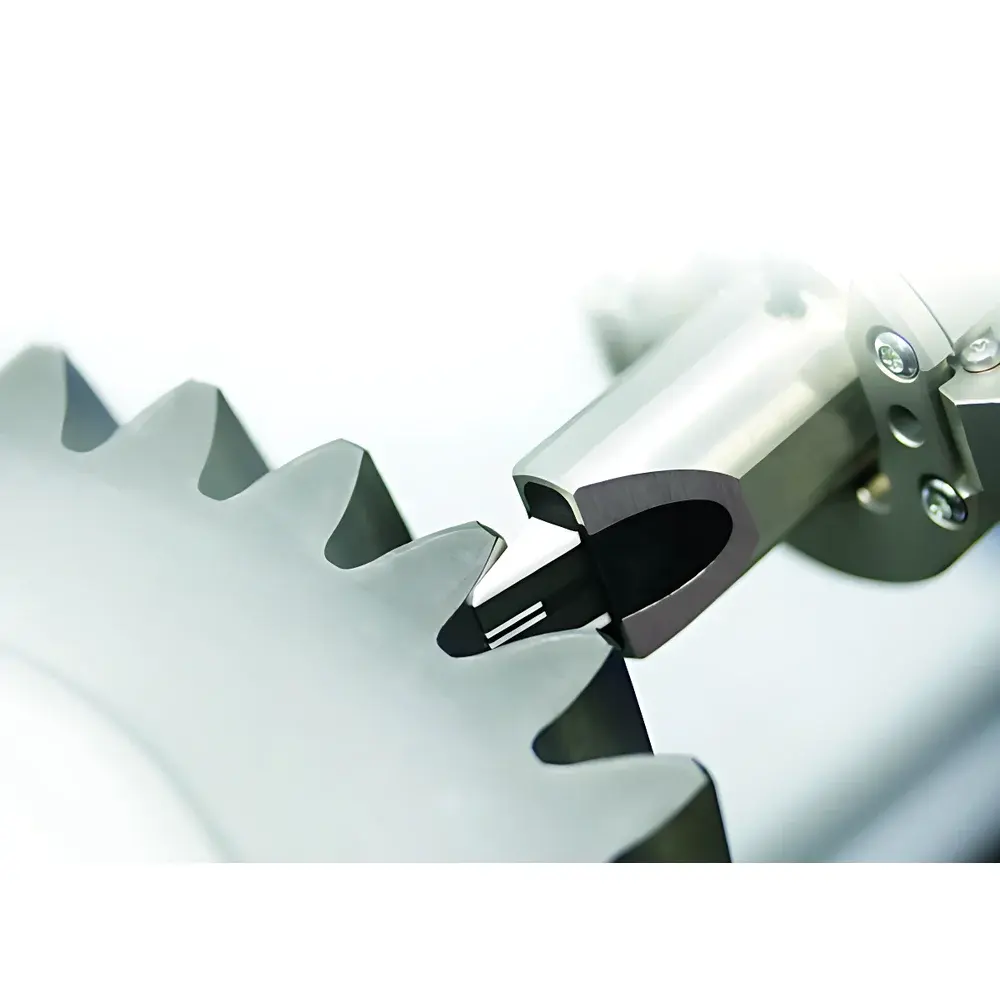
Stresstech Rollscan 250 Magnetic Barkhausen Noise (MBN) Surface Integrity Analyzer
| Brand | Stresstech Oy |
|---|---|
| Origin | Finland |
| Model | Rollscan 250 |
| Sensor Compatibility | Interchangeable MBN probes (standardized with Rollscan 300 platform) |
| Signal Processing | Digital Signal Processor (DSP)-based real-time analysis |
| Measurement Depth Range | 10–400 µm (material- and probe-dependent) |
| Output Parameters | MBN voltage amplitude, RMS value, peak frequency, spectral centroid, full-width-at-half-maximum (FWHM), and integrated energy density |
| Compliance | Designed for ISO 26892:2022 (Non-destructive testing — Magnetic Barkhausen noise and magnetic flux leakage methods — General principles), ASTM E3072-17 (Standard Guide for Magnetic Barkhausen Noise Testing), and compatible with GLP/GMP documentation workflows via ViewScan software audit trail functionality |
| Power Supply | 100–240 V AC, 50/60 Hz |
| Operating Temperature | 10–40 °C |
| Enclosure Rating | IP20 |
Overview
The Stresstech Rollscan 250 is a precision-engineered Magnetic Barkhausen Noise (MBN) surface integrity analyzer designed for non-destructive evaluation of grinding-induced damage in ferromagnetic components. Unlike X-ray stress analyzers—which rely on lattice strain measurement via diffraction—the Rollscan 250 operates on the physical principle of domain wall dynamics: when a time-varying magnetic field is applied to a ferromagnetic material, irreversible magnetization jumps generate transient voltage pulses in a pickup coil. These pulses—collectively termed Barkhausen noise—are highly sensitive to microstructural changes including residual stress gradients, phase transformations (e.g., secondary quenching martensite), dislocation density, and early-stage microcracking. The instrument is specifically calibrated for detecting thermal damage in the near-surface zone (10–400 µm depth), where conventional hardness or metallographic inspection lacks resolution or requires destructive sampling.
Key Features
- DSP-based real-time signal acquisition and spectral analysis with configurable sampling rate (up to 10 MS/s) and 16-bit ADC resolution
- Modular sensor architecture supporting interchangeable MBN probes—including surface-scanning, contour-following, and bore-hole variants—for geometry-adaptive inspection of gears, camshafts, crankshafts, bearing races, piston pins, and landing gear components
- No external magnetic compensation required: built-in closed-loop field control ensures stable excitation across varying permeability and geometry
- Adjustable excitation parameters via front-panel rotary encoder: peak-to-peak magnetic field strength (Hpp), frequency (1–1000 Hz), and waveform shape (sinusoidal, triangular, or trapezoidal)
- Real-time visualization of time-domain MBN signals, power spectral density (PSD), and derived metrics including amplitude distribution, pulse count rate, and spectral skewness
- Integrated hardware trigger interface for synchronization with CNC grinders or robotic scanning systems
Sample Compatibility & Compliance
The Rollscan 250 is validated for use on carbon steels, alloy steels, stainless steels (ferritic/martensitic grades), nickel-based superalloys (e.g., Inconel 718), and cobalt-chromium alloys. It is not suitable for austenitic stainless steels, aluminum, titanium, or non-ferromagnetic materials. All measurements conform to ISO 26892:2022 requirements for MBN method validation, including probe calibration traceability to NIST-traceable reference standards. When used with ViewScan software (optional), the system supports 21 CFR Part 11-compliant electronic records, including user authentication, audit trails, electronic signatures, and data integrity controls required for regulated manufacturing environments (e.g., aerospace MRO, medical device production).
Software & Data Management
ViewScan (sold separately) provides comprehensive post-processing, statistical process control (SPC), and reporting capabilities. It enables multi-parameter correlation mapping (e.g., MBN amplitude vs. residual stress gradient), batch comparison against master reference curves, and automated pass/fail classification using user-defined thresholds. Raw data are stored in HDF5 format for long-term archival and third-party analysis. The software includes built-in report templates compliant with AS9100, ISO 9001, and internal QA procedures—exportable as PDF, CSV, or XML. All configuration changes, operator logins, and measurement events are timestamped and logged for full traceability.
Applications
- Detection of grinding burn in high-value rotating components prior to final assembly or acceptance testing
- Process validation and optimization of grinding parameters (wheel speed, feed rate, coolant flow) to minimize subsurface damage
- In-process monitoring during high-precision cylindrical and surface grinding operations
- Root cause analysis of premature fatigue failure linked to near-surface microstructural degradation
- Qualification of heat-treated parts following induction hardening, flame hardening, or laser cladding
- Verification of surface integrity after shot peening or roller burnishing
FAQ
Does the Rollscan 250 require calibration standards for daily operation?
Yes—daily verification uses certified MBN reference blocks with known stress states and microstructures. Stresstech supplies NIST-traceable calibration kits per ISO 26892 Annex B.
Can it distinguish between tensile and compressive residual stress?
No—MBN amplitude and spectral features correlate strongly with stress magnitude but not sign. Complementary techniques (e.g., XRD or hole-drilling) are required for stress polarity determination.
Is the system compatible with automated robotic scanning?
Yes—via TTL-triggered acquisition mode and Ethernet-based command protocol (TCP/IP), enabling integration into FANUC, KUKA, or ABB robotic cells.
What is the typical measurement repeatability under controlled conditions?
Within ±3% coefficient of variation (CV) for amplitude-based metrics on homogeneous test samples, per ISO 26892 repeatability assessment protocols.
Does ViewScan support multilingual user interfaces?
Yes—English, German, French, Spanish, Chinese, and Japanese language packs are available upon license activation.
Related Products



