
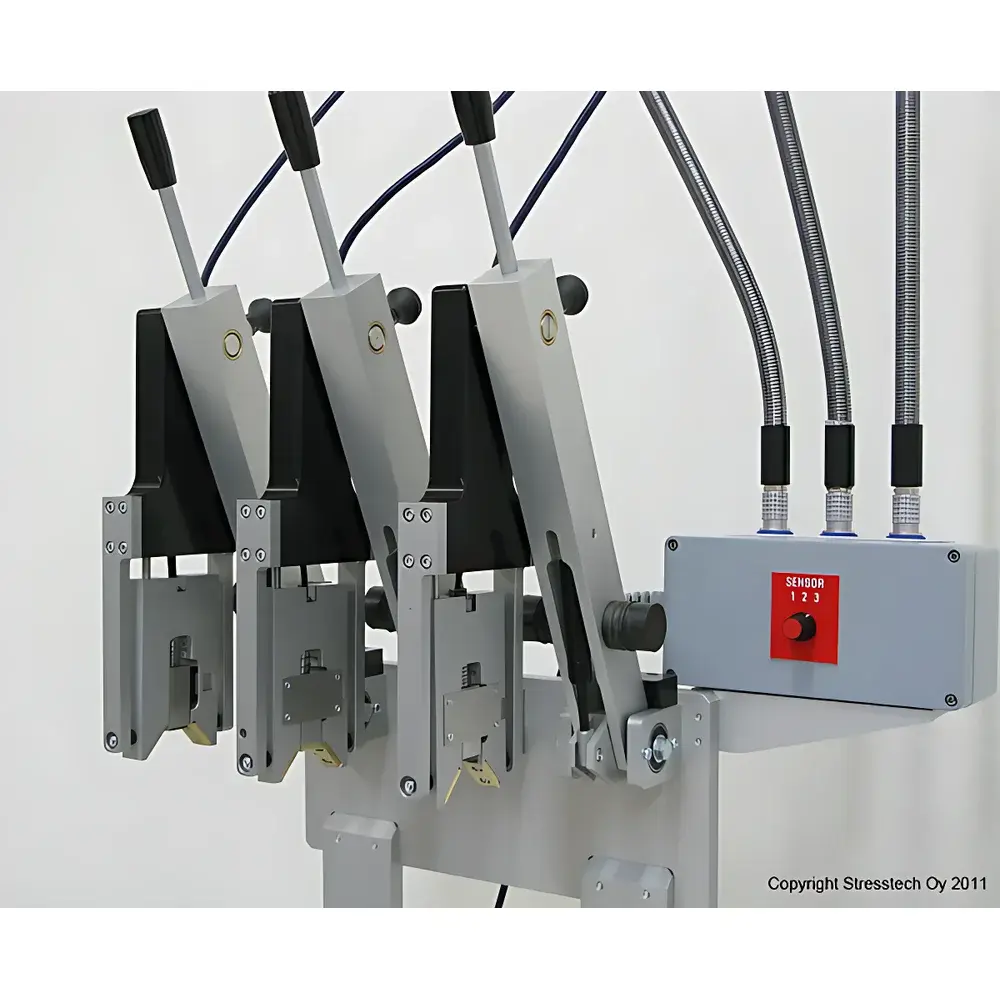
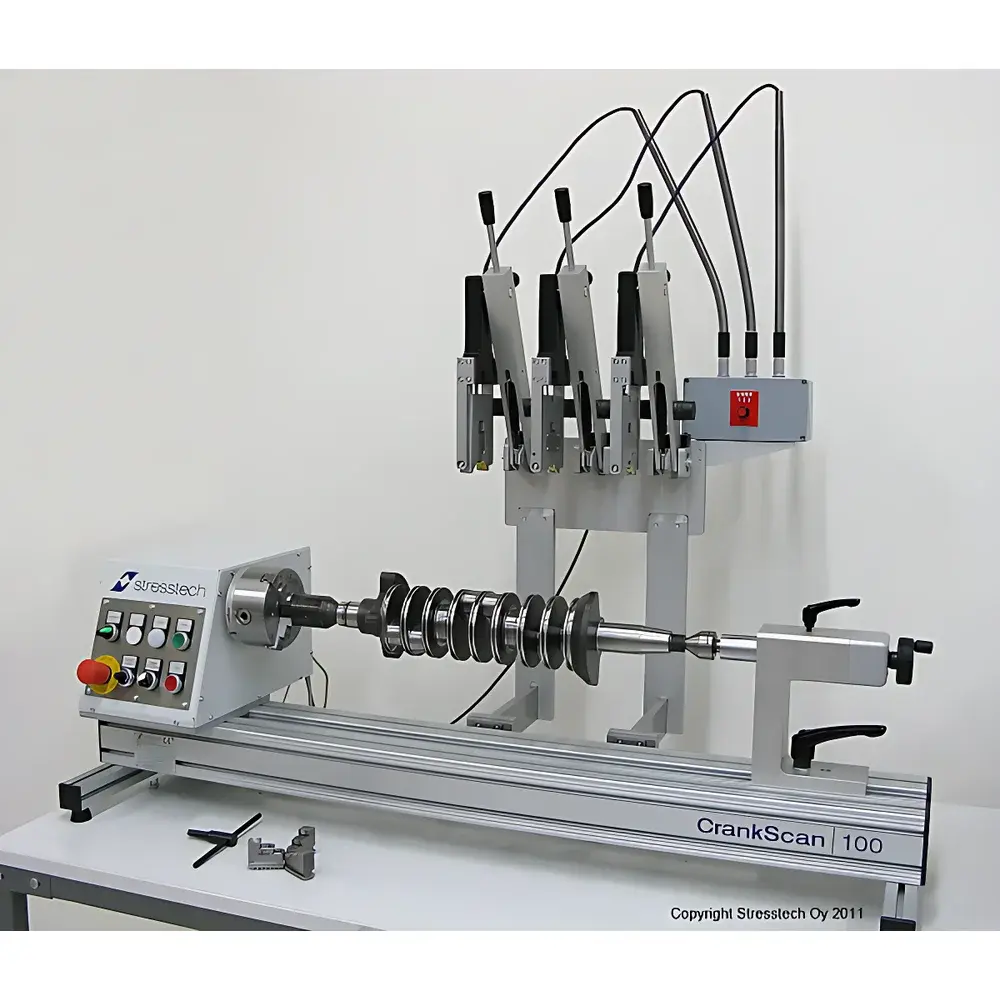
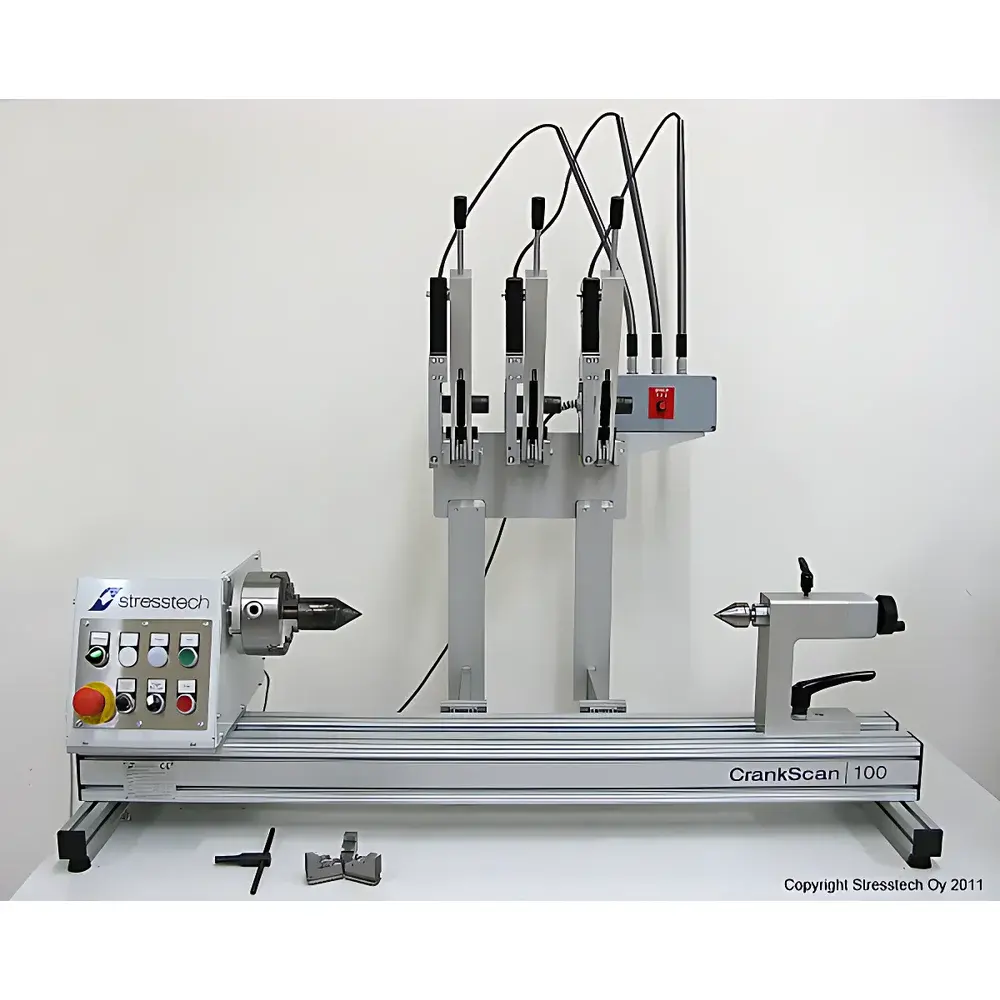
Stresstech CrankScan Barkhausen Noise-Based Grinding Burn Detection System
| Brand | Stresstech Oy |
|---|---|
| Origin | Finland |
| Model | CrankScan |
| Detection Principle | Magnetic Barkhausen Noise (MBN) |
| Measurement Type | Non-Destructive Surface Integrity Assessment |
| Application Scope | Crankshafts, Camshafts, Gears, Bearings, Fuel Injectors, Piston Rods, Landing Gear Components |
| Probe Configurations | Single-Channel & Multi-Channel Modular Probes (Curved, Contoured, Miniature, High-Resolution) |
| Environmental Rating | IP54 |
| Typical Measurement Time per Location | < 5 Seconds |
| Compliance Framework | ASTM E3029–23 (Standard Guide for MBN Testing of Ferromagnetic Components), ISO 28079:2011 (Non-destructive testing — Magnetic Barkhausen noise testing — General principles), Supports GLP/GMP Audit Trail via Software Logging |
Overview
The Stresstech CrankScan is a purpose-engineered, non-destructive surface integrity assessment system designed specifically for the detection and quantification of grinding-induced thermal damage and heat treatment burn on ferromagnetic components. Unlike legacy acid etching methods—which introduce chemical corrosion, require hazardous waste disposal, and provide only qualitative, post-process pass/fail indications—the CrankScan leverages the physical phenomenon of Magnetic Barkhausen Noise (MBN) to deliver objective, repeatable, and spatially resolved data on subsurface microstructural changes. When a time-varying magnetic field is applied to a ferromagnetic material, irreversible domain wall movements generate transient voltage pulses in a pickup coil; their amplitude, frequency distribution, and statistical dispersion correlate directly with residual stress gradients, plastic deformation, martensitic phase transitions, and localized overheating from grinding. The CrankScan captures these signals in real time, enabling precise mapping of burn severity across complex geometries without surface preparation or material removal.
Key Features
- True multi-point inspection capability via configurable single-channel and multi-channel probe arrays—enabling simultaneous evaluation of journal surfaces, fillet radii, shoulders, and contoured cam lobes on crankshafts and camshafts.
- Modular probe library including miniature contour probes (diameter down to 3 mm), flexible shaft-mounted sensors, and custom-machined fixtures for high-curvature regions such as crankpin fillets and bearing raceways.
- Ruggedized industrial housing rated IP54, qualified for operation in machine shop environments with ambient temperatures from 5 °C to 45 °C, relative humidity up to 80 % non-condensing, and exposure to coolant mist and metal particulates.
- Real-time signal processing architecture with 16-bit ADC resolution, adaptive noise filtering, and automatic baseline compensation to maintain measurement stability across varying surface finishes (Ra 0.2–3.2 µm) and coating conditions (e.g., thin phosphate layers).
- Integrated threshold-based alarm logic with user-definable pass/fail limits per measurement zone, visualized via color-coded overlay on CAD-aligned component schematics within the software interface.
Sample Compatibility & Compliance
The CrankScan is validated for use on carbon steels, alloy steels, case-hardened steels (e.g., 1045, 4140, 8620, 18CrNiMo7-6), and tool steels commonly employed in powertrain, aerospace, and heavy machinery applications. It complies with ASTM E3029–23 (Standard Guide for Magnetic Barkhausen Noise Testing of Ferromagnetic Components) and ISO 28079:2011 (Non-destructive testing — Magnetic Barkhausen noise testing — General principles). Measurement protocols support traceability requirements under AS9100 Rev D and EN 9100:2018 for aerospace suppliers. All calibration and verification procedures are documented per ISO/IEC 17025:2017 guidelines for testing laboratories, and raw signal archives include timestamped metadata required for FDA 21 CFR Part 11-compliant electronic records when deployed in regulated manufacturing environments.
Software & Data Management
The CrankScan operates with Stresstech’s proprietary ScanView™ software suite, which provides full workflow control from probe calibration and measurement plan definition to statistical analysis and report generation. The software supports import of STEP or IGES geometry files for spatial registration of measurement points, enabling automated scanning path programming for CNC-integrated setups. Signal data is stored in HDF5 format with embedded metadata (operator ID, environmental conditions, probe serial number, calibration date). Built-in statistical process control (SPC) tools calculate Cp/Cpk indices per inspection zone, while trend analysis modules detect gradual degradation over successive production lots. Audit logs record all user actions—including limit modifications, data exports, and report approvals—with digital signature support for GLP/GMP compliance.
Applications
The system is routinely deployed for in-process and final inspection of critical rotating components across multiple sectors: crankshaft journals and fillets in automotive and marine diesel engines; cam lobe surfaces and base circles in high-performance valve trains; gear tooth flanks and root radii subjected to profile grinding; bearing inner/outer raceways after superfinishing; fuel injector nozzles and needle valves requiring microstructural homogeneity; piston rods and landing gear struts where localized overheating compromises fatigue life. Its ability to quantify burn depth (typically 10–150 µm below surface) makes it indispensable for validating grinding wheel conditioning, coolant flow efficacy, and feed rate optimization in high-precision manufacturing cells.
FAQ
Does the CrankScan require surface preparation prior to measurement?
No—measurements are performed directly on finished machined surfaces, including ground, honed, or superfinished states. No cleaning beyond standard shop wipe-down is necessary.
Can the system distinguish between grinding burn and residual tensile stress?
Yes—through multi-parameter MBN analysis (pulse amplitude, RMS voltage, peak frequency shift, and kurtosis), the software differentiates thermally induced microcracking and untempered martensite from purely stress-driven domain wall pinning effects.
Is operator certification required to perform compliant inspections?
While basic operation requires minimal training, personnel conducting audits for AS9100 or ISO 9001 must complete Stresstech’s certified MBN Method Training Course and maintain documented competency records per internal QA procedures.
How is probe calibration maintained across extended use?
Each probe includes an integrated NIST-traceable reference sample. Daily verification is performed using this standard; full recalibration is recommended annually or after 10,000 measurement cycles, using Stresstech’s accredited service center.
Can CrankScan data be integrated into MES or QMS platforms?
Yes—ScanView™ supports OPC UA and RESTful API interfaces for bidirectional data exchange with Siemens Opcenter, ETQ Reliance, and similar enterprise quality management systems.






