
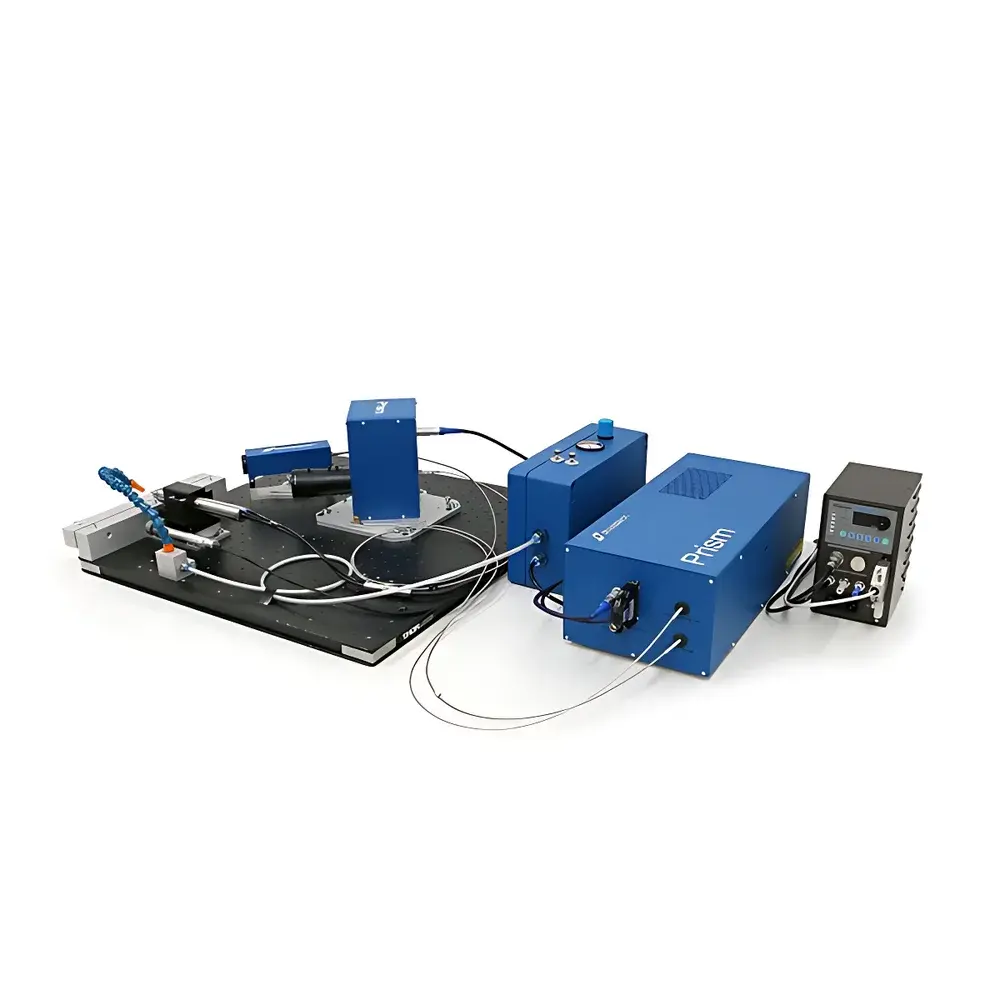
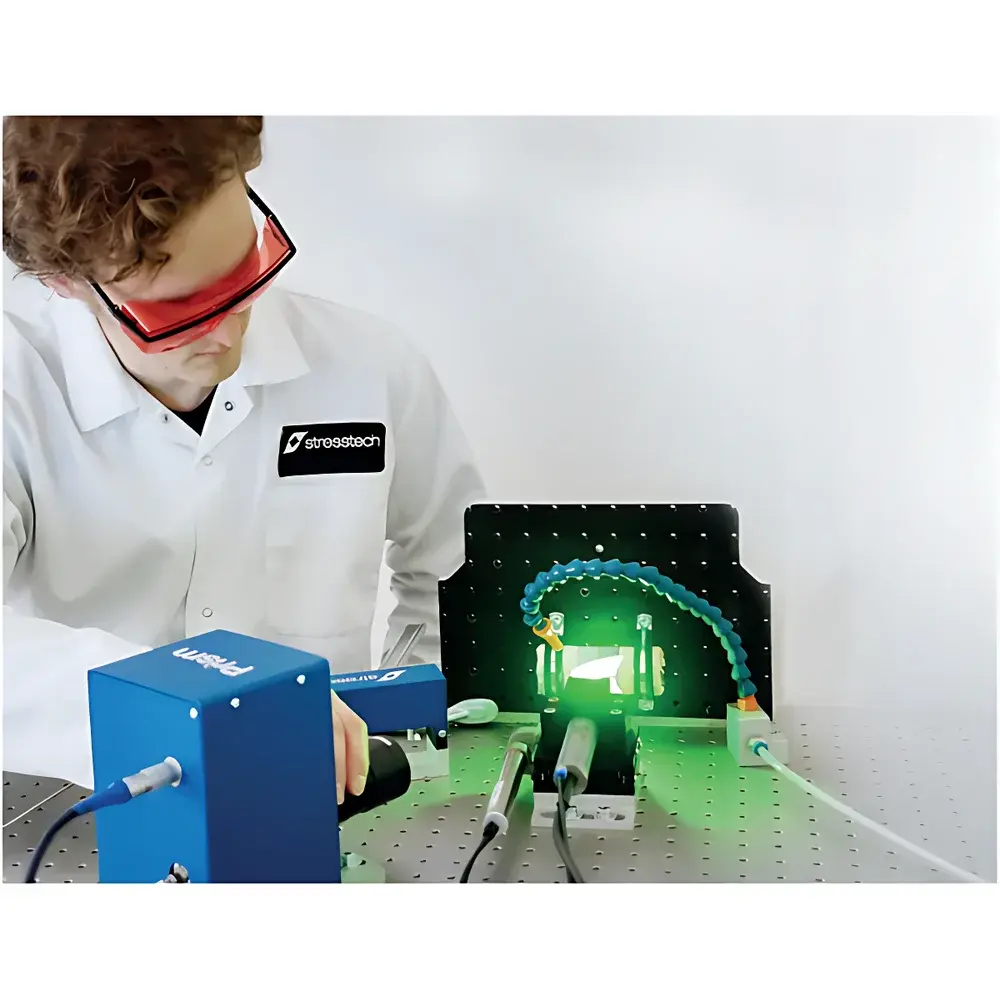
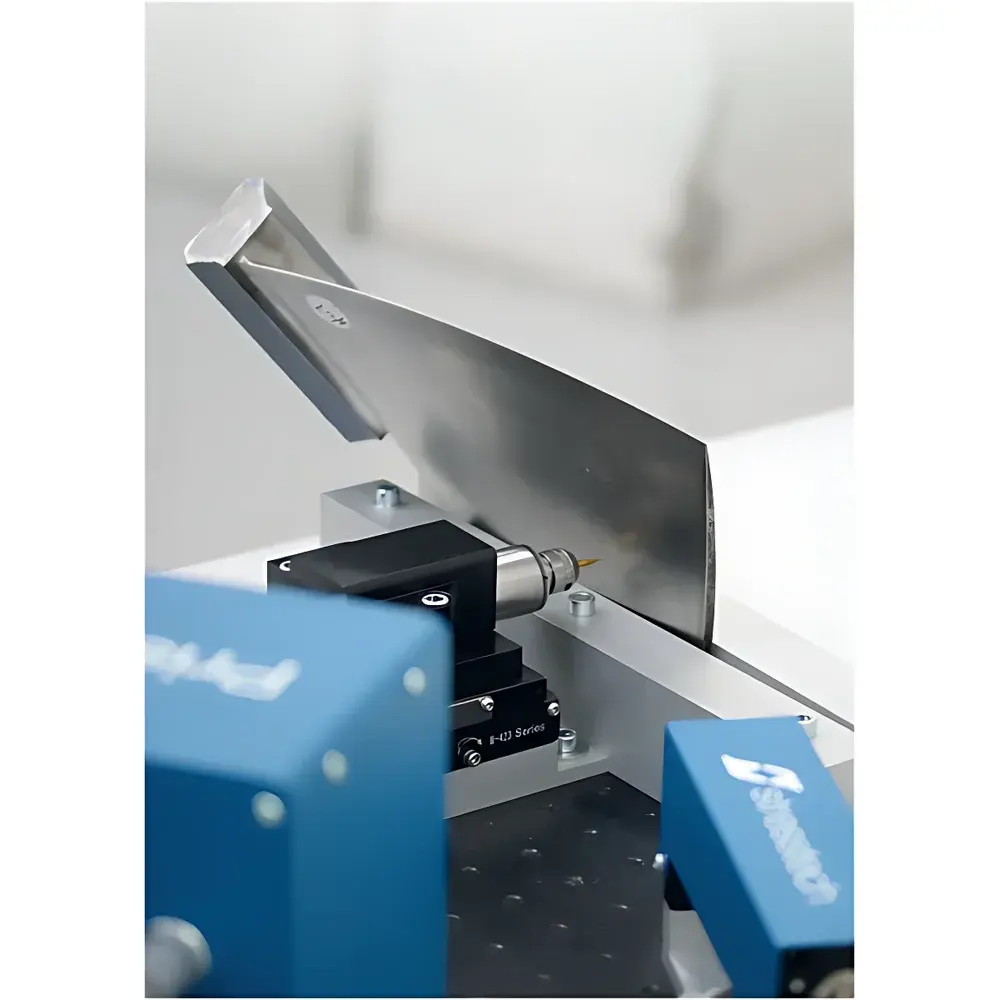
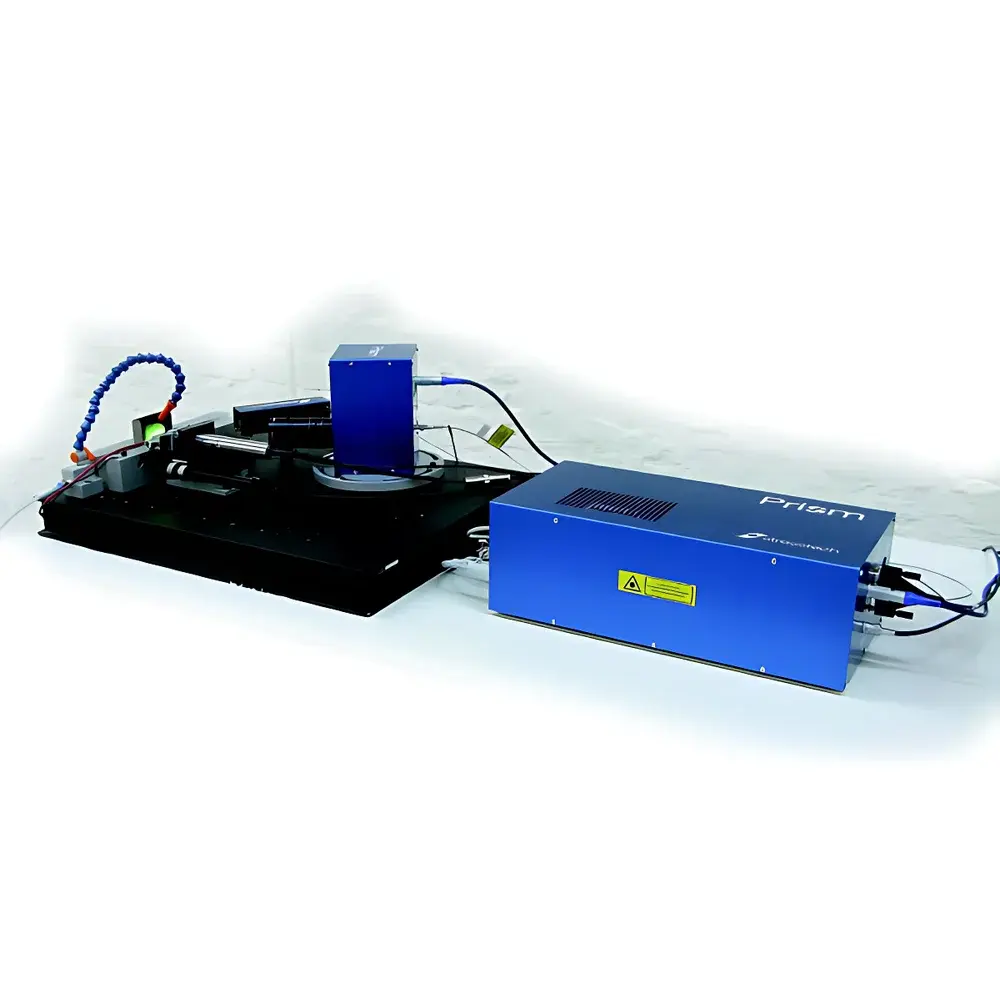
Stresstech Prism Laser Hole-Drilling Residual Stress Analyzer
| Brand | Stresstech Oy |
|---|---|
| Origin | Finland |
| Manufacturer Type | Authorized Distributor |
| Origin Category | Imported |
| Model | Prism |
| Pricing | Upon Request |
Overview
The Stresstech Prism Laser Hole-Drilling Residual Stress Analyzer is a precision-engineered, portable optical system designed for non-contact, high-resolution residual stress evaluation in engineering components using the incremental hole-drilling method combined with Electronic Speckle Pattern Interferometry (ESPI). Unlike conventional strain-gauge-based hole-drilling systems, the Prism employs coherent laser illumination and real-time speckle field analysis to quantify full-field surface displacement fields with sub-micrometer sensitivity. The measurement principle relies on the mechanical perturbation induced by controlled, incremental blind-hole drilling — a standardized stress-relief technique defined in ASTM E837 and ISO 21927. As material is removed layer-by-layer, the surrounding elastic matrix relaxes, generating measurable in-plane and out-of-plane surface displacements. These displacements are captured interferometrically and inverted via elasticity-based computational algorithms to reconstruct the original through-thickness residual stress profile (σ₁, σ₂, τ₁₂) at the measurement location.
Key Features
- Non-contact ESPI-based displacement measurement eliminates sensor bonding artifacts and enables repeatable measurements on coated, heat-treated, or roughened surfaces.
- Integrated coaxial laser alignment and auto-focus optics ensure consistent illumination geometry and speckle contrast across varying surface finishes (Ra ≤ 12.5 µm).
- Motorized, CNC-guided drilling unit with programmable depth increments (0.01–0.1 mm/step) and real-time feed-force monitoring to prevent thermal distortion or micro-cracking.
- Portable design (≤18 kg) with battery-powered operation and ruggedized enclosure rated IP54 for shop-floor deployment near machining cells, foundries, or field service environments.
- Real-time displacement visualization: live fringe pattern rendering and quantitative displacement maps updated after each drilling increment.
- Compliance-ready data structure supporting audit trails, user authentication, and electronic signatures per FDA 21 CFR Part 11 and EU Annex 11 requirements.
Sample Compatibility & Compliance
The Prism accommodates a broad spectrum of metallic and non-metallic engineering materials including aluminum alloys, titanium Ti-6Al-4V, austenitic stainless steels (e.g., 316L), cast iron, nickel-based superalloys (Inconel 718), ceramics (Al₂O₃, SiC), thermoset composites, and injection-molded engineering plastics (e.g., PEEK, PA66-GF30). Surface preparation requirements are minimal: no polishing required beyond standard manufacturing finish; compatible with shot-peened, grit-blasted, anodized, and plasma-sprayed surfaces. Blind-hole diameter range: 0.5–3.0 mm (0.02–0.12 in), optimized for ASTM E837 Class A and Class B applications. Measurement validity requires perpendicular access to the target surface and unobstructed line-of-sight for both laser illumination and interferometric imaging.
Software & Data Management
The Prism Control Suite (v4.2+) provides a validated Windows-based platform for test definition, acquisition sequencing, inverse stress calculation, and reporting. It implements the integral method per ASTM E837 Annex A3 and supports alternative reconstruction kernels (e.g., Sachs, Lekhnitskii) for anisotropic or layered materials. All raw interferograms, drilling logs, displacement matrices, and stress tensors are stored in HDF5 format with embedded metadata (operator ID, timestamp, environmental conditions, calibration certificate ID). Export options include CSV, PDF reports compliant with ISO/IEC 17025 documentation requirements, and XML schemas for integration into LIMS or MES platforms. Software validation documentation (IQ/OQ/PQ protocols) and 21 CFR Part 11 configuration files are provided with system delivery.
Applications
- Verification of stress relief effectiveness post-welding, heat treatment, or cold working processes in aerospace structural components.
- In-process validation of shot peening intensity and coverage on turbine blades, landing gear, and compressor disks.
- Residual stress mapping across cast engine blocks, cylinder heads, and exhaust manifolds to predict fatigue initiation zones.
- Quality assurance of additive-manufactured parts (e.g., LPBF Ti-6Al-4V) where thermal gradients induce complex stress states.
- Failure analysis investigations involving stress-corrosion cracking, distortion in thin-walled housings, or delamination in ceramic-metal joints.
- Research-grade characterization of stress evolution during thermo-mechanical cycling in nuclear cladding materials and fusion reactor first-wall candidates.
FAQ
What standards does the Prism system comply with for residual stress measurement?
The Prism adheres to ASTM E837 (Standard Test Method for Determining Residual Stresses by the Hole-Drilling Strain-Gage Method) and ISO 21927 (Metallic materials — Determination of residual stresses by the hole-drilling method), with ESPI implementation validated against NIST-traceable reference specimens.
Can the Prism measure residual stresses in curved or contoured surfaces?
Yes — curvature compensation is achieved via real-time surface normal vector estimation from the initial laser triangulation image; maximum allowable local radius of curvature is ≥25 mm.
Is operator training required before deploying the system in production environments?
Stresstech provides certified 3-day application training covering measurement protocol selection, uncertainty budgeting per GUM (JCGM 100), and report generation for ISO/IEC 17025 accreditation purposes.
How is measurement uncertainty quantified for each test?
Total expanded uncertainty (k=2) is calculated per GUM principles, incorporating contributions from drilling geometry error (±0.005 mm), ESPI displacement noise (±0.02 µm), material property assumptions (E, ν), and numerical inversion conditioning — typically 15–25 MPa for near-surface stresses in aluminum alloys.
Does the system support automated multi-point scanning?
Yes — optional motorized XY stage integration enables programmed grid-based stress mapping (up to 100 locations/hour) with automatic focus and alignment revalidation between points.





