
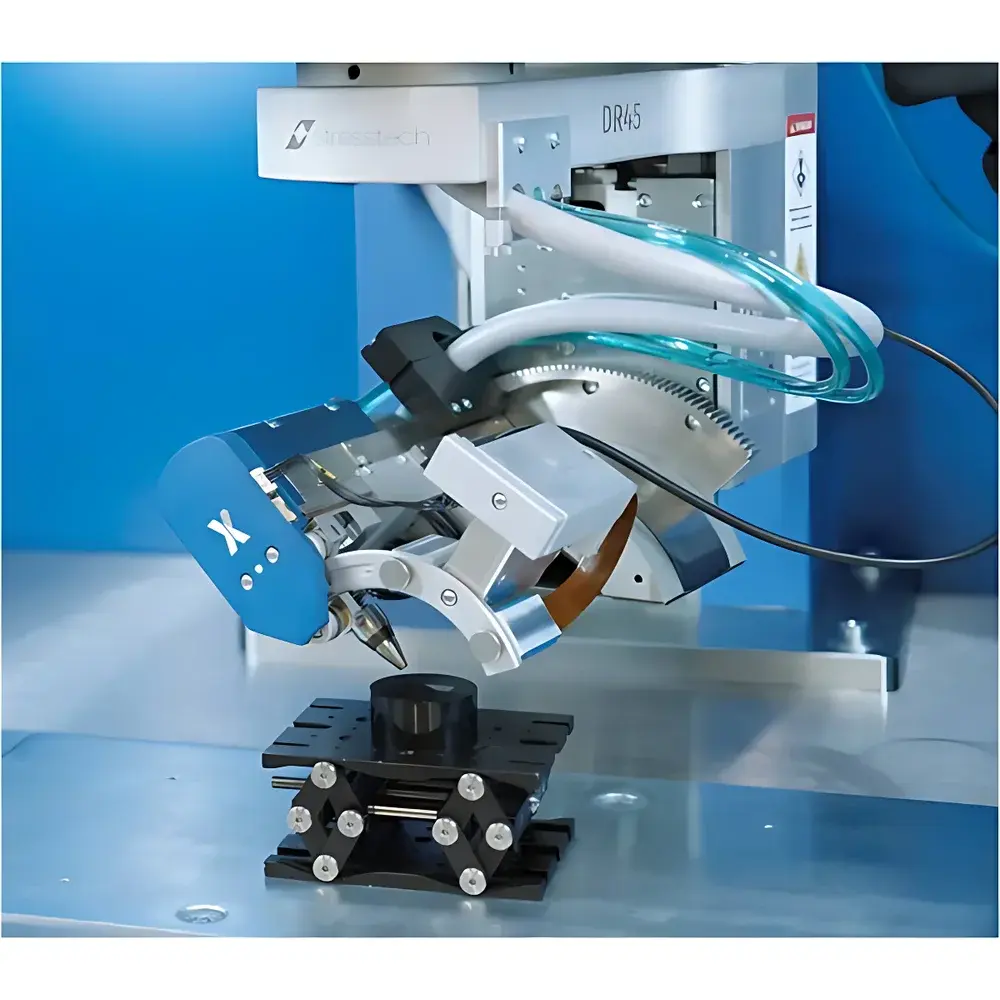
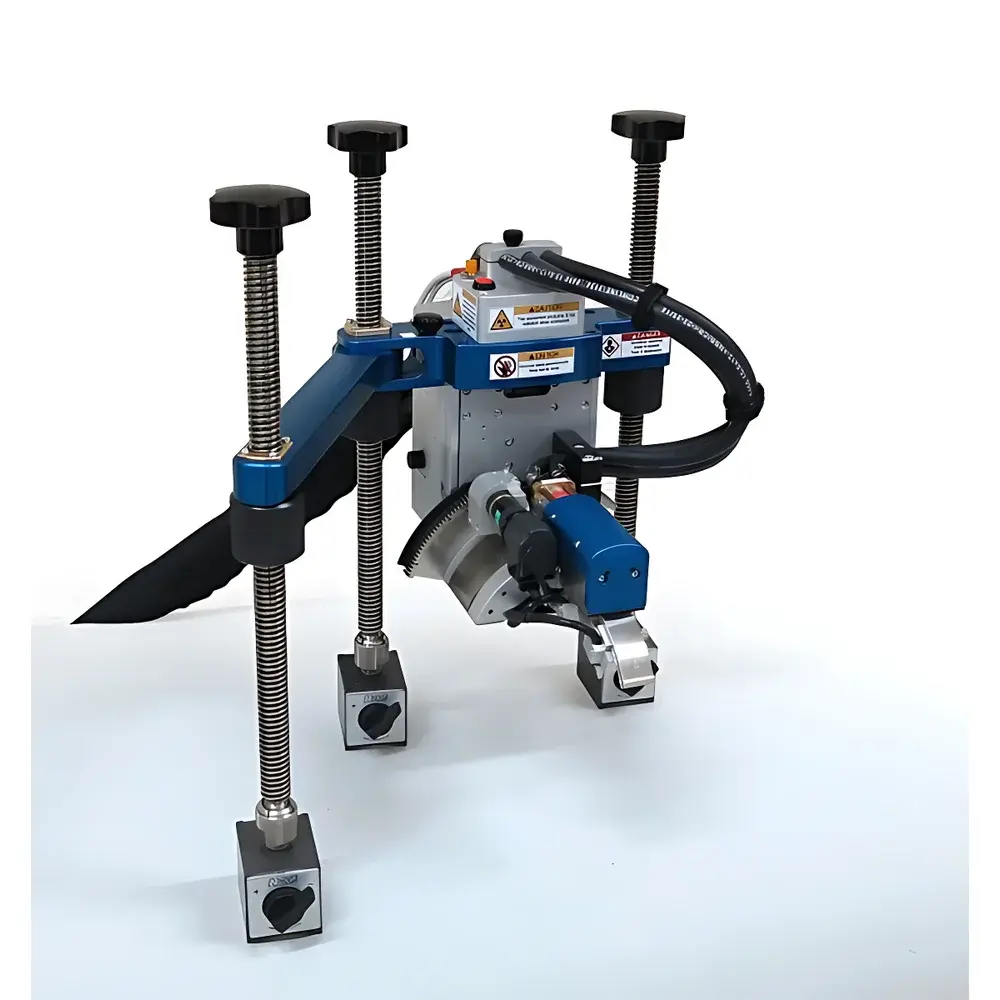
Stresstech Xstress 3000 Portable Automated Retained Austenite Analyzer
| Brand | Stresstech Oy |
|---|---|
| Origin | Finland |
| Model | Xstress 3000 |
| Goniometer | Tilt-and-rotation stage with improved y-geometry (side-inclination method) |
| Detector Configuration | Symmetrically mounted dual solid-state position-sensitive proportional counters (MOS linear imaging detectors) |
| 2θ Range | Continuously adjustable from 110° to 170° |
| Collimator Options | Interchangeable apertures Φ0.5 mm, Φ0.8 mm, Φ1.0 mm, Φ2.0 mm, Φ5.0 mm |
| Angular Resolution | 0.029°/pixel (512-pixel linear array) |
| Calibration | Fully automated, including real-time goniometric distance correction with positional repeatability < 0.003 mm |
| X-ray Tube | Micro-focus tube, 5–30 kV / 0–10 mA / up to 300 W |
| Power Consumption | 1 mW per detector |
| Portability | Integrated battery-powered field unit with ruggedized enclosure for on-site industrial use |
Overview
The Stresstech Xstress 3000 Portable Automated Retained Austenite Analyzer is a field-deployable X-ray diffraction (XRD) system engineered for quantitative phase analysis of retained austenite (RA) in ferrous alloys—particularly heat-treated steels, bearing components, gears, and case-hardened parts. Unlike conventional lab-based XRD systems, the Xstress 3000 implements a side-inclination (y-geometry) goniometric configuration optimized for surface-normal diffraction geometry, enabling precise RA quantification without requiring sample rotation or destructive sectioning. The instrument operates on Bragg’s law principles, measuring integrated intensities of characteristic diffraction peaks—primarily the (200), (220), and (311) reflections of austenite—and comparing them against ferrite/martensite reference peaks (e.g., α-Fe (200), (211)) using Rietveld refinement or the direct comparison method per ASTM E975 and ISO 21942. Its portability, combined with automated alignment and real-time data acquisition, supports in-situ measurements directly on production floors, maintenance bays, or repair workshops—eliminating transport delays and preserving thermal/mechanical history of critical components.
Key Features
- Automated goniometric calibration with sub-micron positional repeatability (< 0.003 mm), ensuring long-term measurement stability across thermal cycles and field deployments.
- Dual symmetric MOS linear imaging detectors (512 pixels, 0.029°/pixel angular resolution) delivering high signal-to-noise ratio and eliminating the need for high-voltage power supplies—reducing electromagnetic interference and enhancing operational safety.
- Modular microfocus X-ray tube with user-selectable anodes (Cr, Cu, Co, Ti, Mn), each equipped with dedicated water-cooling channels and tool-free hot-swap capability (< 3 min replacement).
- Continuously variable 2θ range (110°–170°) accommodating diverse lattice parameters and enabling optimization for low-RA detection limits (down to ~0.5 vol%) in high-carbon steels and stainless alloys.
- Integrated φ-rotation system that decouples sample orientation from goniometer motion—critical for coarse-grained or textured materials where peak broadening or preferred orientation would otherwise compromise phase quantification accuracy.
- Ruggedized IP54-rated enclosure with internal Li-ion battery support (≥4 h continuous operation), meeting MIL-STD-810G shock/vibration requirements for industrial field use.
Sample Compatibility & Compliance
The Xstress 3000 accommodates samples of arbitrary geometry and size—including fully assembled gearboxes, turbine blades, railway axles, and welded joints—without dimensional constraints. Surface preparation requirements are minimal: localized grinding or electropolishing (per ASTM E1122) is recommended only for roughness > Ra 0.8 µm. The system complies with IEC 61000-6-3 (EMC), IEC 61000-6-4 (industrial immunity), and EU Directive 2013/59/Euratom for radiation safety. Measurement protocols align with ASTM E975 (Standard Test Method for Determining Volume Fraction of Retained Austenite Using X-Ray Diffraction), ISO 21942:2020 (Non-destructive testing — X-ray diffraction methods for retained austenite determination), and EN 15305 (Non-destructive testing — Test method for residual stress analysis by X-ray diffraction). Full audit trail logging meets GLP/GMP documentation requirements per FDA 21 CFR Part 11 when used with validated software configurations.
Software & Data Management
Controlled via Stresstech’s proprietary Xstress Studio v5.x software, the system provides real-time diffraction pattern visualization, automated peak identification, and phase fraction calculation using both Rietveld full-pattern fitting and intensity-ratio algorithms. All raw data (including detector frames, goniometer positions, tube parameters, and environmental metadata) are stored in vendor-neutral HDF5 format. Software supports batch processing, report generation (PDF/CSV), and integration with enterprise LIMS via OPC UA or RESTful API. Electronic signatures, user role management (admin/operator/auditor), and immutable audit trails satisfy regulatory traceability mandates. Firmware updates are delivered over secure HTTPS with SHA-256 signature verification.
Applications
- Quantitative retained austenite mapping in carburized, nitrided, or induction-hardened steel components to verify heat treatment efficacy and predict fatigue life.
- In-process QA during gear manufacturing—detecting excessive RA (>15 vol%) that may lead to dimensional instability or premature spalling.
- Root cause analysis of rolling contact fatigue failures in bearings and rails, correlating RA content with subsurface plastic deformation zones.
- Validation of cryogenic treatment effectiveness in tool steels and high-speed steels.
- Residual stress–phase coupling studies, where simultaneous RA and stress measurements (using same optical path) enable correlation of phase transformation strains with macroscopic stress states.
FAQ
Does the Xstress 3000 require external cooling water or compressed air?
No. Each X-ray tube incorporates a self-contained recirculating water-cooling module with thermoelectric heat rejection—no facility connections required.
Can the system measure retained austenite through coatings or surface layers?
Yes—penetration depth is tunable via kV selection (e.g., Cr Kα at 25 kV yields ~15–25 µm effective depth in steel); thin PVD/CVD coatings (< 5 µm) typically do not interfere with bulk-phase quantification.
Is operator certification required for regulatory compliance?
Per ISO/IEC 17025, personnel must complete Stresstech’s certified training program (Level 2 NDT XRD) and maintain documented competency records—especially for ISO 17836 or ASME BPVC Section V applications.
How is measurement uncertainty estimated for retained austenite results?
Uncertainty budgets follow GUM (JCGM 100:2008), incorporating contributions from peak integration (±0.3 vol%), texture correction (±0.5 vol%), background subtraction (±0.2 vol%), and calibration drift (±0.1 vol%)—typical expanded uncertainty (k=2) is ±1.2 vol% for RA levels > 2%.
What maintenance intervals are recommended for field deployment?
Detector gain calibration every 90 days; goniometer backlash verification every 6 months; X-ray tube lifetime monitored via cumulative mAs counter (rated ≥ 10,000 h at 50% duty cycle).




