
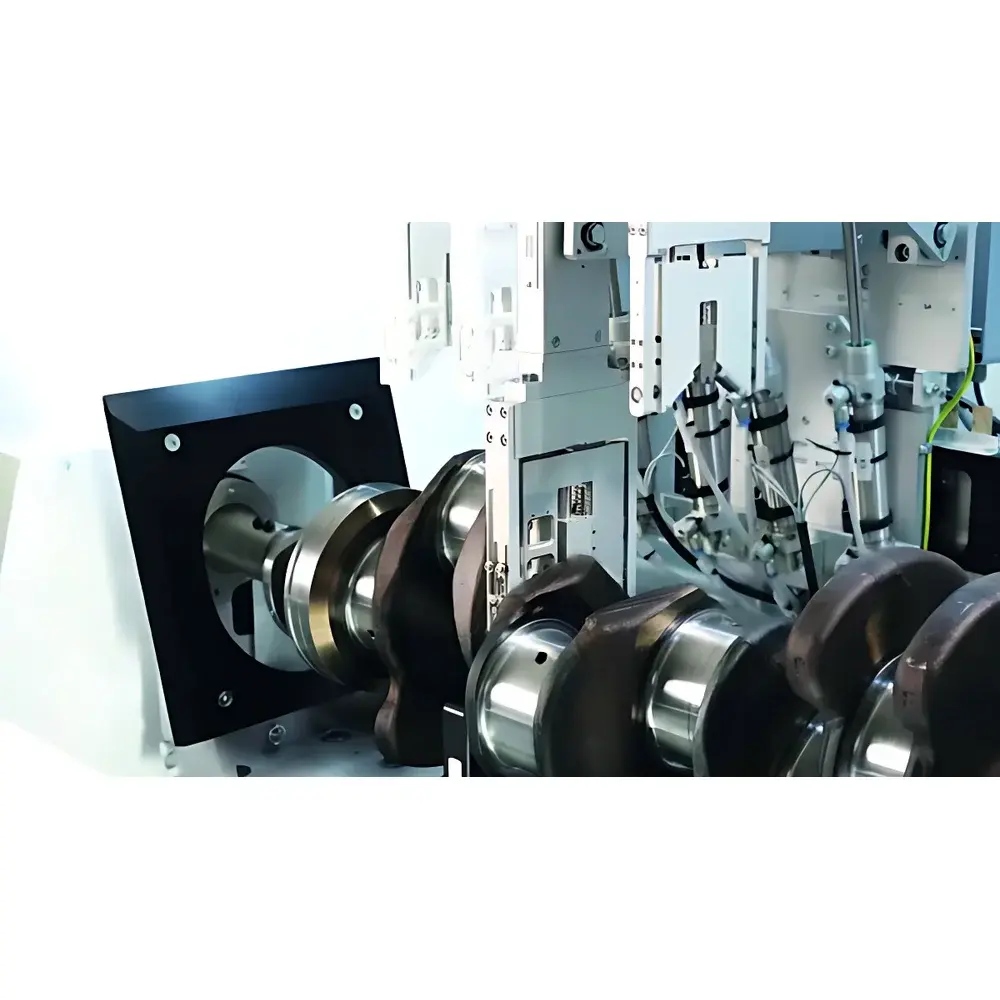
Stresstech CrankScan Portable Barkhausen Noise Surface Integrity Analyzer
| Brand | Stresstech Oy |
|---|---|
| Origin | Finland |
| Model | CrankScan |
| Detection Principle | Magnetic Barkhausen Noise (MBN) |
| Portability | Handheld / Portable |
| Typical Measurement Time | 6–8 s per inspection zone |
| Channel Configuration | Single- or Multi-channel |
| Probe Options | Interchangeable probes for curved, flat, and contoured surfaces |
| Alarm Thresholding | User-configurable pass/fail limits |
| Data Output | Real-time waveform + RMS/peak amplitude quantification |
| Compliance | Designed for ISO 25178-2, ASTM E3049, and EN 10327-based surface integrity verification protocols |
Overview
The Stresstech CrankScan is a portable, precision-engineered magnetic Barkhausen noise (MBN) analyzer developed by Stresstech Oy (Finland) for non-destructive evaluation of surface integrity in ferromagnetic components subjected to grinding, hard turning, or heat treatment. Unlike conventional destructive methods—such as nital etching or metallographic sectioning—the CrankScan leverages the physical phenomenon of Barkhausen emission: abrupt, stochastic magnetization jumps induced by domain wall pinning at microstructural defects (e.g., untempered martensite, residual tensile stress gradients, grinding-induced phase transformations). This enables direct, quantitative assessment of subsurface damage depth (typically 0.02–0.2 mm), thermal damage severity, and localized stress anomalies without part preparation, surface alteration, or chemical reagents. The instrument is purpose-built for high-value rotating components where fatigue life, crack initiation resistance, and dimensional stability are mission-critical—especially in aerospace, powertrain, and energy infrastructure applications.
Key Features
- True portable architecture: Weighing under 2.8 kg with integrated battery (≥4 h continuous operation), enabling in-situ inspection on production floors, engine assembly lines, or field maintenance bays.
- Multi-probe compatibility: Includes radial, axial, and contour-conforming probes optimized for crankshaft journals, cam lobes, gear teeth, bearing races, and landing gear spindles—each calibrated for consistent lift-off compensation and signal-to-noise ratio.
- Real-time parametric output: Simultaneously displays time-domain MBN waveform, root-mean-square (RMS) amplitude, peak amplitude, and spectral centroid shift—correlating directly with burn severity per ASTM E3049 Annex A2 guidelines.
- Multi-channel acquisition: Supports up to four synchronized channels for parallel inspection of adjacent journal surfaces, reducing cycle time and eliminating positional repeatability errors during serial component screening.
- Traceable calibration: Factory-calibrated against NIST-traceable reference standards; supports user-defined calibration curves using certified reference samples with known burn grades (e.g., DIN 50145-compliant test blocks).
- Ruggedized industrial design: IP54-rated enclosure, shock-absorbing housing, and MIL-STD-810G compliant electronics ensure reliability in high-vibration, temperature-variable environments (operating range: −10 °C to +50 °C).
Sample Compatibility & Compliance
The CrankScan is validated for use on hardened steels (e.g., 100Cr6, 42CrMo4, 18CrNiMo7-6), case-hardened alloys, and nitrided surfaces with hardness ≥45 HRC. It complies with functional requirements outlined in ISO 25178-2 (surface texture parameters), ASTM E3049 (standard guide for MBN testing), and EN 10327 (non-destructive testing of automotive components). Its measurement methodology supports GLP/GMP audit trails when paired with Stresstech’s optional software package, satisfying FDA 21 CFR Part 11 requirements for electronic records and signatures in regulated manufacturing environments.
Software & Data Management
The CrankScan interfaces seamlessly with Stresstech’s WinView Pro software (Windows 10/11 compatible), providing full data acquisition, visualization, statistical process control (SPC) charting, and report generation. Each inspection record includes timestamp, operator ID, probe type, location coordinates (via optional encoder integration), raw MBN waveform, and pass/fail status relative to user-defined thresholds. Audit logs capture all parameter modifications, calibration events, and export actions—enabling full traceability for internal quality audits or third-party certification bodies (e.g., TÜV, DNV, AS9100 registrars).
Applications
- Aerospace: Inspection of turbine shafts, landing gear actuators, and helicopter transmission gears for grinding burn prior to acceptance testing.
- Automotive: In-line verification of crankshafts, camshafts, and CV joint housings post-grinding to prevent premature fatigue failure in Tier 1 supply chains.
- Power Generation: Screening of generator rotor journals and steam turbine blades following refurbishment cycles.
- Rail & Heavy Machinery: Assessment of axle journals and gearboxes after regrinding operations under EN 13103/EN 13104 compliance frameworks.
- Research & Development: Correlation studies between MBN response, X-ray diffraction residual stress profiles, and microhardness gradients in novel heat-treated alloys.
FAQ
How does Barkhausen noise differ from conventional eddy current or ultrasonic NDT methods?
Barkhausen noise specifically targets microstructural changes within the first 100 µm beneath the surface—making it uniquely sensitive to grinding burn and tempering damage—whereas eddy current detects near-surface conductivity variations and ultrasound resolves deeper volumetric flaws.
Can CrankScan quantify residual stress magnitude?
No—it detects stress-induced changes in magnetic domain mobility, which correlate qualitatively and semi-quantitatively with near-surface tensile/compressive states; absolute stress values require complementary X-ray diffraction (XRD) or neutron diffraction validation.
Is probe selection critical for measurement accuracy?
Yes—probe geometry, frequency response, and lift-off tolerance must match the curvature and finish of the inspected surface; Stresstech provides application-specific probe qualification reports for each component family.
Does CrankScan require periodic recalibration?
Annual factory recalibration is recommended; however, daily verification using a certified reference sample is mandatory per ISO/IEC 17025-compliant QA procedures.
Can data be exported to MES or SAP QM modules?
Yes—WinView Pro supports CSV, XML, and SQL database exports; custom API integration is available for enterprise-level SPC system interoperability.
Related Products




