
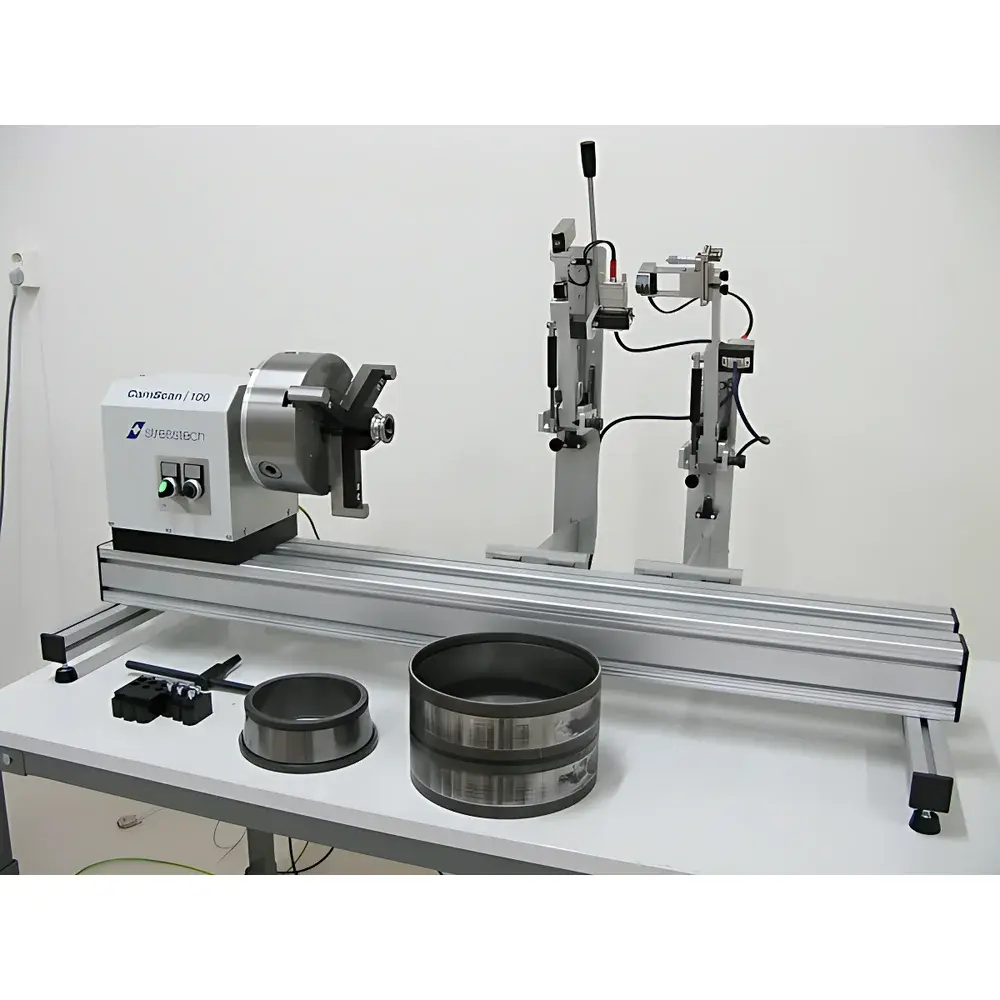
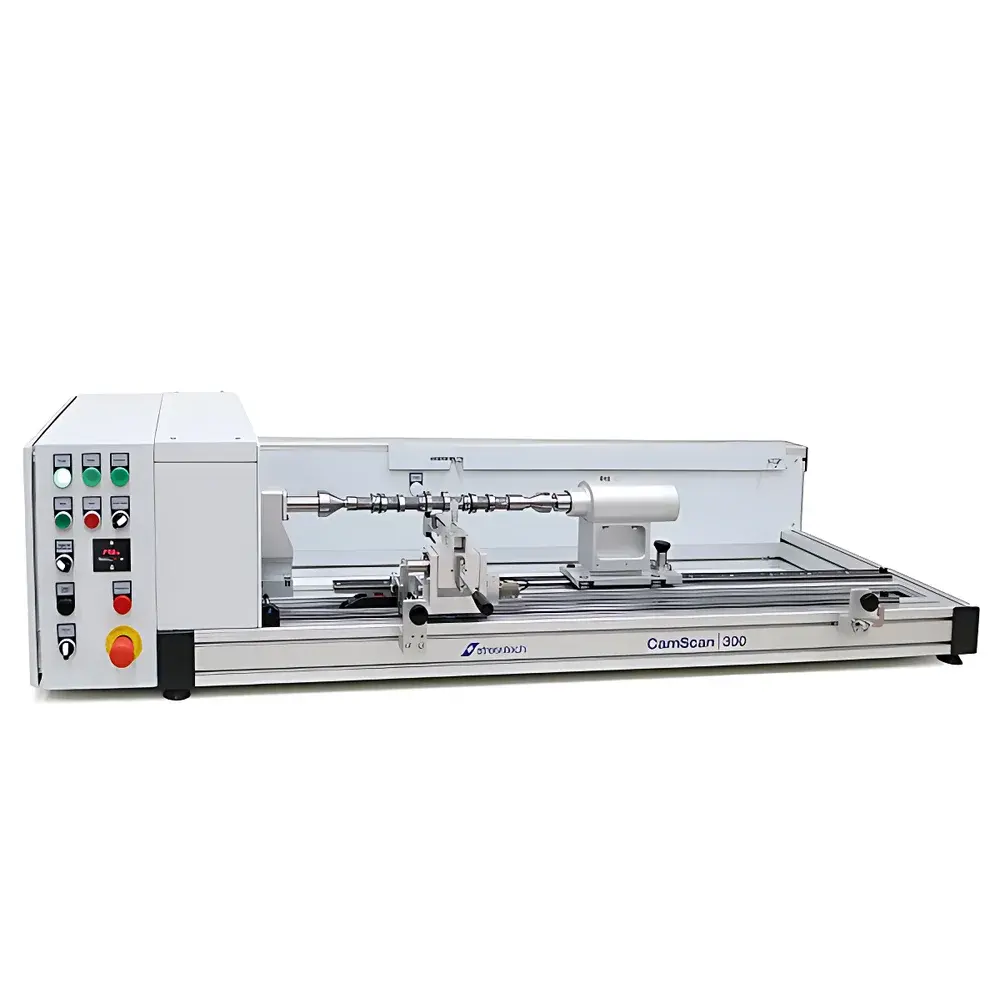
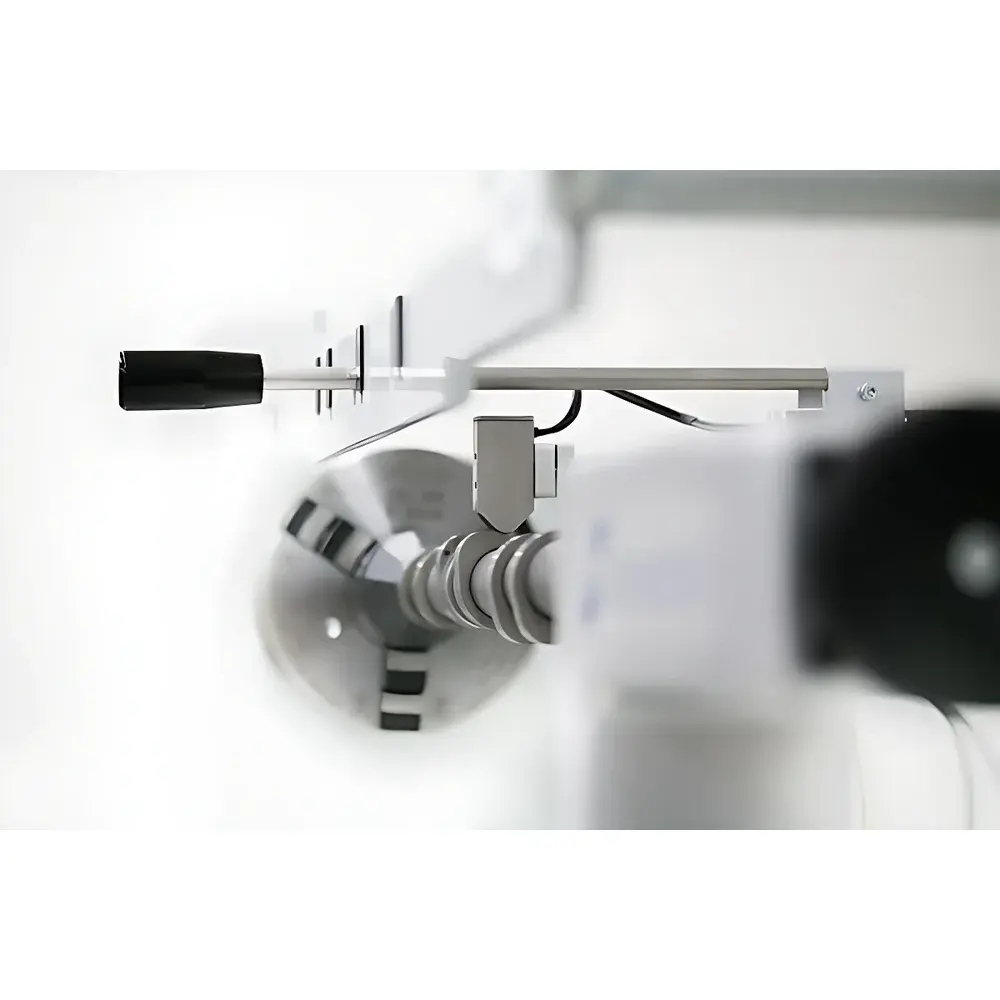
Stresstech Camscan Barkhausen Noise Analyzer for Camshaft Grinding Burn Detection
| Brand | Stresstech Oy |
|---|---|
| Origin | Finland |
| Model | Camscan |
| Power Supply | 90–260 VAC, 49–61 Hz, single-phase |
| Max Inrush Current | 40 A @ 115 VAC / 80 A @ 230 VAC |
| Max Power Consumption (charging) | 150 VA |
| Nominal Power Consumption | ≤100 VA |
| Magnetization Frequency Range | 1.0–1000 Hz |
| Magnetization Voltage | 0–16 V |
| Signal Analysis Bandwidths | 10–70 kHz, 70–200 kHz, 200–450 kHz |
| Channel Configuration | Single-channel (expandable) |
| Probe Compatibility | Interchangeable electromagnetic transducers for cam lobes, journal surfaces, and curved geometries |
Overview
The Stresstech Camscan Barkhausen Noise Analyzer is a precision-engineered, semi-automated non-destructive testing (NDT) system designed specifically for the detection of grinding burns, heat treatment defects, and near-surface microstructural anomalies on camshafts and other rotationally symmetric components. It operates on the physical principle of the Barkhausen effect—where rapid, discontinuous magnetic domain wall jumps in ferromagnetic materials (e.g., hardened steel) generate measurable voltage pulses under controlled AC magnetization. These pulse amplitudes, counts, and spectral distributions correlate directly with residual stress states, hardness gradients, phase transformations (e.g., untempered martensite), and localized plastic deformation induced during aggressive grinding or improper quenching. Unlike destructive metallography or time-consuming acid etching, the Camscan delivers quantitative, repeatable surface integrity assessment in seconds—without surface preparation, material removal, or chemical exposure. Its engineering focus aligns with high-volume automotive powertrain manufacturing, where camshaft reliability directly impacts engine durability, NVH performance, and warranty risk.
Key Features
- Optimized electromagnetic probe architecture for conformal coupling to cam lobe profiles, bearing journals, and tapered shaft sections—minimizing lift-off sensitivity and ensuring consistent signal-to-noise ratio across complex curvatures.
- Multi-bandwidth spectral analysis (10–70 kHz, 70–200 kHz, 200–450 kHz) enables differentiation between subsurface grinding burn (shallow tempering), deep-seated thermal damage, and quench cracking precursors based on frequency-dependent noise energy distribution.
- Programmable magnetization parameters: adjustable frequency (1–1000 Hz) and peak voltage (0–16 V) allow calibration to material grade (e.g., 100Cr6, 5120, EN10084), hardness range (55–65 HRC), and part geometry—ensuring optimal domain excitation without saturation.
- Single-channel base configuration with field-upgradable multi-channel support for inline or multi-zone scanning of camshafts up to 600 mm in length and 120 mm in diameter.
- Real-time pass/fail evaluation via user-defined amplitude thresholds, pulse count limits, and spectral ratio alarms—integrated with visual indicators and digital output triggers for automated sorting systems.
- Rugged industrial enclosure rated IP54; designed for integration into QC cells, heat-treatment lines, or final assembly stations with ambient temperature stability from 5 °C to 40 °C.
Sample Compatibility & Compliance
The Camscan is validated for use on through-hardened and case-hardened ferromagnetic steels commonly employed in camshaft manufacturing—including alloy steels per ISO 683-17 (e.g., 20MnCr5, 16NiCr4), bearing steels per ISO 683-17 (e.g., 100Cr6), and nitrided grades. It complies with EN 1369 (Magnetic Particle Inspection), ASTM E1444/E1444M (Standard Practice for Magnetic Particle Testing), and supports traceability requirements under IATF 16949 and ISO 9001:2015. While not a direct replacement for X-ray diffraction (XRD) stress measurement, its Barkhausen response correlates empirically with near-surface residual stress (±50 MPa resolution) and is widely accepted by OEMs (e.g., Bosch, Mahle, Schaeffler) as a production-grade screening tool per internal specification SAE J2598 and VW 60310.
Software & Data Management
The Camscan is operated via Stresstech’s proprietary WinView software—compatible with Windows 10/11 64-bit platforms. The interface provides synchronized waveform display, real-time spectral waterfall plots, statistical process control (SPC) charts (X̄/R, Cpk), and automated report generation in PDF/CSV formats. All measurement sessions include full audit trail logging: operator ID, timestamp, probe serial number, calibration date, and parameter settings—meeting FDA 21 CFR Part 11 requirements when configured with electronic signatures and role-based access control. Raw data files (.bnd) retain full digitized pulse trains for retrospective re-analysis or third-party algorithm validation.
Applications
- Detection of grinding-induced tempering burns on cam lobes after cylindrical or profile grinding—identifying over-heated zones with reduced hardness and elevated tensile residual stress.
- Verification of quench uniformity in batch or continuous furnaces—flagging under-cooled or delayed-quenched regions prone to retained austenite or soft spots.
- Early-stage crack precursor identification: localized stress concentrations at micro-notches or inclusion clusters manifest as anomalous high-frequency Barkhausen bursts prior to macroscopic crack formation.
- Process validation for new grinding wheel specifications, coolant formulations, or feed rate adjustments—quantifying burn risk before destructive sampling.
- Quality gate enforcement in Tier-1 supplier shipments to OEM engine plants—reducing field failures linked to camshaft fatigue initiation.
FAQ
Does the Camscan require surface preparation prior to inspection?
No—Barkhausen noise analysis is fully non-contact and non-destructive; no cleaning beyond standard oil-free degreasing is required. Surface roughness up to Ra 3.2 µm does not significantly affect signal fidelity.
Can it detect subsurface defects deeper than 100 µm?
The effective penetration depth is material- and frequency-dependent but typically limited to 50–150 µm below the surface. Deeper flaws (e.g., core cracks) fall outside its primary detection envelope and require complementary methods such as ultrasonic testing or eddy current array.
Is calibration traceable to national standards?
Yes—Stresstech provides NIST-traceable calibration certificates for probe sensitivity and system linearity, performed annually using certified reference specimens per ISO/IEC 17025-accredited procedures.
How does it differentiate between grinding burn and decarburization?
Decarburization reduces near-surface carbon content, lowering coercivity and increasing Barkhausen noise amplitude at low frequencies (10–70 kHz); grinding burn elevates dislocation density, broadening the mid-frequency band (70–200 kHz) and suppressing high-frequency components due to domain wall pinning.
What maintenance is required for long-term operational stability?
Annual verification of magnetization coil impedance, probe cable continuity, and analog front-end gain drift is recommended. No consumables or routine recalibration are needed between scheduled service intervals.




