
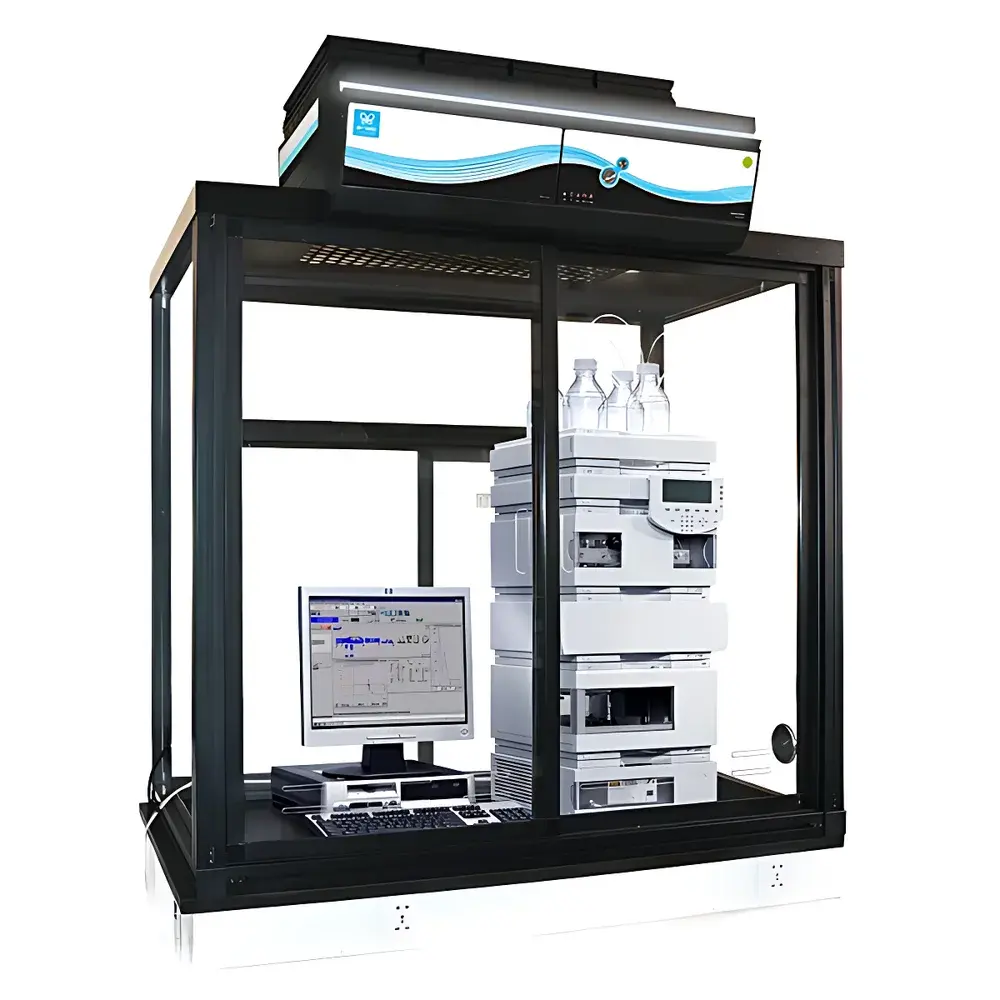
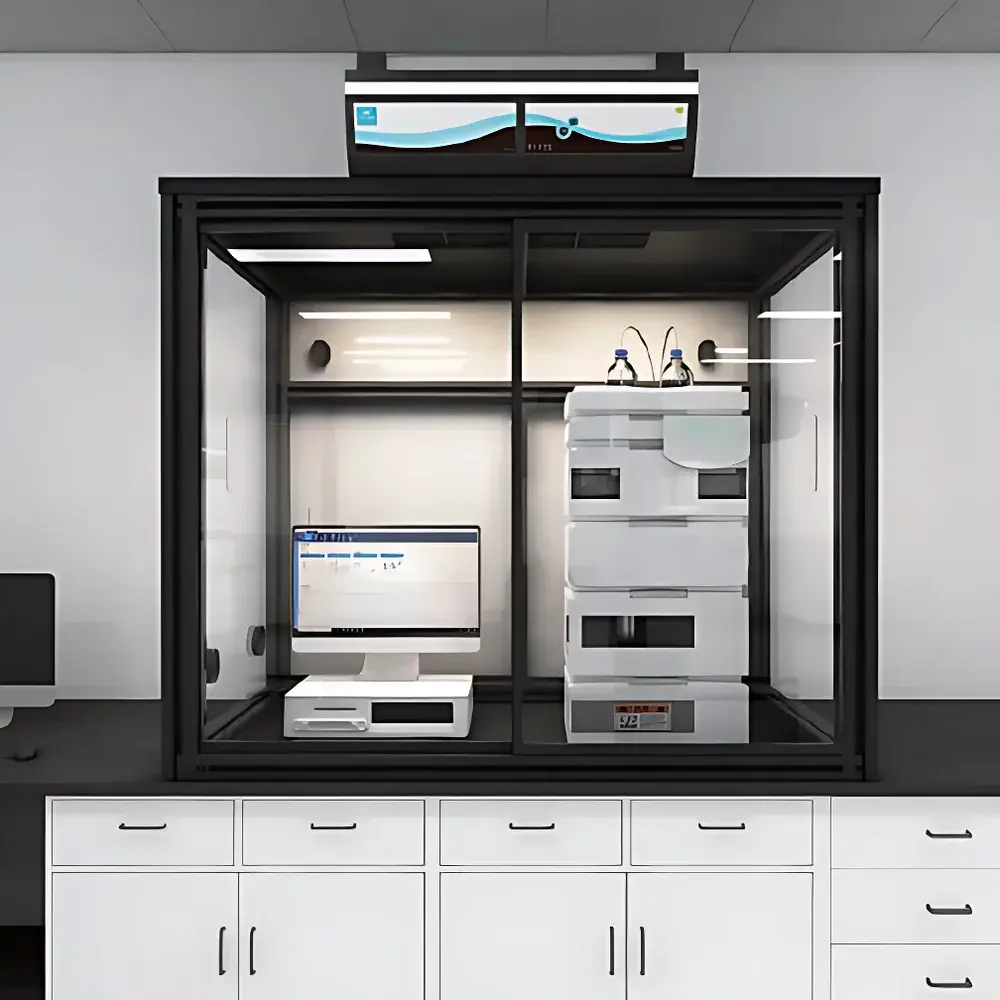
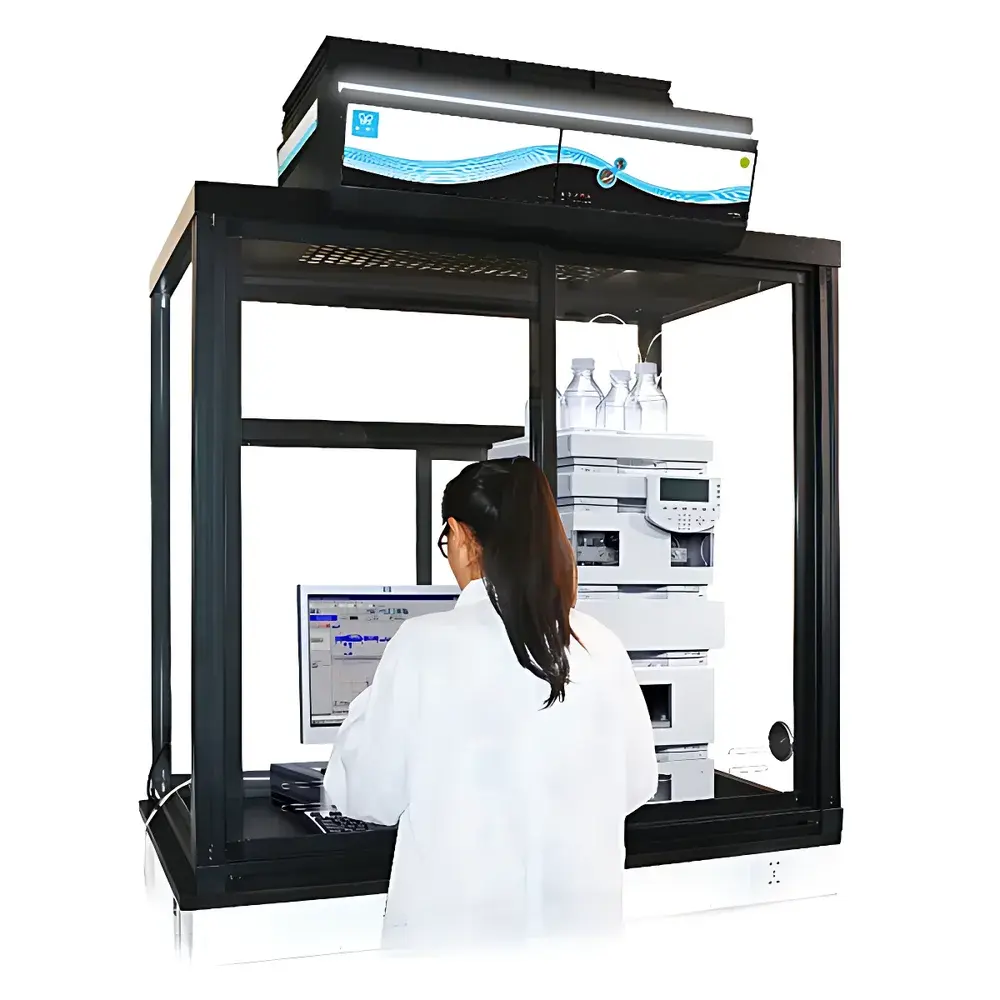
Erlab Custom-Built Instrument Enclosure IE
| Brand | Erlab |
|---|---|
| Origin | Jiangsu, China |
| Manufacturer Type | Authorized Distributor |
| Product Category | Domestic |
| Model | IE (Instrument Enclosure) |
| Price Range | USD 7,000 – 14,000 |
| Cabinet Material | Fully Steel Construction |
| Ventilation Type | Ductless (Filter-Based) |
| Air Intake Method | Supplementary Air Intake (Front-Flow Compensation) |
| Application Domain | Chemical Volatile Handling |
| Exhaust Position | Top-Mounted Exhaust |
| Filtration System | Integrated Dual-Stage Carbon + HEPA Filter Module |
| Airflow Range | 220–880 m³/h |
| Lighting | Energy-Efficient LED (500–600 lux at work surface) |
| User Capacity | 1–2 Operators |
Overview
The Erlab IE (Instrument Enclosure) is a custom-engineered, ductless laboratory safety enclosure designed specifically for the containment and safe operation of automated analytical instruments that emit low-to-moderate concentrations of volatile organic compounds (VOCs), acidic vapors, or particulate byproducts. Unlike conventional fume hoods requiring external ductwork and dedicated HVAC infrastructure, the IE operates on a closed-loop recirculation principle grounded in advanced molecular filtration—leveraging Erlab’s proprietary NanoPure® filter technology. This architecture enables installation flexibility in retrofit labs, modular facilities, or cleanroom-adjacent zones where structural ducting is impractical or cost-prohibitive. The enclosure complies with EN 14175-3 (Laboratory fume cupboards — Part 3: Type testing of ductless fume cupboards) and meets the performance criteria outlined in ANSI/AIHA Z9.5–2022 for non-ducted enclosures used with defined chemical classes.
Key Features
- Fully welded steel chassis with epoxy-powder-coated finish for corrosion resistance and structural integrity under continuous operation.
- Dual-stage filtration system: Pre-filter (G4 class) captures dust and coarse particulates; main stage integrates activated carbon (impregnated with potassium permanganate for aldehydes and amines) and HEPA H14 (99.995% @ 0.1 µm) for submicron aerosols and fine mists.
- Intelligent airflow management via variable-speed EC motor and real-time differential pressure monitoring across filter banks—ensuring consistent face velocity (0.4–0.6 m/s) across the full operational range (220–880 m³/h).
- Supplementary air intake design minimizes room air depletion; draws ambient air from below the sash plane to maintain laminar front-to-back flow without inducing turbulence near instrument interfaces.
- Integrated LED lighting (500–600 lux at 80 cm working height) with glare-free diffuser panels and optional UV-resistant acrylic sash for optical instrument compatibility.
- Modular footprint: Configurable internal dimensions (standard WxDxH: 1200 × 800 × 2100 mm) accommodate common automation platforms including HPLC systems, autosamplers, ICP-MS sample introduction modules, and benchtop FTIR spectrometers.
Sample Compatibility & Compliance
The IE is validated for use with instruments generating emissions within Erlab’s certified chemical compatibility matrix—including acetone, methanol, ethanol, chloroform, acetonitrile, dilute hydrochloric and nitric acids (<10%), and formaldehyde solutions (<1%). It is not intended for perchloric acid, hydrogen fluoride, or radioactive isotopes. All filter replacement cycles are tracked via built-in RFID-tagged cartridges and logged in compliance with GLP audit requirements. The enclosure supports ISO/IEC 17025-accredited laboratories through documented filter efficiency validation reports (per ISO 10121-1 and ISO 16000-23) and includes optional calibration certificates traceable to NIST standards.
Software & Data Management
Equipped with Erlab’s SmartGuard™ control panel (7″ capacitive touchscreen), the IE provides real-time visualization of filter saturation (% remaining life), static pressure drop, airflow stability index, and ambient CO₂ levels. Event logs—including door open duration, filter change timestamps, and alarm history—are exportable as CSV files compliant with FDA 21 CFR Part 11 (electronic signature-ready when paired with enterprise authentication). Remote monitoring via Ethernet or Wi-Fi enables integration into centralized lab infrastructure management systems (LIMS/LabVantage compatible).
Applications
- Encapsulation of liquid chromatography systems (UHPLC/HPLC) during method development involving solvent-rich mobile phases.
- Safe housing of headspace samplers and purge-and-trap concentrators emitting VOCs in environmental testing labs.
- Isolation of mass spectrometer ion sources during maintenance or calibration to prevent cross-contamination in multi-user core facilities.
- Containment of dissolution testers and automated titrators operating with volatile reagents in pharmaceutical QC environments.
- Deployment in university teaching labs where space-constrained instrumentation suites require localized vapor control without building-level ventilation upgrades.
FAQ
What types of instruments are compatible with the IE enclosure?
The IE is engineered for benchtop analytical instruments with defined off-gas profiles—including GC, HPLC, ICP-OES, FTIR, and automated sample prep stations—provided emissions fall within Erlab’s validated chemical compatibility list.
How often must filters be replaced?
Filter service intervals depend on usage intensity and chemical load; typical lifespan ranges from 6–12 months. SmartGuard™ calculates remaining life based on cumulative airflow and real-time adsorption kinetics.
Does the IE require external exhaust ducting?
No. It is a fully self-contained, ductless system relying on recirculated, filtered air—eliminating need for roof penetrations or dedicated exhaust fans.
Can the IE be integrated into an existing LIMS or facility monitoring platform?
Yes. Its embedded Ethernet port supports Modbus TCP and HTTP API protocols for bidirectional data exchange with third-party lab infrastructure software.
Is the IE suitable for GMP-regulated environments?
Yes. With optional 21 CFR Part 11-compliant user access controls, electronic audit trails, and IQ/OQ documentation packages, it meets baseline requirements for pharmaceutical and biotech quality control labs.



