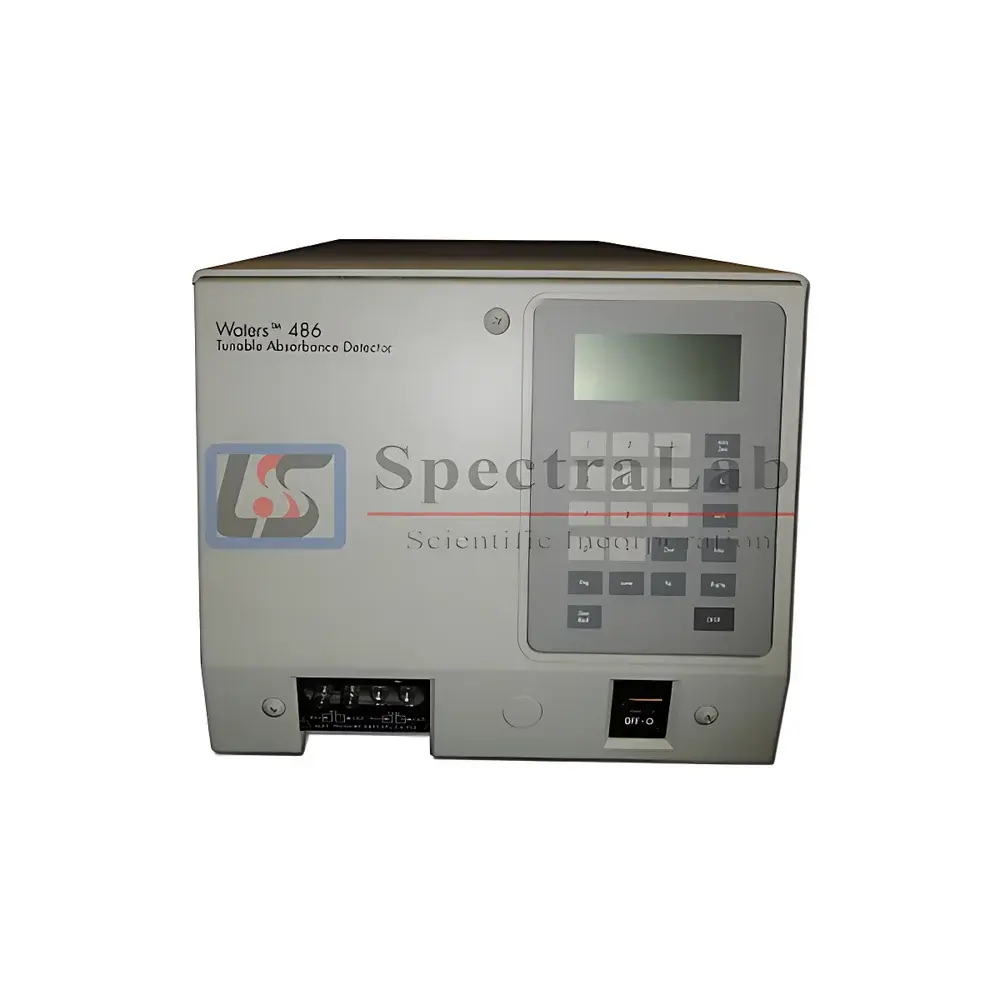
Waters 486 UV-Vis Detector (Refurbished, Pre-Owned)
| Brand | Waters |
|---|---|
| Origin | USA |
| Model | 486 |
| Wavelength Range | 190–380 nm |
| Sensitivity | 0.001 AUFS (Absorbance Units Full Scale) |
| Operational Age | ≥3 years |
| Refurbishment Status | Tested & Verified by SpectraLab Scientific |
| Compliance | Designed to meet legacy ASTM E260 and USP <621> chromatographic detector performance expectations |
Overview
The Waters 486 UV-Vis Detector is a discontinued but widely trusted benchtop ultraviolet-visible absorbance detector engineered for integration into high-performance liquid chromatography (HPLC) systems. Based on dual-beam photometric architecture with a deuterium lamp light source and precision monochromator optics, the 486 delivers stable baseline performance, low electronic noise (< ±0.5 × 10⁻⁵ AU), and minimal baseline drift (< 1.0 × 10⁻⁴ AU/h) under standard operating conditions. Its measurement principle relies on Beer–Lambert law-based quantification of analyte absorbance across a fixed or scanned wavelength range (190–380 nm), enabling reproducible detection of aromatic compounds, conjugated systems, and other chromophores commonly resolved in reversed-phase, ion-exchange, or size-exclusion chromatography. Though no longer manufactured, the 486 remains operationally relevant in academic core facilities, contract testing laboratories, and QC environments where robustness, serviceability, and compatibility with legacy Waters Alliance and Delta systems are prioritized over modern connectivity features.
Key Features
- Dual-beam optical design with real-time reference beam compensation for enhanced signal stability
- Deuterium lamp source with automatic intensity monitoring and end-of-life diagnostics
- Manual and programmable wavelength selection; full spectral scan mode (190–380 nm) with 1 nm resolution
- Interchangeable flow cells (standard 10 mm pathlength, optional 6 mm or microbore configurations) supporting varied flow rates (0.1–10 mL/min) and pressure tolerances up to 6000 psi
- Self-calibrating wavelength verification using internal holmium oxide filter standards
- Battery-backed memory retains method parameters, lamp hours, and calibration history during power loss
- Front-panel keypad interface with LCD display—no external PC required for basic operation
- Standard analog output (0–1 V or 0–10 V) and RS-232 serial interface for integration with third-party data systems
Sample Compatibility & Compliance
The Waters 486 is compatible with standard HPLC mobile phases including aqueous buffers, acetonitrile, methanol, and tetrahydrofuran—provided they are UV-transparent within the operational wavelength window. It supports gradient elution workflows and exhibits linear dynamic range from 0.001 to 2.0 AUFS (verified per ASTM E260-17 Annex A2). While not compliant with FDA 21 CFR Part 11 out-of-the-box due to absence of audit trail or electronic signature capabilities, the detector can be deployed in GLP/GMP-aligned environments when paired with validated data acquisition software (e.g., Empower 2/3, Chromeleon) that provides full traceability, user access controls, and electronic record retention. Its mechanical and optical design conforms to IEC 61010-1 safety standards for laboratory electrical equipment.
Software & Data Management
The 486 operates independently via front-panel controls but communicates with host chromatography data systems (CDS) through RS-232 protocol using ASCII command sets defined in Waters’ original Interface Specification Manual (P/N 71500-01010). It does not support USB, Ethernet, or modern API-based integration. When connected to Empower or OpenLab CDS, detector status (lamp energy, cell temperature, current wavelength) is logged alongside chromatographic data. All calibration events—including wavelength verification and zero-baseline adjustment—are manually documented per laboratory SOPs. SpectraLab Scientific performs pre-shipment functional validation per ISO/IEC 17025-aligned test protocols, including noise/drift assessment, linearity verification, and flow cell integrity check.
Applications
- Pharmaceutical impurity profiling and assay validation per USP and ICH Q2(R2)
- Environmental analysis of PAHs, phenols, and nitroaromatics in water and soil extracts
- Food safety testing for preservatives (e.g., benzoic acid, sorbic acid) and artificial colorants
- Academic teaching labs requiring durable, pedagogically transparent HPLC detection platforms
- Method transfer from legacy Waters systems where detector interchangeability is critical
- Backup or secondary detection channels in multi-detector HPLC setups
FAQ
Is the Waters 486 compatible with modern HPLC systems such as Waters Acquity or Vanquish?
Yes—mechanically and electrically, via analog voltage output or RS-232, though native driver support is limited; configuration requires manual protocol mapping.
Does the unit include a flow cell, lamp, and fuses?
All refurbished units ship with a tested standard flow cell, installed deuterium lamp (with documented remaining lifetime), and complete fuse set.
What documentation accompanies the detector?
Each unit includes a SpectraLab Certificate of Functional Verification, lamp usage log, and copy of the original Waters 486 Operating Manual (P/N 71500-00001).
Can the detector be calibrated for specific pharmacopeial methods?
Yes—wavelength accuracy is verifiable against NIST-traceable holmium oxide filters; absorbance linearity can be confirmed using potassium dichromate solutions per USP .
Is technical support available post-purchase?
SpectraLab provides 30-day email-based troubleshooting assistance and access to archived service bulletins and schematics for authorized repair partners.