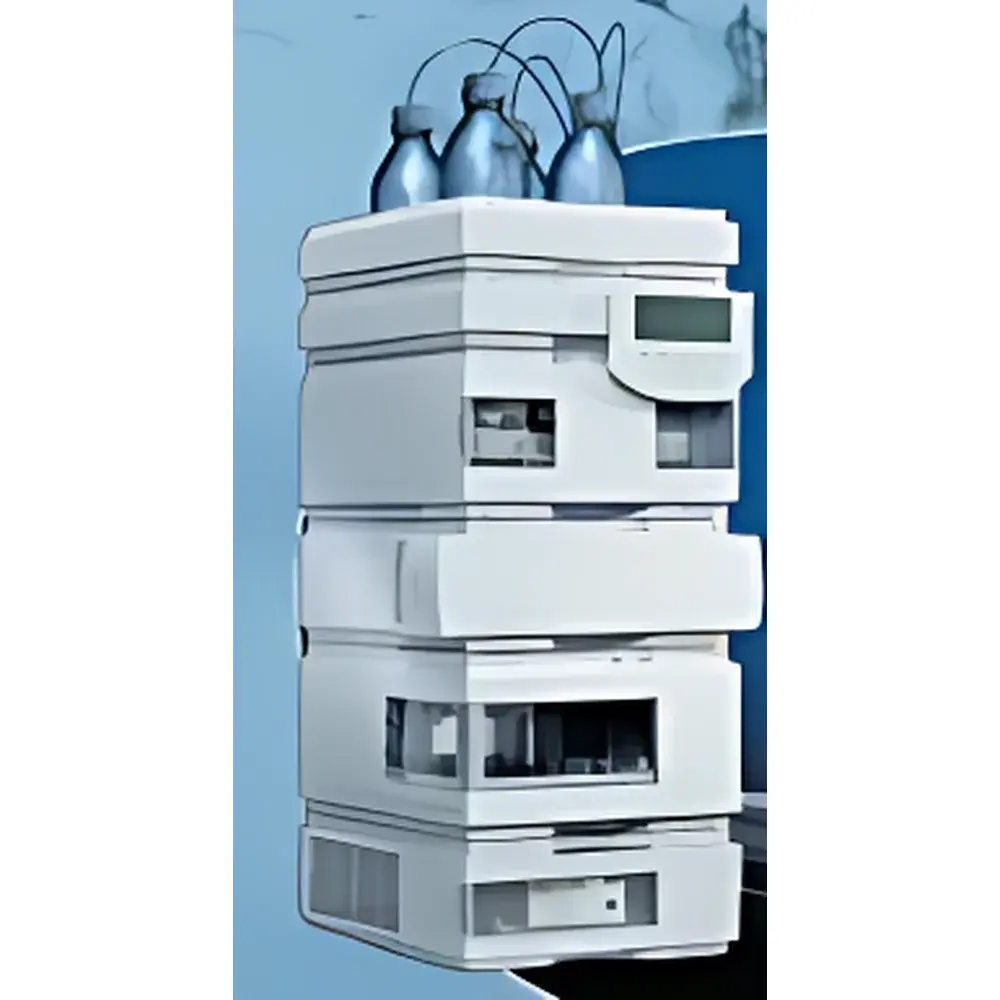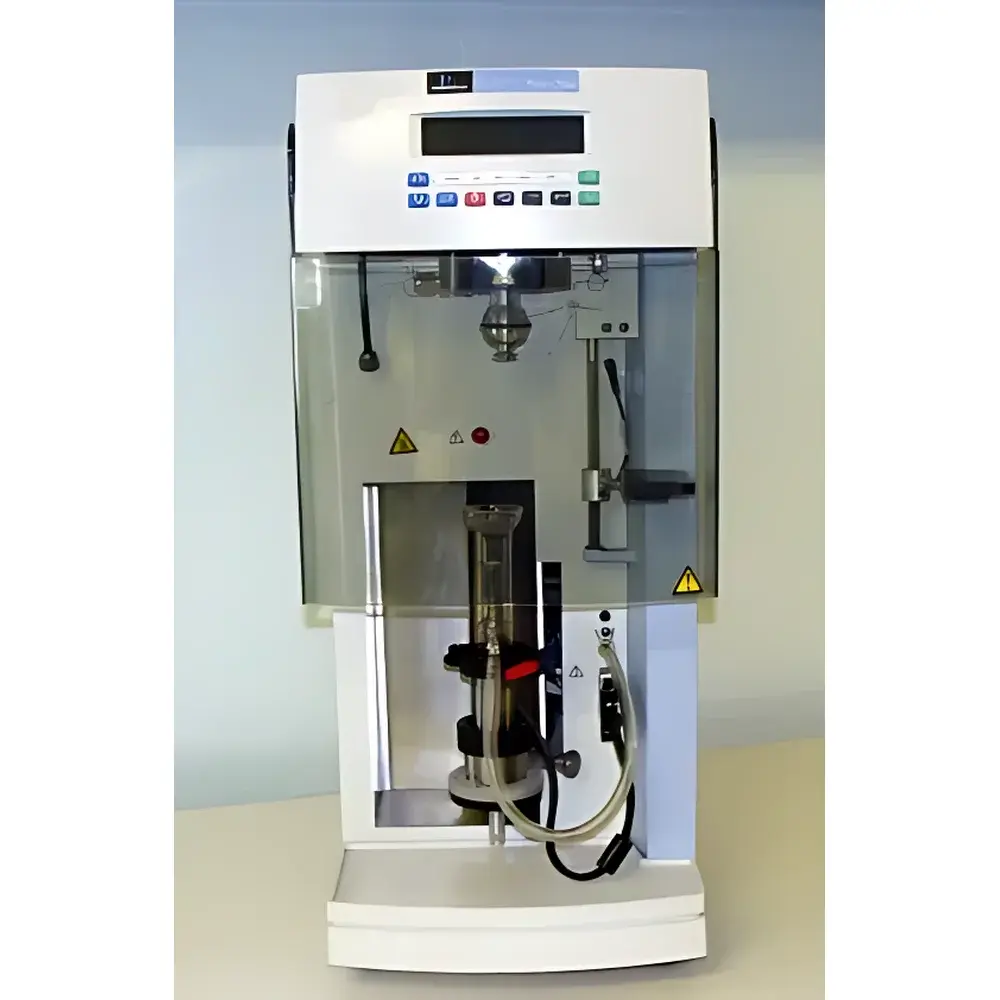
PerkinElmer Pyris 1 Thermogravimetric Analyzer (TGA)
| Brand | PerkinElmer |
|---|---|
| Origin | USA |
| Model | Pyris 1 TGA |
| Balance Sensitivity | 0.1 µg |
| Balance Repeatability | ±2 mg |
| Balance Accuracy | <0.1% |
| Balance Precision | <0.02% |
| Balance Capacity | 1300 mg |
| Weighing Resolution | 10 ppm |
| Sample Capacity | up to 60 µL (standard furnace), up to 250 µL (high-temperature furnace) |
| Temperature Range | RT–1000 °C (standard), 50–1500 °C (high-temp furnace) |
| Heating/Cooling Rate | 0.1–200 °C/min (standard), 0.1–100 °C/min (high-temp) |
| Temperature Accuracy | ±2 °C (standard), ±5 °C (high-temp) |
| Cooling Time | <15 min (1000 °C → 50 °C, standard), <30 min (1500 °C → 100 °C, high-temp) |
| Atmosphere Options | Static/dynamic, N₂, Ar, He, CO₂, air, O₂, or other inert/reactive gases |
| Temperature Sensor | K-type thermocouple (standard), Pt/Rh (10%) thermocouple (high-temp) |
| Heating Element | Pt/30%Rh with PRTD control |
| Cooling Method | Forced-air cooling |
| Sample Form | Solid, liquid, powder, thin film, or fiber |
Overview
The PerkinElmer Pyris 1 Thermogravimetric Analyzer (TGA) is a precision benchtop instrument engineered for quantitative measurement of mass change as a function of temperature or time under controlled atmospheric conditions. Based on the fundamental principle of thermogravimetry—monitoring sample mass loss or gain during thermal treatment—the Pyris 1 delivers high-fidelity data for decomposition kinetics, moisture/volatile content analysis, oxidative stability assessment, and compositional quantification in polymers, pharmaceuticals, ceramics, metals, and geological materials. Its core architecture integrates a vertically oriented ultra-microbalance (0.1 µg sensitivity) mounted above a low-thermal-mass furnace, eliminating thermal coupling between weighing and heating zones—a design feature critical for baseline stability and long-term drift minimization. The system supports both standard (RT–1000 °C) and high-temperature (50–1500 °C) furnace configurations, enabling compliance with ASTM E1131, ISO 11358, and USP guidelines for thermal analysis.
Key Features
- Ultra-high-sensitivity microbalance with 0.1 µg detection limit and 10 ppm weighing resolution, ensuring reliable quantification of sub-milligram weight changes.
- Wide dynamic weighing range up to 1300 mg, accommodating both trace volatiles analysis and bulk material characterization without saturation risk.
- Thermally isolated vertical configuration: balance positioned above furnace, minimizing thermal interference and enhancing linearity and reproducibility.
- Fast thermal response enabled by low-heat-capacity furnace design—linear heating rates up to 200 °C/min (standard) and precise isothermal hold stability (<0.2 °C overshoot at 100 °C/min).
- Integrated forced-air cooling system achieving <15-minute cooldown from 1000 °C to 50 °C (standard furnace), significantly increasing throughput for multi-sample screening.
- Modular atmosphere control supporting static, dynamic, oxidizing, inert, or reactive gas environments—including optional Gas Switching Assembly (GSA) for automated, sequential gas purging during single-run experiments.
- Reduced-pressure capability down to 10⁻⁴ Torr, facilitating studies of low-volatility compounds or vacuum-assisted pyrolysis.
Sample Compatibility & Compliance
The Pyris 1 accepts diverse sample forms—including solids, powders, liquids, thin films, and fibers—within standard alumina or platinum crucibles (60 µL capacity, standard furnace; 250 µL, high-temp furnace). Its robust mechanical design ensures stable operation in non-laboratory environments (e.g., QC labs, pilot plants), without requiring vibration-isolation tables. All thermal calibrations are traceable to NIST-certified standards using Curie-point reference materials, satisfying GLP/GMP documentation requirements. The instrument meets essential regulatory expectations for data integrity: full audit trail support via Pyris software, electronic signature compatibility, and adherence to FDA 21 CFR Part 11 principles when deployed with validated software configurations.
Software & Data Management
Controlled entirely through PerkinElmer’s Pyris™ Thermal Analysis Software, the Pyris 1 enables fully automated experiment execution—including ramp, hold, and multi-step temperature programs—with real-time mass vs. temperature/time plotting. Key software capabilities include automatic zeroing and tare compensation, programmable baseline correction, derivative (DTG) curve generation, and multi-curve overlay for comparative analysis. Data processing functions encompass normalization to initial mass, onset temperature determination (tangent/intersection methods), residual mass calculation, and kinetic modeling (e.g., Flynn-Wall-Ozawa). Raw and processed data are exportable in ASCII, CSV, or universal .tdf formats, compatible with third-party statistical or modeling platforms. Archiving follows hierarchical folder structures with timestamped metadata, supporting long-term data retention per ISO/IEC 17025 clause 7.5.2.
Applications
- Pharmaceutical: Quantification of residual solvents (ICH Q3C), hydrate/dehydrate transitions, excipient compatibility screening, and thermal stability profiling of active pharmaceutical ingredients (APIs).
- Polymers & Composites: Determination of filler content, degradation onset temperature, char yield, and oxidative induction time (OIT) under air/N₂.
- Energy Materials: Characterization of battery electrode materials, catalyst thermal stability, and carbon black burn-off in rubber formulations.
- Geological & Ceramics: Decomposition behavior of carbonates, clays, and refractory oxides; sintering profile development.
- Metals & Alloys: Oxidation kinetics, coating integrity evaluation, and impurity volatilization studies.
FAQ
Is this unit refurbished or used—and what verification has been performed?
This Pyris 1 TGA is a pre-owned instrument with verified operational history (3–4 years of prior use). It underwent full functional validation at SpectraLab Scientific, including balance calibration, furnace temperature profiling, gas flow verification, and software communication diagnostics. A comprehensive test report is available upon request.
What warranty and post-purchase support does it include?
The instrument carries a 6-month limited hardware warranty covering defects in materials and workmanship. Technical support—including remote troubleshooting and application guidance—is provided for the duration of the warranty period.
Can the system be upgraded to meet current regulatory requirements (e.g., 21 CFR Part 11)?
Yes. When paired with a validated Pyris software installation on a compliant Windows OS platform—including user access controls, electronic signatures, and audit trail activation—the system can support regulated environments. Validation documentation templates are available upon consultation.
Are original accessories and calibration standards included?
Yes. The package includes the TGA accessory kit with certified metal calibration standards, Pyris software license (with security key), dedicated control PC, and optional autosampler (if selected). All components were verified during pre-shipment testing.
Does the system support inert gas purging during cooling phases?
Yes. The integrated mass flow controller allows continuous or programmable gas flow throughout the entire thermal cycle—including cooling—ensuring consistent atmosphere control and preventing oxidative artifacts during low-temperature stabilization.