
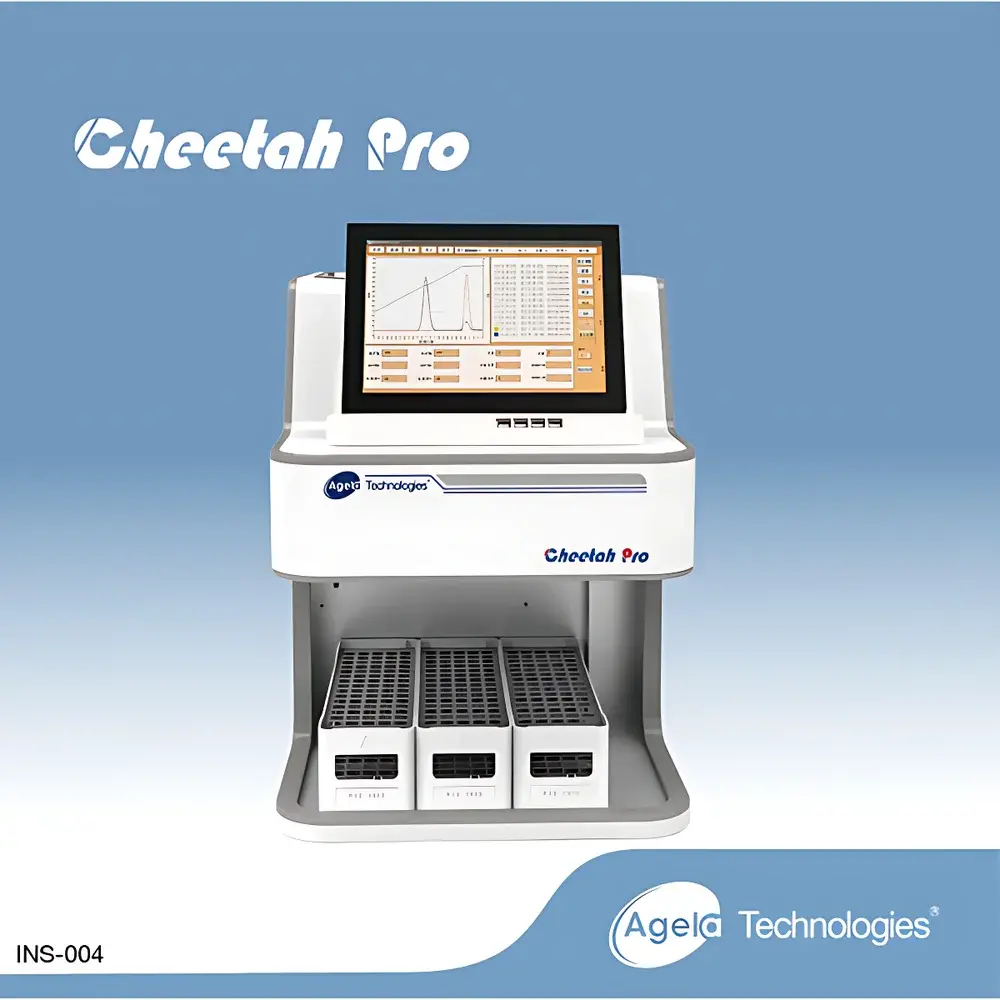
Agela CHEETAH Pro CH-200PII Medium-Pressure Preparative Liquid Chromatography System
| Brand | Agela |
|---|---|
| Origin | Tianjin, China |
| Model | CHEETAH Pro CH-200PII |
| Application Level | Laboratory Grade |
| Instrument Type | Medium-to-Low Pressure Preparative LC System |
| Flow Rate Range | 1–200 mL/min |
| Maximum Operating Pressure | 200 psi (1.38 MPa) |
| UV Detection Wavelength Range | 200–600 nm |
| Gradient Capability | Binary Gradient |
| Column Compatibility | Normal- and Reversed-Phase Flash Columns (4–800 g), Max Sample Load: 80 g |
| Fraction Collection Modes | Full Collection, Peak-Based Collection, Manual Trigger, Time-Window Collection |
| Real-Time Tube Mapping | Color-Coded Fraction Tube Assignment per Peak |
| Optional Air-Purge Module | Integrated Air Pump for Manual/Automatic Flash Column Purging (CH-200PII-Air Variant) |
Overview
The Agela CHEETAH Pro CH-200PII is a medium-pressure preparative liquid chromatography (PLC) system engineered for reproducible, scalable purification of organic compounds, natural products, and synthetic intermediates in academic, pharmaceutical, and contract research laboratory environments. Built upon a robust industrial PC-based control architecture, the system operates under laminar flow conditions governed by Darcy’s law and optimized for flash chromatography applications—leveraging both normal-phase (e.g., silica, alumina) and reversed-phase (e.g., C18, C8) stationary phases. Its 200 psi pressure rating enables efficient elution across a broad range of solvent viscosities without compromising column integrity or resolution, while the integrated UV-Vis detector (200–600 nm) supports real-time monitoring of chromophore-containing analytes with high baseline stability and low noise (< ±0.5 mAU). The system adheres to fundamental chromatographic principles including retention time predictability, linear velocity optimization, and mass-transfer-limited separation efficiency—making it suitable for method development, process validation support, and early-stage compound isolation.
Key Features
- Industrial PC control platform with intuitive graphical user interface (GUI), enabling full system orchestration—including pump, detector, fraction collector, and optional air-purge module—from a single workstation.
- Black conductive tubing throughout fluidic path to minimize electrostatic charge accumulation and prevent solvent vapor ignition hazards in volatile organic solvent environments.
- Binary gradient capability with programmable slope and step profiles; gradient editing supported both online (during run) and offline via drag-and-drop point insertion in method editor.
- Four independent fraction collection modes: full-collection (all effluent), peak-triggered (based on UV threshold crossing), manual trigger (operator-initiated), and time-window collection (user-defined start/stop times per fraction).
- Real-time color-coded tube mapping: each detected peak is automatically assigned a unique color identifier synchronized with physical collection tubes—enabling rapid visual correlation between chromatogram and fractions without post-run re-annotation.
- Optional CH-200PII-Air configuration includes an integrated oil-free air pump module capable of delivering regulated purge gas (N₂ or compressed air) at adjustable flow rates for active flash column drying post-elution—a critical step in solvent removal prior to downstream analysis or formulation.
Sample Compatibility & Compliance
The CHEETAH Pro CH-200PII accommodates standard commercial flash columns ranging from 4 g to 800 g capacity, supporting both packed silica and polymer-based reversed-phase media. Maximum sample loading is validated up to 80 g per run under optimized flow and gradient conditions—ensuring linearity in recovery and minimal band broadening. All wetted components are chemically resistant to common chromatographic solvents (e.g., hexane, ethyl acetate, methanol, acetonitrile, water, and mixtures thereof). The system design conforms to general laboratory safety standards for low-energy instrumentation (IEC 61010-1), and its software architecture supports audit-trail generation and user-access controls required for GLP-compliant workflows. While not FDA 21 CFR Part 11–certified out-of-the-box, the system can be configured with supplementary documentation and procedural controls to meet internal QA/QC requirements for non-GMP purification tasks.
Software & Data Management
Control and data acquisition are managed through Agela’s proprietary CHEETAH Software v3.x, which runs natively on Windows OS platforms. The software provides real-time chromatogram display with adjustable scaling, baseline correction algorithms, peak integration using tangent skim and valley-to-valley methods, and export of raw data in ASCII (.txt) and universal chromatography formats (.cdf). Method files are stored with metadata including date/time stamp, operator ID, instrument serial number, and version-controlled parameters. All user actions—including method edits, fraction triggers, and purge activation—are logged in a tamper-resistant event log. Data backups may be scheduled automatically to network drives or external storage media, and raw datasets comply with FAIR (Findable, Accessible, Interoperable, Reusable) principles when archived with appropriate metadata tagging.
Applications
- Purification of reaction mixtures following organic synthesis (e.g., Suzuki couplings, amide bond formations, heterocycle cyclizations).
- Isolation of bioactive constituents from plant extracts and fermentation broths.
- Desalting and buffer exchange of peptides and small proteins prior to MS analysis.
- Removal of catalysts, ligands, or excess reagents in asymmetric catalysis workflows.
- Preparative-scale separation of diastereomers and regioisomers where HPLC resolution is insufficient but crystallization fails.
- Supporting analytical method transfer by generating purified reference standards for calibration and verification.
FAQ
What column formats and sizes are compatible with the CHEETAH Pro CH-200PII?
The system supports standard disposable flash cartridges (e.g., GraceResolv, Biotage KP-Sil, ISCO RediSep) from 4 g to 800 g, as well as custom-packed glass or stainless-steel columns with 10–50 mm internal diameter.
Does the system support gradient delay volume compensation?
Yes—gradient dwell volume is configurable in the method editor and can be calibrated empirically using step-gradient tests to ensure accurate retention time reproducibility across method transfers.
Can I integrate third-party detectors (e.g., ELSD, MS) with this system?
The CH-200PII features analog output (0–1 V DC) and TTL-compatible digital I/O ports, enabling synchronization with external detectors; however, full bidirectional communication requires custom scripting or middleware integration.
Is the air-purge function available on all configurations?
No—the air-purge module is exclusive to the CH-200PII-Air variant; standard CH-200PII units do not include the integrated air pump or associated gas-handling hardware.
How is data integrity ensured during long-duration purification runs?
Continuous data streaming to local SSD storage, automatic periodic save points, and dual-buffer acquisition architecture prevent data loss even during unexpected power interruptions or software restarts.




