
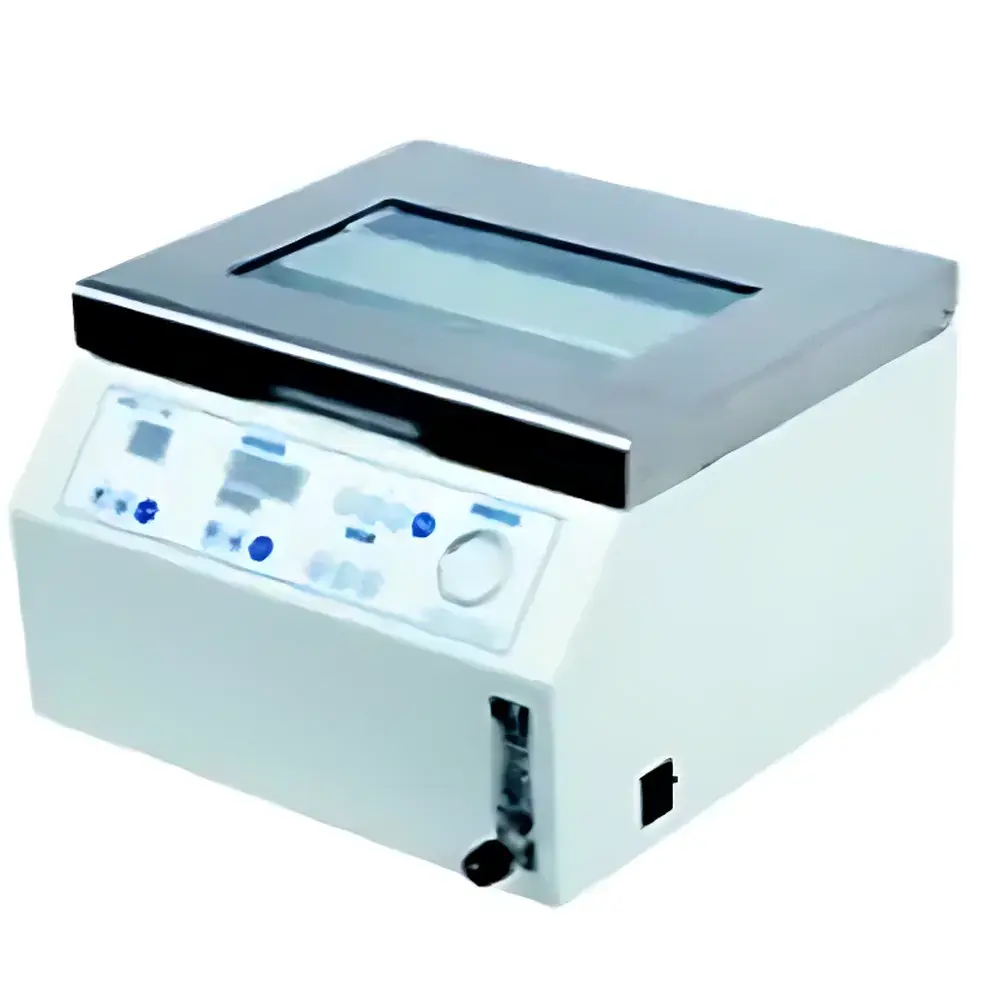
Agela NV24A-II Automated Nitrogen Evaporator
| Brand | Agela |
|---|---|
| Origin | Tianjin, China |
| Model | NV24A-II |
| Sample Capacity | 24 positions |
| Heating Method | Dry-block heating (PTC) |
| Temperature Control | Programmable range with ±0.5 °C stability |
| Endpoint Detection | Optical fiber sensor for precise volume termination at 0.5 mL or 1.0 mL |
| Gas Flow Control | Independent per-channel on/off switching and real-time digital display of flow/pressure |
| Integrated Exhaust | Built-in active exhaust system for volatile organic compound (VOC) removal |
| Compliance | Designed for GLP-compliant laboratories |
Overview
The Agela NV24A-II Automated Nitrogen Evaporator is an engineered solution for high-throughput, reproducible solvent removal in analytical sample preparation workflows. Based on controlled nitrogen gas stream impingement combined with precise dry-block thermal regulation, the system enables parallel concentration of up to 24 samples under consistent, traceable conditions. Unlike water-bath-based evaporators, the NV24A-II employs PTC (Positive Temperature Coefficient) ceramic heating elements embedded in an aluminum block—delivering rapid thermal response, uniform temperature distribution across all positions, and zero risk of cross-contamination from bath media. Its closed-loop endpoint detection relies on optical fiber sensors calibrated to detect meniscus-level changes, triggering automatic shutdown and audible/visual alerts when target volumes (0.5 mL or 1.0 mL) are reached. This eliminates operator-dependent timing errors and ensures inter-run consistency critical for regulated environments such as pharmaceutical QC, environmental residue analysis, and forensic toxicology.
Key Features
- 24-position parallel processing with individual channel activation—enabling selective evaporation without interrupting ongoing runs.
- Digital mass-flow monitoring and pressure feedback for each gas line, displayed in real time on the front-panel interface.
- Optical fiber–based endpoint sensing with sub-milliliter resolution, validated against gravimetric reference standards per ASTM D7097-22 Annex A1.
- PTC dry-block heater delivering stable temperature control within ±0.5 °C across the full operating range (ambient +5 °C to 100 °C), with programmable ramp/soak profiles.
- Integrated active exhaust manifold connected to external fume hood ducting or recirculating filtration systems—designed to capture and remove volatile solvents (e.g., hexane, ethyl acetate, acetonitrile) and low-boiling analytes.
- Non-corrosive stainless-steel gas manifolds and chemically resistant aluminum heating block—compatible with common extraction solvents per ISO 17034 certified reference material handling protocols.
Sample Compatibility & Compliance
The NV24A-II accommodates standard 12–18 mm OD round-bottom and conical-bottom test tubes, GC vials (1.5–4 mL), and custom-format microcentrifuge tubes (0.5–2 mL). Its modular gas nozzle design allows vertical alignment adjustment to match varying tube heights, minimizing vortex formation and splashing. All wetted materials comply with USP Class VI biocompatibility requirements. The instrument’s operational log—including start/stop timestamps, final volume confirmation, temperature setpoints, and gas flow history—is stored internally with optional export via USB for audit trail generation. It supports 21 CFR Part 11–compliant data integrity practices when integrated with LIMS or ELN platforms via RS-232 or optional Ethernet module.
Software & Data Management
While the NV24A-II operates autonomously via its embedded microcontroller interface, it provides ASCII-formatted log files (.csv) exportable to laboratory information management systems (LIMS) or electronic lab notebooks (ELN). Each run generates a unique identifier linked to date/time stamp, user ID (if configured), sample position map, and endpoint validation status. No proprietary software installation is required; raw logs are human-readable and compatible with Python/Pandas or MATLAB-based post-processing pipelines used in method validation studies. Audit trails meet ISO/IEC 17025 clause 7.11.2 requirements for result traceability and change control.
Applications
- Residue analysis: Pre-concentration of pesticide extracts (EN 15662, AOAC 2007.01) prior to GC-MS or LC-MS/MS injection.
- Pharmaceutical impurity profiling: Solvent exchange and volume reduction of forced degradation samples per ICH Q5C guidelines.
- Environmental testing: EPA Methods 508.1, 525.3, and 8081B sample cleanup workflows requiring precise final volumes.
- Forensic toxicology: Concentration of urine or blood extracts following solid-phase extraction (SPE) for amphetamine, opioid, or cannabinoid screening.
- Food safety: Mycotoxin quantification (e.g., aflatoxins, ochratoxin A) per EU Commission Regulation (EC) No 401/2006 Annex I.
FAQ
Is the NV24A-II compatible with corrosive solvents such as hydrochloric acid or trifluoroacetic acid (TFA)?
No—while the gas manifolds and heating block resist common organic solvents, prolonged exposure to strong mineral acids or halogenated acids may degrade seals and optical sensors. Use only with solvents listed in the operator manual.
Can the endpoint detection be calibrated by the user?
Yes—calibration is performed using certified volumetric standards (e.g., NIST-traceable 0.5 mL and 1.0 mL glass syringes) via the service menu; calibration records are saved with timestamp and operator ID.
Does the system support remote monitoring or integration with automation arms?
It includes dry-contact relay outputs for “run complete” and “alarm active” signals, enabling synchronization with robotic liquid handlers (e.g., Hamilton STAR, Tecan Freedom EVO) via TTL or 24 VDC triggers.
What maintenance intervals are recommended for long-term reliability?
Optical sensor windows require cleaning every 200 runs with lint-free wipes and isopropanol; PTC heater performance should be verified annually using a calibrated thermocouple probe per ISO/IEC 17025 internal verification procedures.



