
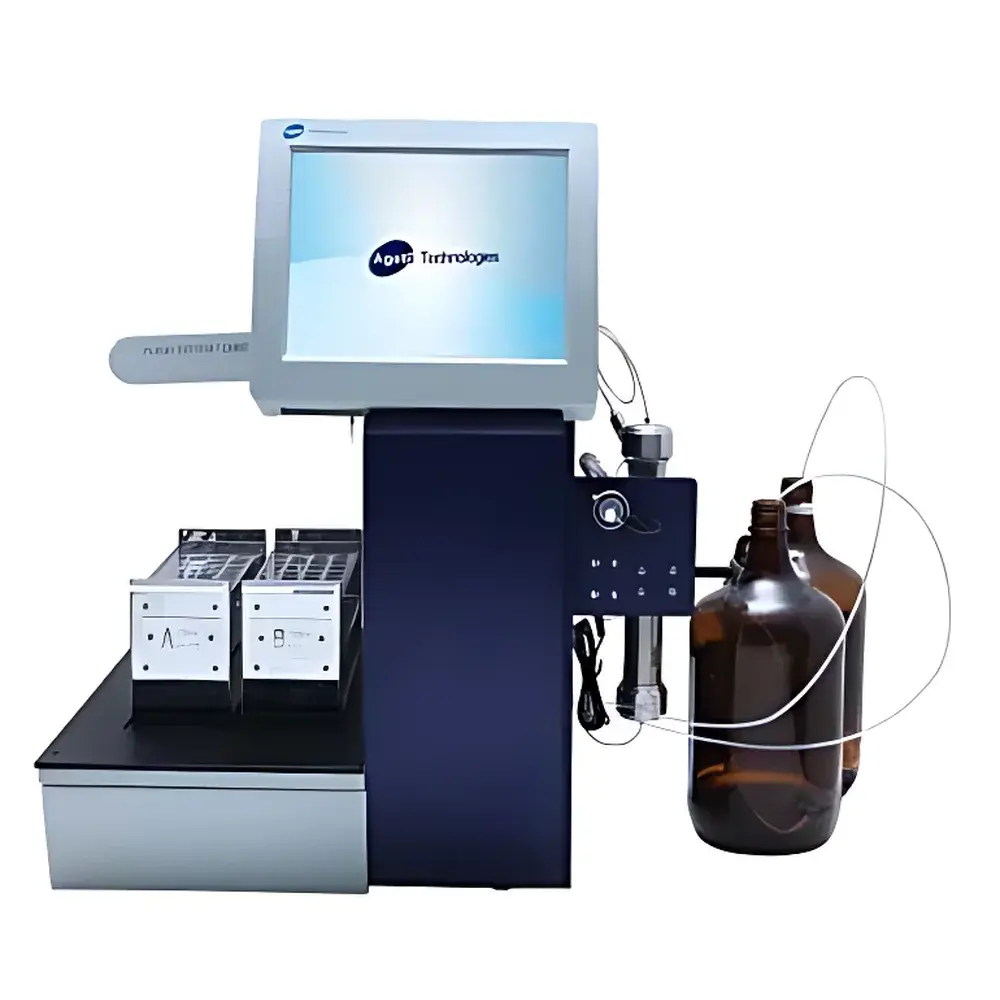
CHEETAH HP Series High-Performance Preparative Liquid Chromatography System
| Brand | Agela |
|---|---|
| Origin | Tianjin, China |
| Manufacturer Type | Authorized Distributor |
| Product Category | Domestic |
| Model | HS-1000 |
| Instrument Type | Fast Liquid Chromatography System |
| Flow Rate Range | 0.1–100.0 mL/min (0.1 mL/min increment) |
| Maximum Operating Pressure | ≤20 MPa |
| Fraction Collection Options | F1–F4 standard tube racks (13 mm, 15 mm, 18 mm, 25 mm OD), F5 conical flask rack (up to 100 mL |
| Sample Injection Volume Range | up to 1 L |
| Temperature Control | Ambient only |
| Wavelength Range | Dual-channel UV-Vis detection at 200–400 nm and 200–800 nm (simultaneously selectable) |
| Data Acquisition Rate | Not specified |
Overview
The CHEETAH HP Series High-Performance Preparative Liquid Chromatography System (Model HS-1000) is an integrated, software-controlled preparative-scale chromatographic platform engineered for high-throughput purification of organic compounds, natural products, pharmaceutical intermediates, and synthetic peptides. Unlike conventional high-pressure preparative systems that rely on external fraction collection or manual intervention, the CHEETAH HP integrates a dual-pump binary high-pressure gradient delivery system, dual-wavelength UV-Vis detection, and intelligent fraction collection into a single unified architecture. Its operational principle is based on reversed-phase or normal-phase liquid chromatography under elevated pressure (≤20 MPa), enabling efficient separation across a wide polarity range. The system employs a robust cam-profile flow compensation algorithm and multi-point flow calibration to ensure consistent volumetric accuracy across the full 0.1–100.0 mL/min range — critical for reproducible method transfer from analytical to preparative scale.
Key Features
- Dual high-pressure parallel pumping system with real-time gradient mixing, minimizing pressure pulsation and ensuring superior gradient reproducibility for scalable method development.
- Dual-wavelength UV-Vis detector with independent optical paths operating simultaneously at 200–400 nm and 200–800 nm — enabling concurrent monitoring of chromophores with disparate absorption maxima in a single injection.
- Intelligent fraction collection logic supporting peak-triggered, slope-based, time-window, and full-run collection modes — programmable via intuitive graphical interface.
- Modular sample introduction options: VICI manual loop valve, Rheodyne 3725i high-capacity valve, or optional preparative-scale autosampler (compatible with 1 mL–1 L injection volumes).
- Pump architecture features floating plunger design and chemically resistant sealing materials, validated for compatibility with aggressive solvents including hexane, chloroform, THF, acetonitrile, and methanol/water mixtures.
- Optimized optical and fluidic path design delivers low baseline noise (<±0.5 mAU) and high signal-to-noise ratio, essential for accurate peak integration and threshold-based fraction triggering.
Sample Compatibility & Compliance
The CHEETAH HP HS-1000 supports a broad spectrum of sample matrices, including crude reaction mixtures, botanical extracts, fermentation broths, and formulated APIs. Its column compatibility spans standard stainless-steel preparative columns (10–50 mm ID) and custom-packed glass or PEEK-bodied columns up to 100 mm ID. All wetted parts comply with USP Class VI and ISO 10993 biocompatibility standards. The system architecture adheres to GLP-relevant design principles: audit-trail-enabled software (optional 21 CFR Part 11 compliance package available), electronic signature support, and full method/version logging. While ambient temperature operation limits thermal control, the system meets ASTM D7093 and ISO 17025 requirements for method validation when operated within defined solvent and flow stability parameters.
Software & Data Management
Control and data acquisition are managed through Agela’s proprietary CHEETAH Control Suite — a Windows-based application supporting method creation, real-time chromatogram visualization, automated fraction mapping, and export of raw data in open ASCII/CSV formats. The software implements configurable event triggers (e.g., absorbance threshold, derivative slope, retention window), automatic vial position tracking, and post-run report generation with integral summary statistics (retention time, peak area, fraction mass balance). Data integrity safeguards include user-level access control, timestamped method changes, and encrypted local database storage. Export modules support LIMS integration via ASTM E1384-compliant file structures.
Applications
- Purification of synthetic small molecules during lead optimization and process R&D.
- Isolation of bioactive constituents from plant and marine extracts for structure-activity relationship studies.
- Desalting and buffer exchange of peptides and oligonucleotides prior to MS analysis.
- Recycling of chiral stationary phase columns in enantiomeric separations.
- Preparative-scale removal of catalyst residues or unreacted starting materials in API synthesis.
- Method scouting and gradient optimization for downstream scale-up to industrial chromatography systems.
FAQ
Does the CHEETAH HP HS-1000 support temperature-controlled column compartments?
No — the system operates at ambient temperature only. Column oven integration is not supported in this configuration.
Can the dual-wavelength detector output two independent chromatograms simultaneously?
Yes — both channels generate synchronized, time-aligned chromatograms with independent gain and filter settings, exportable as separate data streams.
Is the system compatible with ELSD or RI detection?
Yes — optional evaporative light-scattering (ELSD) and refractive index (RI) detectors can be interfaced via analog voltage input and external trigger synchronization.
What is the maximum recommended column backpressure for long-term pump reliability?
For optimal seal life and gradient fidelity, sustained operation above 18 MPa is discouraged; system pressure regulation maintains dynamic stability within ±0.2 MPa of setpoint.
How is method reproducibility verified across multiple operators?
Built-in flow calibration routines, wavelength accuracy verification using holmium oxide filters, and standardized test mix injections enable routine performance qualification per ICH Q2(R2) guidelines.





