
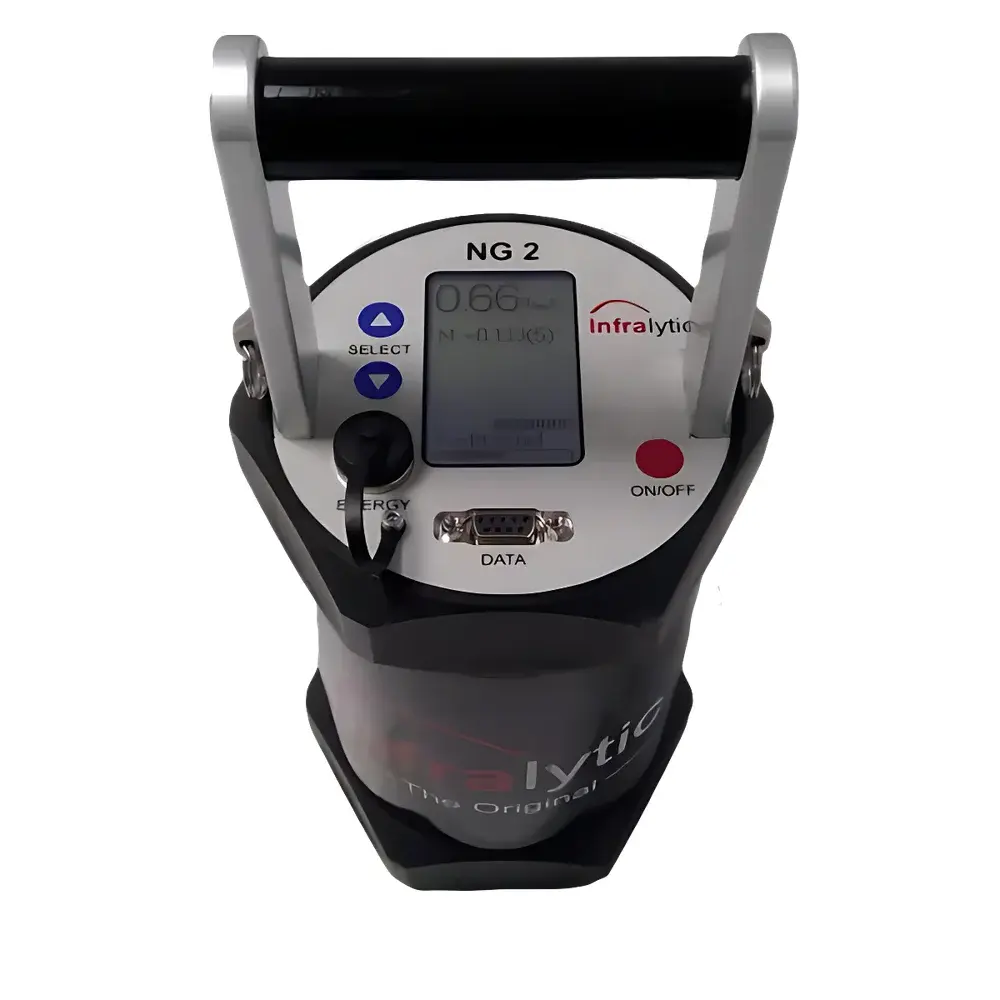
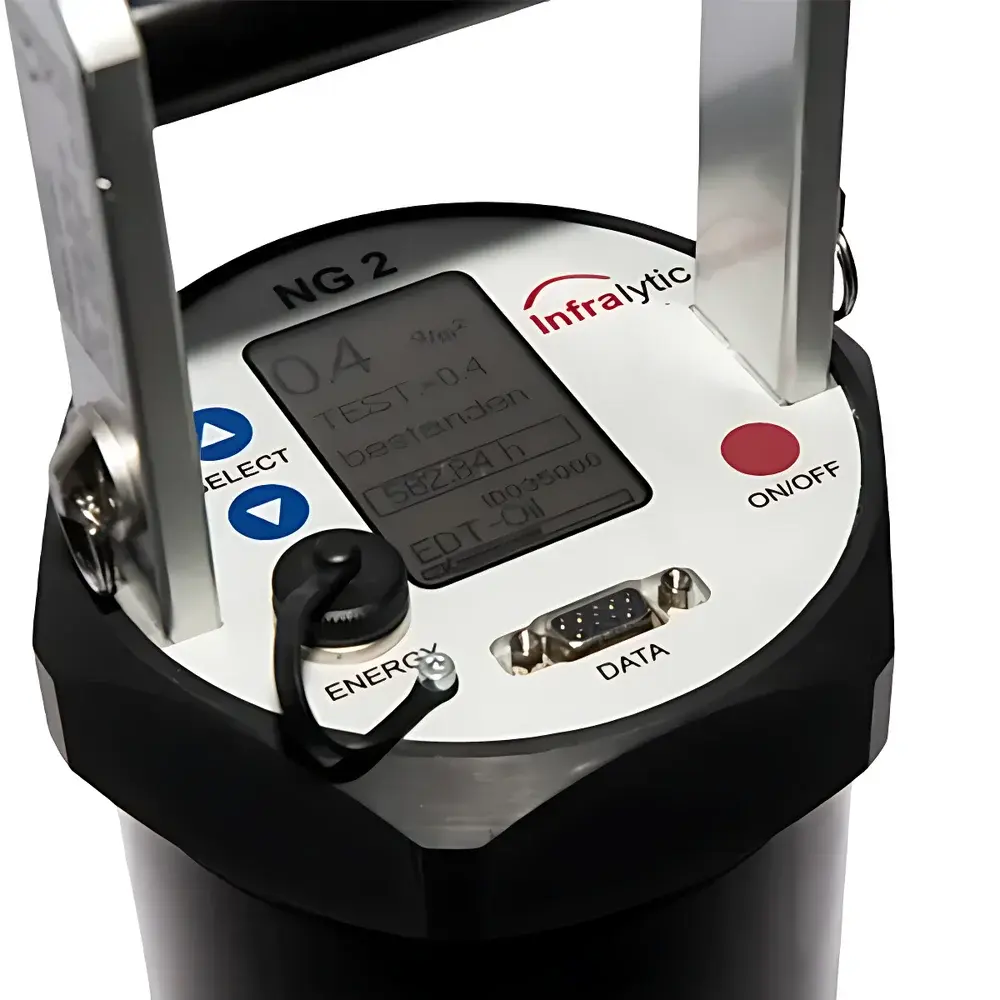
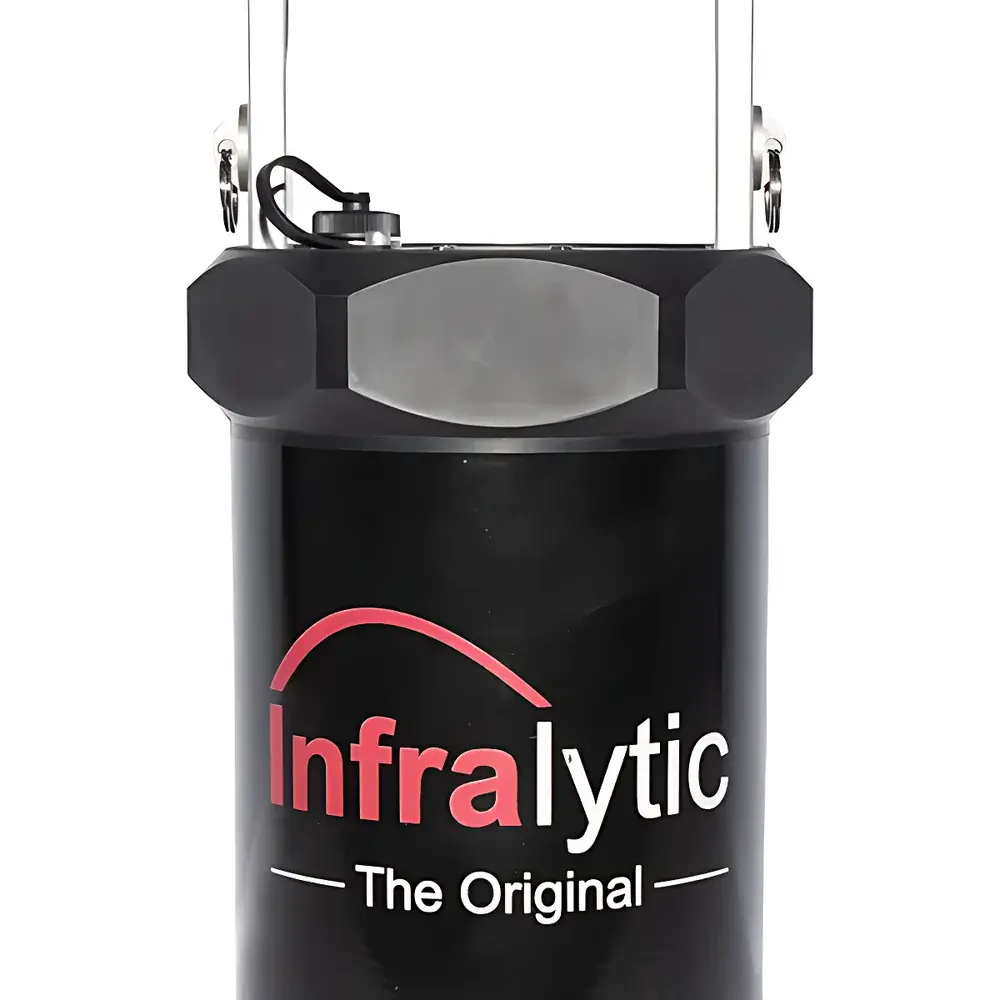
Infralytic NGO Non-Contact Infrared Oil Film Thickness Gauge
| Brand | Infralytic |
|---|---|
| Origin | Germany |
| Model | NGO |
| Measurement Principle | Near-Infrared (NIR) Absorption Spectroscopy |
| Measurement Range | 0.05–6 g/m² |
| Accuracy | ±0.015 g/m² (0.02–0.3 g/m²), ±0.2 g/m² (0.3–2 g/m²), ±10% of reading (>2 g/m²) |
| Repeatability | <0.0010 g/m² |
| Resolution | 0.001 g/m² |
| Measurement Distance | 8 mm (+5/−2 mm) |
| Surface Compatibility | Cold-rolled steel, hot-dip galvanized (HDG), electrogalvanized (EG), phosphated, aluzinc (ZnMg), bare aluminum, pre-treated substrates |
| Lubricant Compatibility | Mineral oils, thixotropic mineral oils, hot-melt adhesives, waxes, other organics (with custom calibration) |
| Operating Temperature | 0–45 °C |
| IP Rating | IP65 |
| Power Supply | Internal rechargeable battery (≥12 h operation) |
| Compliance | Designed for ISO/IEC 17025-aligned QA workflows, supports GLP/GMP traceability via timestamped digital logs |
Overview
The Infralytic NGO is a handheld, non-contact infrared oil film thickness gauge engineered for precision metrology in industrial metalworking environments. Unlike contact-based profilometers or gravimetric methods, the NGO employs near-infrared (NIR) absorption spectroscopy to quantify organic coating mass per unit area (g/m²) on metallic substrates—without physical contact, sample preparation, or surface disruption. Its optical architecture is calibrated to detect characteristic vibrational absorption bands of C–H bonds in hydrocarbon-based lubricants (e.g., mineral oils, waxes, hot-melt adhesives) at specific NIR wavelengths. This enables direct, real-time quantification of residual oil films applied during cold rolling, stamping, or drawing processes—critical for ensuring consistent drawability, weldability, and paint adhesion while minimizing post-process cleaning costs. The instrument operates independently of ambient lighting and is insensitive to minor surface roughness or topography variations typical of mill-finished steel and aluminum coils.
Key Features
- Non-destructive, non-contact measurement via NIR spectroscopy—no risk of substrate scratching or lubricant displacement
- Onboard auto-validation routine with embedded reference checks before and after each measurement sequence
- Automatic substrate recognition algorithm that identifies material type (e.g., cold-rolled steel, HDG, EG, ZnMg, Al) and selects optimal calibration curve
- Integrated high-resolution camera for geotagged, time-stamped photo documentation synchronized with measurement data
- Rechargeable lithium-ion battery providing ≥12 hours of continuous field operation under standard conditions
- Ruggedized housing rated IP65—dust-tight and protected against low-pressure water jets—suitable for shop-floor deployment near rolling mills, slitting lines, and coil coating facilities
- Fixed optical standoff of 8 mm (±2 mm tolerance), eliminating operator-dependent positioning errors
Sample Compatibility & Compliance
The NGO is validated for quantitative analysis on industrially relevant metallic surfaces including uncoated cold-rolled steel, hot-dip galvanized (HDG), electrogalvanized (EG), phosphated EG (enabling automated phosphating verification), galvannealed (GA), aluzinc (ZnMg), and bare or EDT-treated aluminum. It supports measurement of common process lubricants: paraffinic and naphthenic mineral oils, thixotropic formulations, synthetic esters, waxes, and hot-melt adhesives. Custom calibrations are available for proprietary lubricants upon submission of representative samples. The system complies with foundational metrological requirements outlined in ISO 9001 and supports quality assurance frameworks aligned with ISO/IEC 17025. Measurement records include full audit trails—operator ID, timestamp, GPS coordinates (optional), substrate ID, and raw spectral data—for integration into GLP- or GMP-regulated environments where traceability and electronic record integrity are mandated (e.g., automotive Tier 1 supplier audits).
Software & Data Management
Data acquisition and reporting are managed via the Infralytic NG-Link desktop application (Windows 10/11), which imports encrypted .ngd files containing spectra, metadata, and photographic evidence. The software enables batch statistical analysis (X̄–R charts, Cp/Cpk calculation), trend monitoring across coil lots or shifts, and export to CSV, PDF, or SPC-compliant formats. All measurements are digitally signed and time-stamped using internal RTC with NTP synchronization capability. Optional cloud sync allows centralized dashboard access for multi-site quality teams. The system supports 21 CFR Part 11-compliant user authentication, role-based permissions, and immutable audit logs—meeting regulatory expectations for electronic records in audited manufacturing contexts.
Applications
- Real-time verification of oil film uniformity on incoming coil stock prior to stamping or laser welding
- In-line process control during cold rolling—detecting lubricant starvation or over-application before downstream defects emerge
- Validation of phosphating conversion coating efficacy by correlating oil retention behavior with phosphate crystal density
- Supplier qualification testing—quantifying residual lubricant mass on delivered blanks to enforce contractual specifications (e.g., ≤0.8 g/m² for e-coat readiness)
- Root cause analysis of paint delamination or spot weld expulsion linked to inconsistent lubricant residue
- Process optimization studies evaluating lubricant migration, evaporation kinetics, or wipe-off efficiency across different line speeds and tension profiles
FAQ
Does the NGO require periodic recalibration with physical standards?
Yes—annual factory recalibration is recommended; however, daily verification using the included certified reference tile (traceable to PTB) satisfies intermediate calibration checks per ISO 9001 clause 7.1.5.2.
Can the NGO measure on curved or embossed surfaces?
It is optimized for flat or gently curved surfaces with radius >500 mm; severe curvature or deep embossing may exceed the depth-of-field tolerance and require localized flat-spot verification.
Is spectral data export supported for third-party chemometric modeling?
Yes—raw absorbance spectra (1200–2200 nm, 1 nm resolution) are embedded in each .ngd file and can be extracted for PCA, PLS regression, or custom algorithm development.
How does ambient temperature affect measurement stability?
The internal thermal stabilization system maintains detector and optical path temperature within ±0.5°C across the 0–45°C operating range; no user compensation is required.
What substrate-specific calibrations ship standard with the NGO?
Factory-loaded calibrations cover cold-rolled steel, HDG, EG, phosphated EG, GA, ZnMg, and bare aluminum—covering >95% of European and North American automotive and appliance coil applications.



