
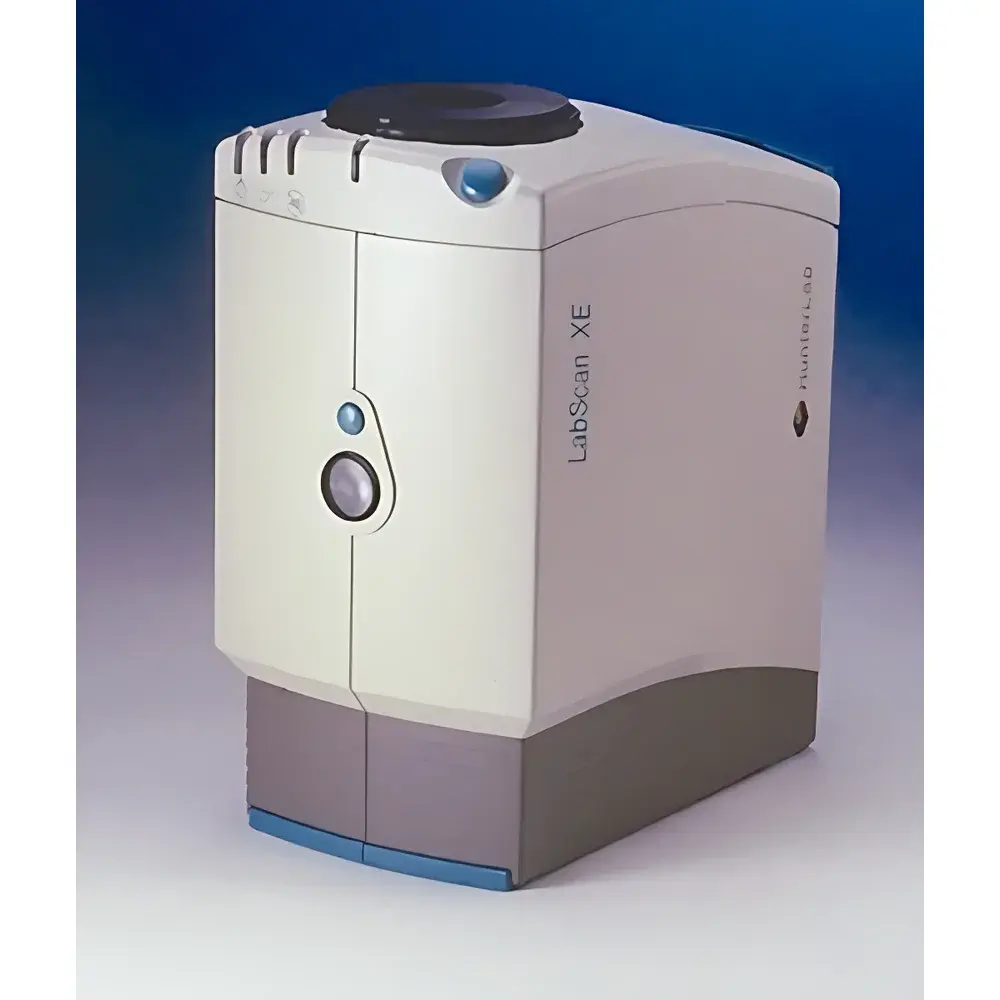
HunterLab LabScan XE Yellowness Index Analyzer for PET Chip
| Brand | HunterLab |
|---|---|
| Origin | USA |
| Model | LSXE |
| Product Type | Spectrophotometric Colorimeter |
| Instrument Type | Benchtop |
| Optical Geometry | 0°/45° |
| Light Source | Pulsed Xenon Lamp |
| Spectral Range | 400–700 nm |
| Repeatability | ΔYI ≤ 0.09 |
| Aperture Options | 3, 8, 15, 25, and 44 mm (LAV) |
| Measurement Time | ≤ 3 s |
| Photometric Range | 0–150% Reflectance |
| Detector | 256-element Silicon Photodiode Array with Diffraction Grating |
| Wavelength Interval | 10 nm |
| CIE Illuminant | D65 (Xenon-filtered) |
| Compliance | ASTM E313, ASTM D6290, ISO 11475, ISO 2470-1, GB/T 2409–2022, GB/T 3978–2008 |
Overview
The HunterLab LabScan XE Yellowness Index Analyzer is a precision benchtop spectrophotometer engineered specifically for quantitative color and yellowness assessment of polyethylene terephthalate (PET) chip in industrial polymer manufacturing environments. Operating on a dual-beam 0°/45° optical geometry—distinct from integrating sphere-based systems—the instrument replicates human visual perception under standardized illumination, minimizing metamerism-related discrepancies and eliminating angular dependency artifacts common in diffuse-geometry instruments. Its pulsed xenon light source delivers high-intensity, stable spectral output across the visible range (400–700 nm), with spectral filtering optimized to closely match the CIE standard illuminant D65. This enables accurate evaluation of yellowing induced by thermal degradation, oxidation, or catalyst residues during PET melt processing and solid-state polymerization. The system complies with critical industry standards including ASTM E313 (Yellowness Index calculation), ASTM D6290 (for PET resin color measurement), ISO 11475 (paper and board color under D65), and ISO 2470-1 (brightness and whiteness). Designed for continuous operation in QC laboratories, it supports traceable, reproducible measurements essential for batch release, process validation, and regulatory documentation.
Key Features
- Dual-beam 0°/45° optical architecture ensures high geometric fidelity to observer viewing conditions, eliminating errors associated with specular component inclusion (SCI) or exclusion (SCE) ambiguity in sphere-based systems.
- Five interchangeable apertures (3 mm, 8 mm, 15 mm, 25 mm, and 44 mm LAV) accommodate heterogeneous PET chip morphology—from fine granules to irregularly shaped flakes—without requiring sample homogenization or pellet pressing.
- Automated variable-focus optical assembly minimizes stray light contribution, enhancing signal-to-noise ratio and improving measurement robustness across low-reflectance, semi-crystalline PET surfaces.
- Ring-shaped photodetector array compensates for polarization effects inherent in birefringent PET materials, ensuring consistent YI and L*a*b* values regardless of chip orientation or crystallinity gradient.
- Pulsed xenon lamp with >1 million flash cycles and D65-spectrum filtering provides long-term photometric stability and enhanced UV energy output—critical for detecting early-stage fluorescence quenching and yellowing per the Hohensteiner reference method.
- 256-channel silicon photodiode array with diffraction grating achieves 10 nm reporting intervals and full spectral capture in ≤3 seconds per measurement.
Sample Compatibility & Compliance
The LabScan XE is validated for direct measurement of loose PET chips, spun fibers, extruded pellets, and compression-molded plaques without grinding or solvent treatment. Its large 44 mm LAV aperture allows representative sampling of ≥50 g batches, mitigating particle-size bias and surface texture variability. The instrument meets GLP-aligned operational requirements: audit-trail-capable software logging (via EasyMatch-QC), user-access controls, electronic signature support (21 CFR Part 11 compliant configuration available), and calibration traceability to NIST-traceable standards. It satisfies mandatory testing protocols specified by Chinese national standards GB/T 2409–2022 (plastic yellowness index) and GB/T 3978–2008 (standard illuminants and observers), as well as international polymer quality benchmarks used by Sinopec, PetroChina, and global PET producers.
Software & Data Management
The LabScan XE integrates seamlessly with HunterLab EasyMatch-QC v5.x—a GMP-ready color management platform supporting multi-instrument network deployment, statistical process control (SPC), and automated pass/fail reporting against user-defined tolerances (e.g., YI ≤ 3.5 ± 0.3 for bottle-grade PET). All spectral data are stored in ASTM E2551-compliant .qtx format, enabling interoperability with third-party formulation software (e.g., Datacolor MatchText, X-Rite Color iMatch). Raw reflectance spectra, derivative indices (WI, YI, K/S, ΔE00), and CIE L*a*b*, L*C*h° coordinates are exportable to CSV, Excel, or LIMS via RS232C or optional Ethernet interface. Firmware updates and spectral recalibration routines are performed locally without vendor dependency.
Applications
Primary applications include real-time monitoring of PET chip yellowness during melt-phase polymerization, post-condensation, and solid-state polycondensation; incoming raw material verification (PTA, EG, catalysts); thermal stability profiling under accelerated aging (ISO 2554); comparative analysis of antioxidant efficacy; and root-cause investigation of off-spec yellowing events linked to reactor residence time, screw shear, or nitrogen purge efficiency. Secondary use cases extend to polyamide (PA6, PA66), polycarbonate (PC), and recycled PET (rPET) feedstock qualification—particularly where birefringence, crystallinity, or surface gloss affects traditional sphere-based readings.
FAQ
Does the LabScan XE require annual recalibration by HunterLab service engineers?
No—users may perform routine verification using supplied ceramic tile standards and execute full spectral recalibration in-house using the built-in calibration routine and NIST-traceable reference tiles.
Can it measure PET chips with high moisture content?
Yes—provided samples are measured within the instrument’s specified operating humidity range (10–90% RH, non-condensing); however, for metrologically rigorous YI trending, ASTM D6290 recommends conditioning to equilibrium at 23°C/50% RH prior to measurement.
Is the 0°/45° geometry compatible with ISO/IEC 17025 accredited laboratories?
Yes—its geometric definition, spectral bandwidth, and repeatability (ΔYI ≤ 0.09) meet ILAC-G15 and EURACHEM guidance for uncertainty budgeting in colorimetric testing.
How does it handle highly reflective or translucent PET fragments?
The ring detector design and polarization compensation reduce specular interference; for translucent chips, the 44 mm LAV aperture ensures sufficient path-length averaging to suppress subsurface scattering artifacts.
Does EasyMatch-QC support automated report generation for internal QA audits?
Yes—it includes configurable templates for PDF/Excel reports with embedded metadata (operator ID, timestamp, instrument serial number, calibration status), compliant with ISO 9001 and IATF 16949 documentation requirements.




