
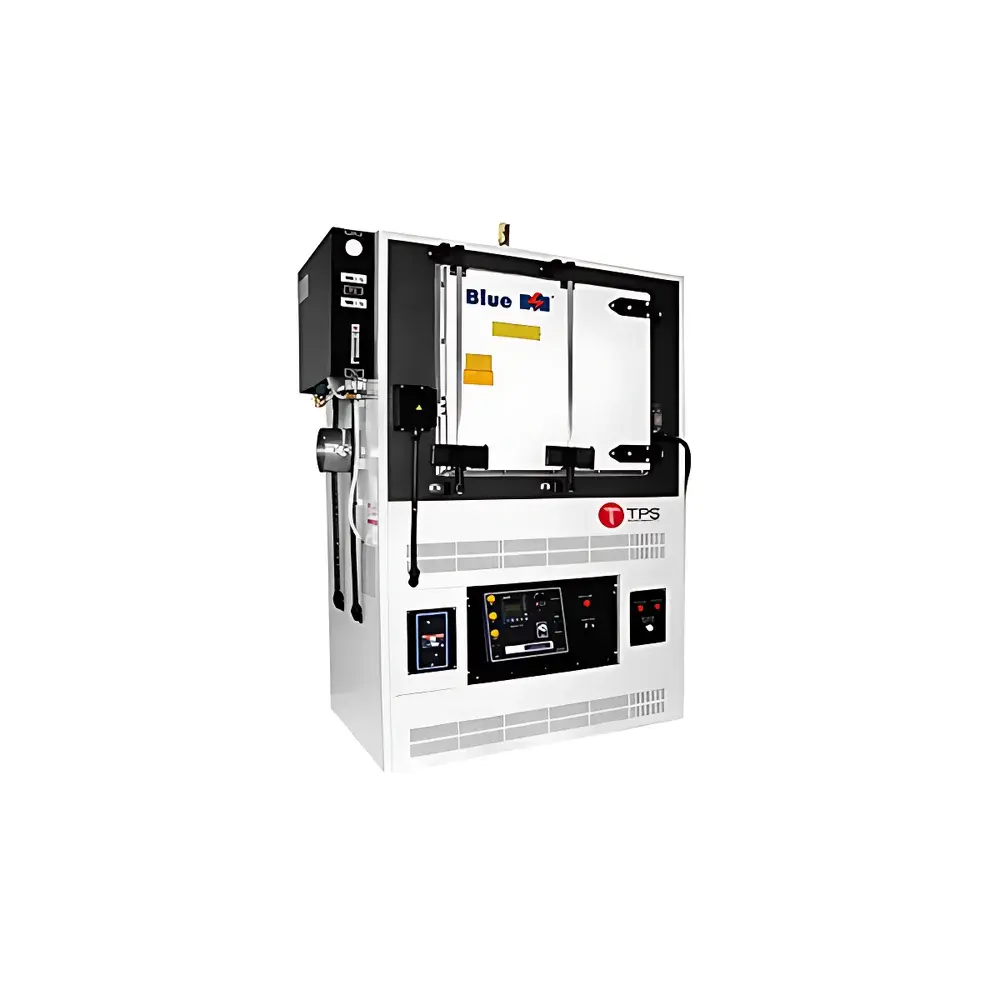
Blue M IGF7780 Inert Atmosphere High-Temperature Aging Oven for PBO Curing
| Brand | Blue M |
|---|---|
| Origin | USA |
| Model | IGF7780 |
| Temperature Range | Ambient +15°C to 593°C (1099°F) |
| Max Operating Temperature | 400°C (standard configuration, up to 593°C rated) |
| Uniformity | ±2% of setpoint |
| Temperature Stability | ±2% of setpoint |
| Temperature Deviation | ±0.5°C |
| Chamber Dimensions (W×H×D) | 25 × 20 × 20 cm |
| Internal Volume | 5.8 ft³ (0.164 m³) |
| Heating Element | Open-wire NiCr |
| Gas Compatibility | N₂, Ar, He, CO₂, and forming gas (4% H₂ / 96% N₂) |
| Safety Features | Door interlock, inert gas leak detection with heater shutdown, pressure monitoring, purge timer, relief valve |
| Insulation | 6-inch mineral wool |
| Door Seal | High-temperature fiberglass gasket |
| Cooling | Air-cooled door (IGF7780) |
| Compliance | NFPA 86 Class B |
Overview
The Blue M IGF7780 Inert Atmosphere High-Temperature Aging Oven is an engineered solution for precision thermal processing of polybenzoxazole (PBO) fibers, films, and composites under controlled inert gas environments. Designed in accordance with NFPA 86 Class B requirements for ovens operating with flammable or reactive atmospheres, the IGF7780 employs a fully welded, leak-tight inner chamber to prevent oxidation and volatile migration during high-temperature curing cycles. Its operational principle relies on convective heat transfer within a sealed, pressurized inert gas enclosure—enabling precise thermal aging, post-cure stabilization, and outgassing protocols essential for aerospace-grade PBO materials. The oven supports continuous operation from ambient +15°C up to 593°C, with certified temperature uniformity and stability critical for reproducible material property development across R&D, quality control, and production validation workflows.
Key Features
- Fully welded stainless steel inner chamber eliminates insulation contamination and ensures long-term inert gas integrity
- Integrated inert gas leak detection system triggers automatic heater shutdown and audible/visual alarm upon loss of chamber pressure or flow deviation
- Dual-stage door interlock disables both heating elements and circulation blower immediately upon door opening—meeting OSHA and ISO 13857 safety clearance requirements
- High-capacity horizontal airflow design with heavy-duty NiCr open-wire heating elements ensures rapid thermal response and minimal gradient across the 25 × 20 × 20 cm work area
- Digital front-panel interface includes real-time monitoring of gas flow rate (L/min), chamber pressure (in. w.c.), purge duration, and heater enable status
- 6-inch thick mineral wool insulation and reinforced fiberglass door gasket maintain thermal efficiency and reduce surface temperatures to <45°C at ambient conditions
- Optional purge timer and programmable ramp-soak profiles support ASTM D3045, ISO 2578, and MIL-STD-810H thermal aging test sequences
Sample Compatibility & Compliance
The IGF7780 accommodates PBO precursor tapes, spun fibers, laminated prepregs, and thin-film substrates requiring inert-atmosphere stabilization between 300°C and 400°C. Its chamber geometry and airflow architecture minimize thermal shadowing and ensure uniform exposure—critical for achieving consistent imidization and cross-linking kinetics. The unit complies with NFPA 86 (2023 Edition) Class B construction standards for ovens using non-flammable inert gases and low-concentration forming gases. It supports GLP-compliant operation when integrated with validated data logging systems, and its pressure and flow monitoring capabilities align with FDA 21 CFR Part 11 audit trail requirements when paired with compliant software platforms.
Software & Data Management
While the IGF7780 operates via a dedicated analog/digital hybrid control panel, it features 4–20 mA and RS-485 Modbus RTU outputs for integration into centralized laboratory automation systems (e.g., LabVantage, Siemens Desigo, or custom SCADA). Optional Ethernet-enabled controllers (sold separately) provide password-protected user access levels, electronic signature support, and exportable CSV log files containing timestamped temperature, pressure, flow, and alarm event histories. All recorded parameters meet ALCOA+ data integrity principles—ensuring attributable, legible, contemporaneous, original, accurate, complete, consistent, enduring, and available records for regulatory submissions.
Applications
- Thermal curing of PBO fibers and yarns prior to tensile strength evaluation per ASTM D2256
- Aging studies of PBO-reinforced composites under nitrogen or argon for aerospace structural qualification
- Outgassing characterization of PBO-based adhesives and encapsulants in vacuum-compatible hardware assemblies
- Accelerated life testing of PBO electrical insulation films per IEC 60216 procedures
- Process validation of high-temperature stabilization steps in polymeric fiber manufacturing lines
- Material screening for thermal oxidative stability in inert environments per ISO 11358
FAQ
What inert gases are certified for use with the IGF7780?
Nitrogen (N₂), argon (Ar), helium (He), carbon dioxide (CO₂), and forming gas (4% H₂ / 96% N₂) are approved per NFPA 86 Annex D and Blue M’s factory certification documentation.
Does the IGF7780 include data logging capability as standard?
No—data logging is optional and requires either the analog output module with external DAQ or the upgraded Ethernet controller with embedded historian.
Can the IGF7780 be used for oxygen-free sintering of ceramics?
Not recommended—this model is rated for Class B (non-flammable inert gases only); sintering applications requiring oxygen scavenging or reducing atmospheres require Class A or Class C ovens with additional explosion relief and purge verification.
Is the temperature resolution traceable to NIST standards?
Yes—the integrated platinum RTD sensor (Class A, DIN EN 60751) is calibrated against NIST-traceable references during final factory verification; calibration certificates are supplied with each unit.
What maintenance intervals are specified for the inert gas system components?
Gas line filters and pressure regulators require inspection every 500 operational hours; door gaskets should be replaced annually or after 2,000 thermal cycles, whichever occurs first.



