
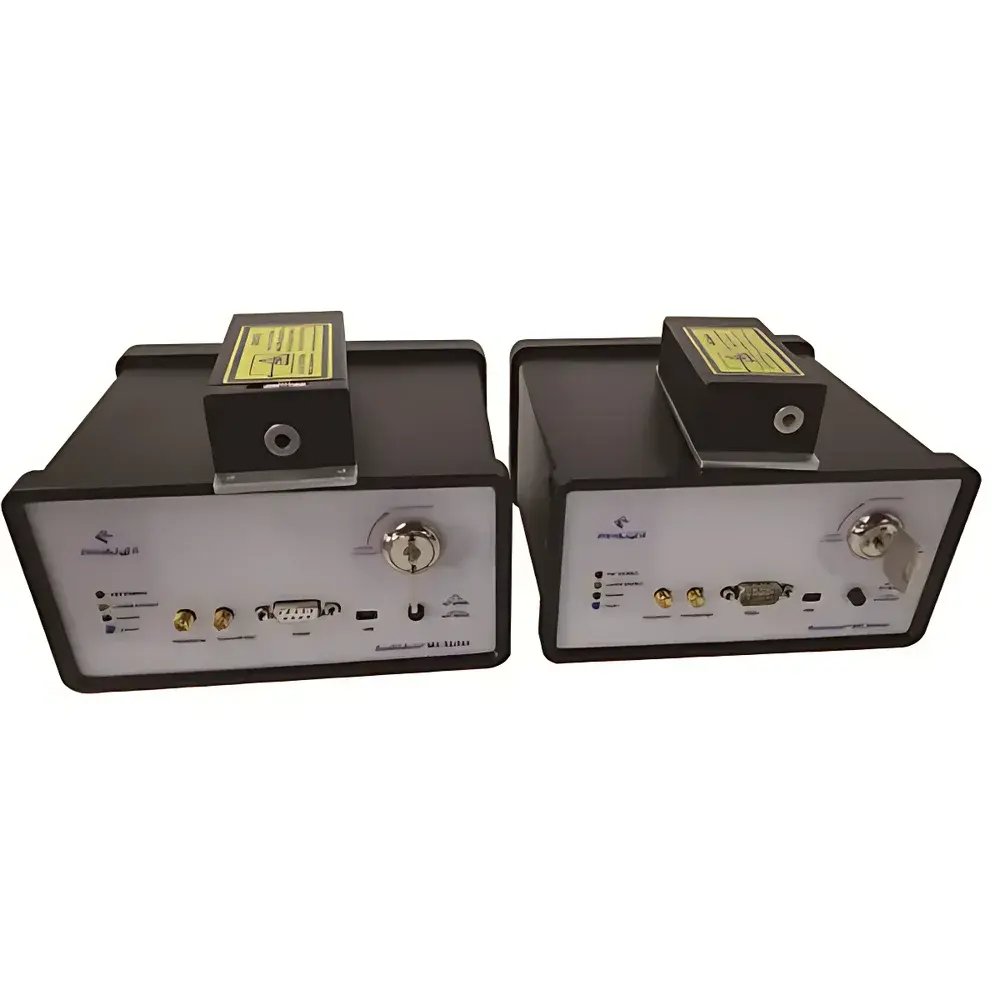
RealLight MCA Series 1.5 ns Microchip Laser
| Brand | RealLight |
|---|---|
| Model | MCA Series |
| Wavelength Options | 1064 / 532 / 355 / 266 nm |
| Pulse Width | ≤1.5 ns (typ. 1.2 ns) |
| Pulse Energy | up to 120 µJ @ 1064 nm |
| Repetition Rate | 1–20 kHz |
| Beam Mode | TEM₀₀ |
| Beam Divergence (full angle, 1/e²) | ≤8 mrad (horizontal), ≤6 mrad (vertical) |
| Polarization Ratio | >100:1 |
| Power Stability (8 h) | ±3% |
| Trigger Interface | TTL 5 V, SMA |
| Input Power | 100–240 VAC, 50/60 Hz |
| System Power Consumption | ≤35 W |
| Laser Head Dimensions (W×H×L) | 45×30×120 mm |
| Power Supply Dimensions (W×H×L) | 168×88×140 mm |
| Operating Temperature | 15–35 °C |
| Storage Temperature | 0–60 °C |
| Output Configuration | Side-emitting (standard) |
| Enclosure | Fully sealed monolithic module for OEM integration |
Overview
The RealLight MCA Series is a family of passively Q-switched, diode-pumped solid-state (DPSS) microchip lasers engineered for high temporal precision, spatial coherence, and long-term operational stability in demanding scientific and industrial environments. Based on monolithic Nd:YAG or Nd:YVO₄ gain media with saturable absorber integration, the MCA architecture leverages intracavity harmonic generation to deliver nanosecond pulses at four fundamental UV–NIR wavelengths: 1064 nm (fundamental), 532 nm (second harmonic), 355 nm (third harmonic), and 266 nm (fourth harmonic). Each variant operates with pulse widths ≤1.5 ns (typ. 1.2 ns), TEM₀₀ spatial mode, and sub-3% power drift over 8-hour continuous operation—enabling reliable use in time-resolved spectroscopy, nonlinear optics pumping, and metrology-grade applications where jitter, pulse-to-pulse energy stability, and beam pointing consistency are critical.
Key Features
- Monolithic microchip design with integrated pump diode and laser crystal—no alignment required, minimal thermal lensing, high mechanical robustness
- Passive Q-switching using semiconductor saturable absorber mirrors (SESAMs) or Cr⁴⁺:YAG—no active electronics in cavity, eliminating timing jitter from external drivers
- Side-emitting configuration with standardized SMA-trigger interface and RS232/USB control—designed for seamless integration into OEM systems and automated test benches
- Hermetically sealed laser head (IP54 equivalent)—resistant to dust, humidity, and minor thermal cycling; supports secondary development including fiber coupling and external harmonic separation
- Flexible repetition rate selection: 1, 5, 10, or 20 kHz per model, with hardware-configurable trigger logic (rising-edge for ≤20 kHz; gate-mode for ≥20 kHz)
- High polarization extinction ratio (>100:1) and diffraction-limited beam quality (M² < 1.1) across all wavelengths—essential for efficient nonlinear conversion and interferometric applications
Sample Compatibility & Compliance
The MCA Series meets baseline requirements for laboratory-grade optical instrumentation under ISO/IEC 17025-accredited environments. Its fully sealed construction complies with IEC 61000-6-3 (EMC emission limits) and IEC 61000-6-2 (immunity to electrostatic discharge and conducted RF disturbances). While not certified for medical or aviation use out-of-box, the platform supports customization to meet FDA 21 CFR Part 11 data integrity requirements when paired with compliant software logging and audit-trail modules. The laser head conforms to Class 4 laser safety per IEC 60825-1:2014; appropriate interlocks and labeling must be implemented by the end-user system integrator. All models are RoHS-compliant and manufactured in an ISO 9001-certified facility in Beijing.
Software & Data Management
RealLight provides a cross-platform configuration utility (Windows/macOS/Linux) via USB or RS232 that enables real-time monitoring of output energy, repetition rate, internal temperature, and trigger status. The software logs timestamped pulse energy readings with configurable sampling intervals (1 Hz to 1 kHz), exports CSV-formatted datasets compatible with MATLAB, Python (NumPy/Pandas), and LabVIEW, and supports remote firmware updates. For GLP/GMP environments, third-party SCADA or LIMS integration is achievable through ASCII command protocol (e.g., “GET:ENERGY?”, “SET:FREQ 10”). Audit trails—including user login, parameter changes, and error events—are recordable upon request with optional secure digital signature extension.
Applications
- Laser-induced breakdown spectroscopy (LIBS) requiring high peak power (>100 MW) and stable single-shot energy delivery
- Pumping optical parametric oscillators (OPOs) and amplifiers for tunable mid-IR generation
- Time-of-flight laser ranging and 3D flash LiDAR systems with sub-nanosecond timing resolution
- Laser desorption/ionization mass spectrometry (LDI-MS) and matrix-assisted variants (MALDI)
- Laser-induced fluorescence (LIF) and two-photon excitation microscopy in biological tissue imaging
- Atmospheric sensing via differential absorption lidar (DIAL) and Raman scattering at 355/266 nm
- Non-destructive evaluation (NDE) using laser ultrasonics and plasma acoustic generation
- Optical frequency comb seeding, optical clock synchronization, and ultrafast pump-probe setups
- Calibration sources for photodetector rise-time measurement and streak camera characterization
FAQ
What is the typical pulse width for the MCA-1064-10-040 model?
The nominal pulse width is 1.2 ns (FWHM), measured with a fast photodiode and 12 GHz oscilloscope under standard operating conditions (25 °C, 10 kHz, 40 µJ).
Can the laser head be fiber-coupled?
Yes—the side-emitting aperture is optimized for collimation and subsequent coupling into multimode or single-mode fibers (e.g., 105 µm core, NA 0.22) using off-the-shelf focusing optics; RealLight offers optional pre-aligned fiber launch adapters.
Is external cooling required?
No—conductive cooling via the aluminum housing is sufficient for continuous operation within 15–35 °C ambient; no water or TEC integration is needed.
How is wavelength selection implemented?
Wavelength is determined by the harmonic generation crystal set installed during manufacturing; discrete models are factory-configured—no in-field wavelength switching is supported.
Does the system support analog modulation of pulse energy?
No—pulse energy is fixed per model; amplitude control is achieved via external AOM or EOM, or by reducing repetition rate while maintaining per-pulse energy.




