
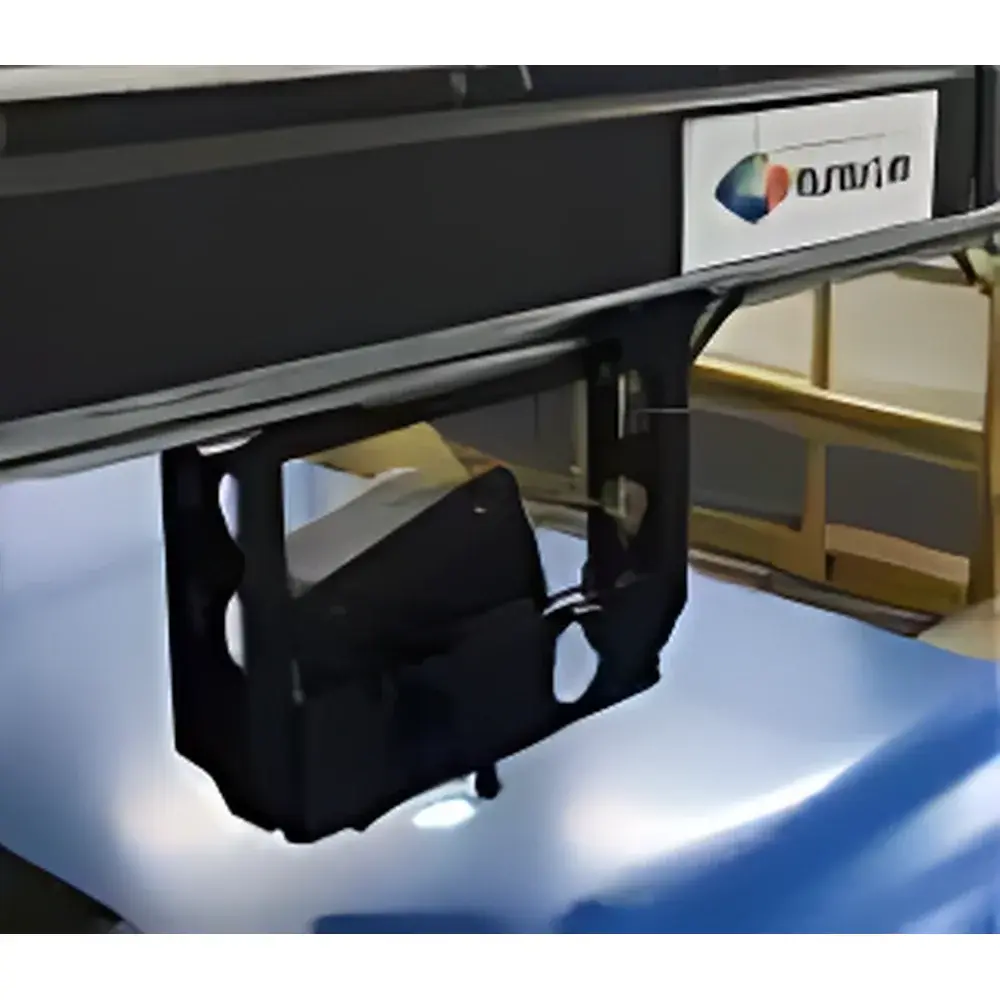
HunterLab SpectraTrend-HT Online Paper Color Measurement System
| Brand | HunterLab |
|---|---|
| Origin | USA |
| Manufacturer Type | Authorized Distributor |
| Product Category | Imported Instrument |
| Model | SpectraTrend-HT |
| Product Type | Spectrophotometric Colorimeter |
| Instrument Type | In-Line |
| Optical Geometry | 0°/45° Integrating Sphere |
| Light Source | Full-Spectrum Balanced Solid-State LED Array |
| Spectral Range | 400–700 nm |
| Spectral Bandwidth | 10 nm |
| Repeatability (ΔE*ab) | ≤0.03 |
| Measurement Distance | Up to 100 mm (4 in) |
| Measurement Speed | 5 Hz (non-contact) |
| IP Rating | NEMA 4 / IP56 |
| Interface | Standard Ethernet (TCP/IP), PLC-compatible |
| Software Platform | HunterLab EasyMatch QC v5.x or later |
Overview
The HunterLab SpectraTrend-HT Online Paper Color Measurement System is a purpose-engineered, spectrophotometric in-line color monitoring solution designed exclusively for continuous paper manufacturing processes. Operating on the principle of 0°/45° geometry with an integrating sphere detector, it delivers laboratory-grade spectral reflectance data under dynamic production conditions. Unlike conventional spot-checking instruments, the SpectraTrend-HT performs non-contact, real-time scanning across the full web width—capturing both CIE L*a*b*, ΔE*ab, and physical height information simultaneously. Its solid-state LED illumination provides photometrically stable, full-spectrum excitation (400–700 nm) with <10 nm bandwidth resolution, ensuring traceable compliance with ASTM E308, ISO/CIE 15, and ISO 27677 standards for paper and board color evaluation. The system is engineered to support Process Analytical Technology (PAT) frameworks and integrates seamlessly into Quality by Design (QbD) initiatives aligned with FDA Guidance for Industry and ICH Q8/Q9.
Key Features
- Full-web automatic traverse mechanism with programmable scan path and collision-avoidance logic
- Simultaneous dual-parameter acquisition: spectral color (CIE XYZ, L*a*b*, Yellowness Index, Whiteness Index) and surface height (±0.1 mm resolution)
- Height-compensated color correction algorithm—automatically adjusts for substrate elevation variance, conveyor belt speed fluctuations, and web flutter
- NEMA 4/IP56-rated stainless-steel enclosure for high-humidity, dust-laden, and chemically aggressive paper mill environments
- Self-calibrating optical path with user-definable calibration interval scheduling—eliminates manual intervention and associated safety risks
- 5 Hz measurement rate enables detection of sub-second color drifts; synchronized timestamping supports root-cause analysis in SPC workflows
- Multi-sensor network architecture via standard Ethernet—no RS-232 limitations; scalable to >32 nodes on a single subnet
Sample Compatibility & Compliance
The SpectraTrend-HT is validated for use on uncoated, coated, recycled, and specialty papers—including kraft, newsprint, tissue, and board substrates—across grammage ranges from 40 g/m² to 400 g/m². Its non-contact design eliminates surface abrasion, static charge interference, or thermal loading effects common with contact probes. All spectral output conforms to CIE 15:2018 spectral irradiance requirements and is traceable to NIST SRM 2021a. The system meets GLP/GMP documentation requirements through audit-trail-enabled software logging (21 CFR Part 11 compliant when deployed with EasyMatch QC’s electronic signature module). It supports Six Sigma DMAIC protocols by delivering Cp/Cpk-ready datasets and integrates with LQM (Laboratory Quality Management) dashboards for enterprise-level KPI tracking.
Software & Data Management
HunterLab EasyMatch QC v5.6+ serves as the central interface—providing real-time visualization of color deviation maps, spectral overlays, trend charts (X-bar/R, EWMA), and height-profile heatmaps. Data export options include CSV, XML, and native Microsoft Excel (.xlsx) formats with customizable templates for QA reporting. Role-based access control allows segregation of operator, supervisor, and administrator privileges. Measurement logs are time-stamped, digitally signed, and stored with immutable metadata (instrument ID, calibration epoch, environmental sensor readings). Optional OPC UA server module enables bidirectional communication with Siemens, Rockwell, or Schneider PLCs for closed-loop process feedback—e.g., automatic basis weight or dye dosing adjustments based on ΔL* thresholds.
Applications
Primary deployment targets include paper machine dry end monitoring, coating station verification, reel-to-reel batch validation, and converting line quality gates. Secondary applications extend to corrugated board lamination, tissue embossing consistency checks, and recycled pulp blending optimization. While optimized for paper, its height-aware spectral engine also supports validated use in continuous extrusion lines (PVC, PE, PET), baked goods ovens (crust browning uniformity), and metal foil anodizing baths—where surface topography directly influences perceived color. Each application benefits from the same metrological foundation: SI-traceable reflectance measurements referenced to ISO 2470-1 (paper brightness) and ISO 2471 (opacity).
FAQ
Does the SpectraTrend-HT require periodic lamp replacement?
No—the solid-state LED light source has a rated lifetime exceeding 100,000 hours with <2% spectral shift over operational life, eliminating consumable lamp costs and recalibration downtime.
Can it be integrated into an existing DCS or MES platform?
Yes—via Modbus TCP, OPC UA, or RESTful API endpoints; pre-certified drivers are available for ABB 800xA, Emerson DeltaV, and Honeywell Experion PKS.
How is measurement repeatability verified during installation?
HunterLab provides factory-issued Certificate of Conformance (CoC) with NIST-traceable inter-instrument agreement data (ΔE*ab < 0.02 between units) and on-site validation using certified paper standards per ISO 22112.
Is height measurement used only for compensation, or does it generate independent quality metrics?
Both—height data is logged alongside color values and can trigger alarms for web thickness deviation, splice detection, or coating thickness anomalies when correlated with upstream gauges.
What cybersecurity protocols does the Ethernet interface support?
TLS 1.2 encryption, IEEE 802.1X port-based authentication, and configurable firewall rules via embedded Linux OS—fully compliant with IEC 62443-3-3 Level 2 requirements.




