
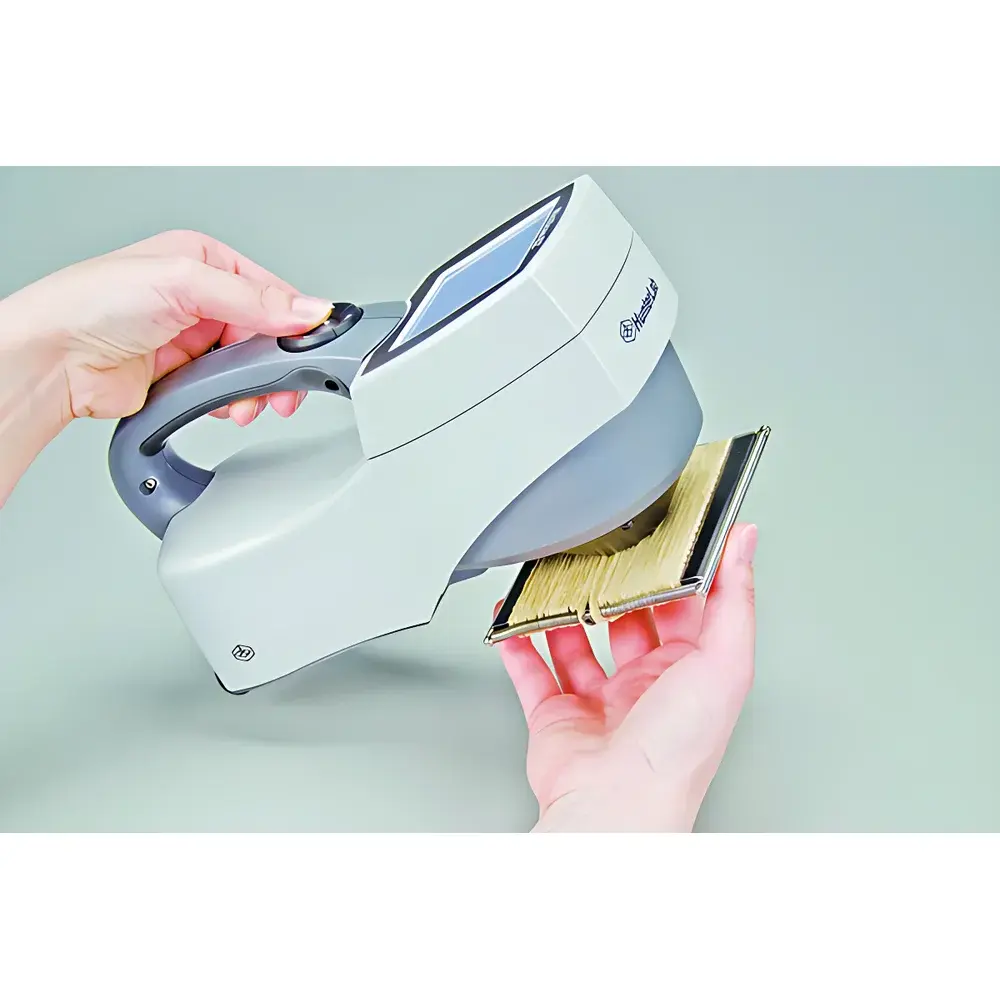
HunterLab MiniScan EZ Portable Colorimeter
| Brand | HunterLab |
|---|---|
| Origin | USA |
| Model | MiniScan EZ |
| Product Type | Color Difference Meter |
| Instrument Type | Portable |
| Optical Geometry | 0°/45° Integrating Sphere |
| Light Source | Xenon Flash Lamp |
| Spectral Range | 400–700 nm |
| Repeatability | ΔE*ab ≤ 0.05 (mean, BCRA II tiles) |
| Aperture Options | LAV 31.8 mm (25.0 mm view), SAV 6.0 mm (5.0 mm view), Integral Sphere LAV 25.0 mm (20.0 mm view), VSAV 6.0 mm (4.0 mm view), SAV 14.3 mm (8.0 mm view) |
| Weight | <1.5 kg |
| Power | AC/DC adapter or standard rechargeable AA batteries |
Overview
The HunterLab MiniScan EZ Portable Colorimeter is an advanced, field-deployable spectrophotometric color measurement instrument engineered for high-precision, repeatable color evaluation across diverse industrial environments. Based on the proven 0°/45° optical geometry with an integrating sphere detector, it delivers CIE-compliant tristimulus values (L*, a*, b*, ΔE*ab, ΔE*00) and chromaticity coordinates (x, y, Y; u’, v’) using a pulsed xenon lamp as its stable, broadband light source. Unlike traditional d/8° instruments, the 0°/45° configuration minimizes directional sensitivity to surface texture and gloss—making it especially suitable for textured, metallic, or semi-gloss samples encountered in plastics, textiles, coatings, food, and packaging applications. Its spectral acquisition spans the full visible range (400–700 nm) at nominal 10 nm intervals, enabling accurate quantification of both non-fluorescent and fluorescent materials when used with appropriate calibration protocols.
Key Features
- Integrated probe-and-processor architecture eliminates cable dependency and signal degradation common in modular handheld systems
- Dual calibration capability—including white tile and proprietary green tile reference—enables real-time monitoring and correction of wavelength drift, significantly enhancing long-term photometric stability
- Four selectable viewing orientations (0°, 90°, 180°, 270°) for ergonomic operation under variable lighting or spatial constraints
- Ergonomic rubberized grip and compact form factor (<1.5 kg, ~25 cm length) support true one-handed operation in production, warehouse, or shipping dock settings
- Multi-aperture support: Large Area View (LAV, 31.8 mm), Small Area View (SAV, 6.0 mm and 14.3 mm), Very Small Area View (VSAV, 6.0 mm), and integral sphere LAV (25.0 mm)—each validated for specific sample classes per ASTM E308 and ISO/CIE 11664 standards
- Flexible power system: Operates on standard rechargeable AA cells or AC/DC adapter—eliminating proprietary battery dependency and reducing total cost of ownership
Sample Compatibility & Compliance
The MiniScan EZ accommodates opaque solids, transparent films, powders, pastes, metallic finishes, and fluorescent specimens—including those containing optical brightening agents (OBAs). Its 0°/45° geometry complies with ASTM D2244 (Standard Practice for Calculation of Color Tolerances), ASTM E308 (Computing Tristimulus Values), and ISO 7724-1 (Colorimetry — Part 1: CIE Standard Colorimetric Observers). Instrument performance is traceable to NIST-traceable ceramic standards, and calibration verification procedures align with GLP and internal quality audit requirements. While not FDA 21 CFR Part 11–validated out-of-the-box, the device supports secure data export formats compatible with regulated environments when integrated into validated laboratory information management systems (LIMS).
Software & Data Management
Data capture and analysis are supported via optional HunterLab EasyMatch QC software, which provides statistical process control (SPC) charts, pass/fail tolerancing against master standards, batch reporting, and audit trail generation. Measurement records include timestamp, operator ID, aperture selection, illuminant/observer condition (e.g., D65/10°), and full spectral reflectance data (when enabled). Export options include CSV, XML, and PDF formats compliant with ISO/IEC 17025 documentation requirements. Firmware updates are delivered through USB interface and maintain backward compatibility with legacy MiniScan EZ Plus configurations.
Applications
- Real-time color verification on extrusion lines, injection molding cells, and coating applicators
- Raw material acceptance testing for polymers, pigments, and textile fibers
- Quality assurance of printed packaging, labels, and laminated films
- Food product consistency monitoring—including meat, dairy, confectionery, and baked goods—under ambient or controlled lighting
- Batch-to-batch comparison for automotive interior components, architectural panels, and consumer electronics housings
- Field-based supplier audits where lab-grade repeatability is required outside controlled environments
FAQ
Does the MiniScan EZ require annual recalibration by HunterLab?
No—routine user verification using supplied white and green tiles is sufficient for daily stability checks. Full factory recalibration is recommended every 12–24 months depending on usage frequency and environmental exposure.
Can the MiniScan EZ measure translucent or backlit samples?
It is optimized for reflective measurements only. Translucent or transmission-mode applications require dedicated transmission-capable instruments such as the HunterLab UltraScan VIS.
Is spectral data export available for third-party analysis?
Yes—raw reflectance spectra (400–700 nm, 10 nm steps) can be exported in ASCII format via EasyMatch QC or direct USB transfer for external modeling or spectral matching workflows.
What regulatory standards does the MiniScan EZ support?
It conforms to ASTM D2244, ASTM E308, ISO 7724-1, ISO 11664-4, and CIE Publication 15:2018. It is widely deployed in ISO 9001, IATF 16949, and GMP-aligned facilities for color-critical processes.
How does green tile correction improve measurement reliability?
The green tile serves as a secondary photometric reference to detect and compensate for subtle xenon lamp spectral shifts over time—reducing long-term drift in a* and b* channels without requiring physical recalibration.






