
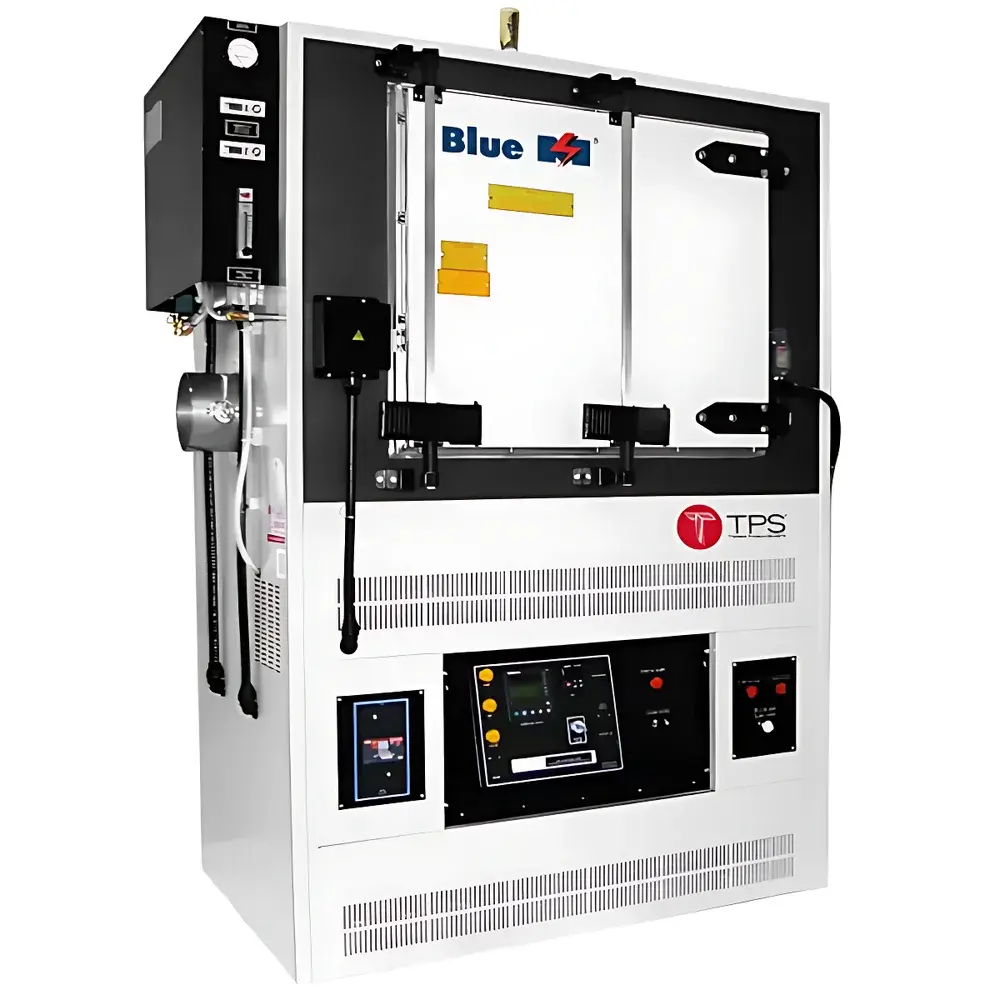
Blue M IGF-8880 Ultra-Temp® Inert Atmosphere High-Temperature Curing Oven for Polyimide (PI) Film Processing
| Brand | Blue M |
|---|---|
| Origin | USA |
| Model | IGF-8880 |
| Temperature Range | Ambient +15°C to 593°C (1099°F) |
| Uniformity | ±2% of setpoint |
| Temperature Stability | ±2% of setpoint |
| Temperature Deviation | ±0.5°C |
| Heating Rate | Ambient +15°C to 593°C (1099°F) |
| Internal Chamber Dimensions (W×H×D) | 25 × 20 × 20 cm |
| Chamber Construction | Welded stainless steel inner chamber with inert gas compatibility |
| Gas Compatibility | N₂, Ar, He, CO₂, and forming gas (4% H₂ / 96% N₂) |
| Cooling | Water-cooled door (IGF-8880 & IGF-9980 models) |
| Safety Features | Door interlock (heater/fan shutdown), leak detection alarm with automatic heater cutoff, pressure monitoring, purge timer, relief valve |
| Insulation | 6-inch mineral wool |
| Airflow | High-capacity horizontal laminar flow system |
| Sealing | Fiberglass-reinforced silicone door gasket |
| Compliance | NFPA 86 Class B oven certification |
Overview
The Blue M IGF-8880 Ultra-Temp® Inert Atmosphere High-Temperature Curing Oven is an engineered thermal processing system designed specifically for the controlled thermal curing of polyimide (PI) precursors in semiconductor packaging, flexible printed circuit (FPC) manufacturing, and advanced microelectronics assembly. Unlike standard convection ovens, the IGF-8880 operates under precisely regulated inert or forming gas atmospheres—critical for preventing oxidative degradation during PI imidization. Polyimide films require complete solvent removal and cyclodehydration at elevated temperatures (typically 300–400°C), where even minor oxygen ingress causes discoloration, microcracking, reduced dielectric strength, and compromised adhesion. This oven integrates NFPA 86 Class B-compliant safety architecture with ultra-stable thermal control (±0.5°C deviation, ±2% uniformity) and validated inert gas management to ensure repeatable film morphology, optical homogeneity, and electrical integrity across production lots.
Key Features
- Welded, leak-tight 316 stainless steel inner chamber—eliminates outgassing and prevents contamination migration into sensitive PI layers
- Water-cooled door design (standard on IGF-8880 and IGF-9980) maintains structural integrity and operator safety during high-temperature operation up to 593°C
- Horizontal laminar airflow system ensures uniform convective heat transfer across the full 25 × 20 × 20 cm working volume, minimizing thermal gradients that induce film stress
- Integrated gas monitoring suite: digital mass flow controllers, chamber pressure transducer, and real-time purge timer with configurable dwell cycles
- Automated safety interlocks: door switch disables heating elements and circulation fan upon opening; gas leak detection triggers audible/visual alarm and immediate heater shutoff
- 6-inch mineral wool insulation combined with double-wall construction achieves low external surface temperature (<55°C at 593°C internal setpoint) and energy-efficient operation
- Fiberglass-reinforced silicone door gasket rated for continuous use at 600°C ensures long-term sealing performance under repeated thermal cycling
Sample Compatibility & Compliance
The IGF-8880 accommodates substrates including silicon wafers, ceramic carriers, copper-clad polyimide laminates, and photolithographically patterned thin-film structures. Its inert atmosphere capability supports processing of both solvent-based PI varnishes (e.g., PMDA-ODA systems) and precursor spin-coated films requiring multi-ramp cure profiles. The system meets NFPA 86 Standard for Ovens and Furnaces (Class B for inert and flammable gas atmospheres), and its construction complies with ASME BPVC Section VIII Div. 1 for pressure boundary components. While not inherently 21 CFR Part 11 compliant, the oven’s analog/digital control interface can be integrated into validated manufacturing execution systems (MES) supporting GLP/GMP audit trails when paired with external data acquisition hardware and timestamped logging protocols.
Software & Data Management
The IGF-8880 utilizes a microprocessor-based controller with dual PID loops—one for chamber temperature and one for gas flow regulation—providing independent tuning for ramp/soak profiles and purge stabilization. Setpoints, actual temperatures, gas flow rates, and chamber pressure are continuously displayed on the front-panel LCD. Optional RS-485 Modbus RTU or Ethernet/IP interfaces enable integration with SCADA or PLC-based factory automation networks. Raw process data (time-stamped temperature, flow, and pressure readings) can be exported via USB memory stick in CSV format for offline analysis, statistical process control (SPC), or submission to quality documentation systems per ISO 9001:2015 clause 8.5.2.
Applications
- Thermal imidization of polyimide dielectric layers in wafer-level packaging and chip-on-flex assemblies
- Curing of photosensitive PI resists used in lithographic patterning of redistribution layers (RDL)
- Aging and reliability qualification of PI-based encapsulants and underfill materials per JEDEC JESD22-A108
- High-temperature stress testing of thin-film sensors and MEMS devices under inert conditions
- Controlled pyrolysis of polymer-derived ceramics where oxygen exclusion prevents carbon oxidation
- Pre-bake and post-exposure bake (PEB) steps for high-thermal-stability photoresists in advanced lithography processes
FAQ
What inert gases are certified for use with the IGF-8880?
Nitrogen (N₂), argon (Ar), helium (He), carbon dioxide (CO₂), and forming gas (4% H₂ / 96% N₂) are all approved per NFPA 86 Class B classification.
Is the oven suitable for vacuum processing?
No—the IGF-8880 is designed exclusively for positive-pressure inert gas environments and is not rated for vacuum operation.
Can the chamber accommodate multiple wafers or panels simultaneously?
Yes, the 25 × 20 × 20 cm internal volume supports standard 6-inch wafers or up to four 100 × 100 mm FPC panels with adequate spacing for uniform airflow.
How is temperature uniformity validated?
Uniformity is verified per ASTM E2207 using nine calibrated thermocouples placed in a 3 × 3 grid across the working zone during IQ/OQ qualification, with results documented in the factory acceptance test (FAT) report.
Does the system include data logging as standard equipment?
Basic real-time display is included; continuous data logging requires optional communication module and external PC-based software or third-party DAQ system.



