
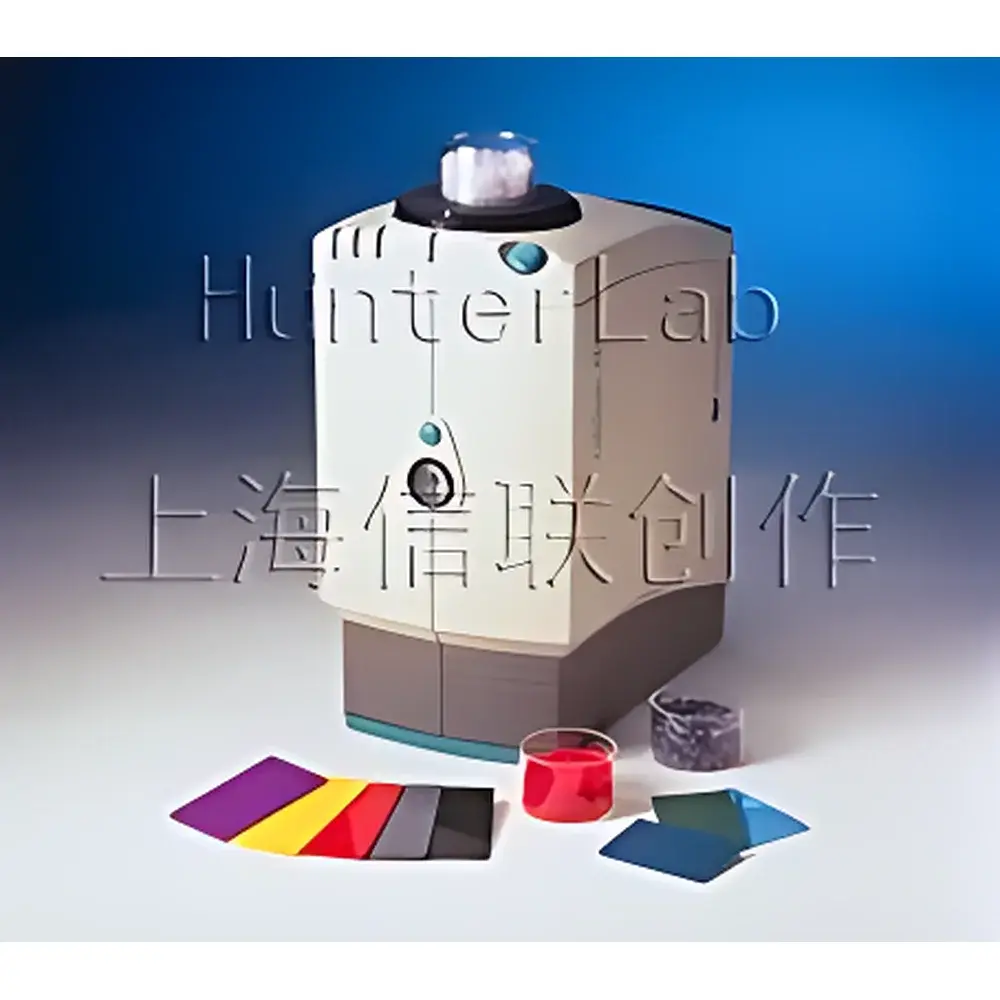
HunterLab LabScan XE 0/45° Desktop Spectrophotometer
| Brand | HunterLab |
|---|---|
| Origin | USA |
| Model | LabScan XE |
| Product Type | Spectrophotometric Colorimeter |
| Instrument Type | Benchtop |
| Optical Geometry | 0°/45° Annular Illumination with 15-Point Fiber-Optic Detection |
| Light Source | Pulsed Xenon Lamp |
| Spectral Range | 400–700 nm |
| Wavelength Interval | 10 nm |
| Photometric Range | 0–150% |
| Repeatability (ΔE*ab) | ≤0.09 |
| Illumination Area (Standard) | 44 mm Ø |
| Optional Variable Sample Illumination (VSI) | 44 / 25 / 13 / 6 / 3 mm Ø |
| Detector | 256-element Silicon Array |
| Monochromator | Diffraction Grating |
| UV Control | Automatic UV-absorbing filter (cut-on ~420 nm) |
| Lamp Lifetime | ≥1 billion flashes |
| Power Input | 100–240 VAC, 47–63 Hz |
| Operating Temperature | 10–40 °C |
| Relative Humidity | 10–90% RH (non-condensing) |
Overview
The HunterLab LabScan XE is a benchtop spectrophotometric colorimeter engineered for high-fidelity color measurement under standardized 0°/45° annular geometry. Unlike diffuse d/8° instruments, the LabScan XE replicates human visual perception more closely by emulating the directional illumination and multi-angle viewing conditions that govern how observers interpret hue, chroma, and lightness across diverse surface textures. Its optical architecture employs a pulsed xenon lamp coupled with a diffraction grating monochromator and a 256-element silicon photodiode array to deliver full-spectrum reflectance data from 400 to 700 nm at 10 nm intervals. The instrument’s defining feature is its 15-point fiber-optic ring detector, positioned at precisely 45° around the 0° illumination axis—enabling spatial averaging of reflectance signals to minimize bias from surface gloss, micro-roughness, directional lay (e.g., in textiles or extruded plastics), or structural anisotropy. This design ensures robust inter-instrument agreement and long-term stability without requiring frequent recalibration, making it suitable for regulated environments where traceability and reproducibility are mandated.
Key Features
- Benchtop form factor with integrated power supply—no external transformer or auxiliary modules required
- Single-button operation directly adjacent to the sample port; enables standalone measurement without PC connectivity
- Two physical sample port orientations: upward-facing (for solids, powders, pastes) and forward-facing (for liquids in cuvettes or translucent films)
- Standard 44 mm Ø large-area illumination optimized for heterogeneous or textured samples; optional Variable Sample Illumination (VSI) provides five discrete aperture sizes (44, 25, 13, 6, and 3 mm Ø) for targeted analysis of small features or patterned surfaces
- Automatic UV-filtering system (420 nm cut-on) with selectable UV-included/UV-excluded modes—critical for fluorescent whitening agent (FWA) evaluation in paper, textiles, and detergents per ISO 11475 and ASTM E308
- Dual-beam optical path design mitigates drift caused by lamp aging or thermal fluctuation, maintaining spectral accuracy over extended operational cycles
- Compliant with CIE No. 15:2018, ISO/CIE 11664 series, and ASTM D2244 for color difference computation (ΔE*ab, ΔE00, ΔEcmc)
Sample Compatibility & Compliance
The LabScan XE accommodates a broad spectrum of physical forms—including opaque solids (plastic pellets, painted panels, ceramic tiles), semi-transparent liquids (beverages, pharmaceutical suspensions), granular powders (pigments, food ingredients), fibrous materials (yarns, nonwovens), and thin films—without requiring custom fixtures or optical adapters. Its 0°/45° geometry inherently suppresses specular reflection artifacts, eliminating the need for gloss traps or mechanical gloss compensation. For industries operating under quality management systems, the instrument supports audit-ready operation: measurement logs include timestamp, operator ID, instrument serial number, calibration status, and spectral metadata. When paired with HunterLab’s EasyMatch QC software, it meets FDA 21 CFR Part 11 requirements for electronic records and signatures—including user authentication, audit trails, and secure data export—facilitating GLP and GMP compliance in pharmaceutical, food, and cosmetic manufacturing.
Software & Data Management
HunterLab EasyMatch QC software provides a validated platform for method creation, statistical process control (SPC), pass/fail tolerancing, and cross-instrument data harmonization. Users define measurement protocols—including illuminant (D65, A, F2, etc.), observer angle (2° or 10°), color space (CIELAB, CIELCH, CMYK), and tolerancing models (DE00, DEcmc)—and deploy them as locked methods across multiple LabScan XE units. Raw spectral data (.qtx files) and processed results (.csv, .xlsx) are exportable with embedded metadata for LIMS integration. The software includes built-in tools for batch reporting, trend analysis, and deviation root-cause investigation—supporting ISO 9001 clause 8.5.1 (Control of production and service provision) and IATF 16949 section 8.5.1.1 (Control plan requirements).
Applications
- Plastics: Batch-to-batch color consistency verification for injection-molded parts, extrusions, and masterbatches
- Textiles & Apparel: Shade matching across dyed yarns, woven fabrics, and finished garments under multiple illuminants
- Paints & Coatings: Quantification of metamerism, weathering-induced color shift, and metallic flake orientation effects
- Food & Beverage: Objective assessment of fruit pulp browning, dairy product yellowness (b*), and beverage haze-corrected color
- Pharmaceuticals: Excipient color qualification, tablet film-coating uniformity, and stability-indicating assays per USP & Ph. Eur. guidelines
- Paper & Packaging: Whiteness (CIE WH, Ganz), brightness (ISO 2470-1), and fluorescence correction for recycled fiber content
FAQ
What distinguishes 0°/45° geometry from d/8° integrating sphere geometry?
0°/45° geometry isolates directional reflectance while excluding specular components, yielding measurements highly correlated with visual assessment under controlled lighting—especially critical for textured, brushed, or pearlescent surfaces. In contrast, d/8° integrates total reflectance (diffuse + specular), which may mask appearance differences perceptible to human observers.
Can the LabScan XE measure transparent or translucent liquids?
Yes—when used with the forward-facing port and matched-path quartz cuvettes (10 mm standard pathlength), it performs transmission measurements compliant with ASTM D1209 (APHA/Pt-Co) and ASTM D5386 (color of liquids by tristimulus colorimetry).
Is UV filtering mandatory for all measurements?
No—UV filtering is configurable. It is enabled by default for daylight-simulating illuminants (e.g., D65) but can be disabled for UV-containing sources (e.g., C) when evaluating fluorescent materials.
How is instrument-to-instrument agreement maintained?
HunterLab certifies inter-instrument agreement (IIA) to ΔE*ab ≤ 0.15 on BCRA Series II tiles. Each unit ships with NIST-traceable calibration standards and a Certificate of Conformance referencing NIST SRM 2020 and 2035.
Does the LabScan XE support networked deployment in a multi-site facility?
Yes—via RS-232 or optional Ethernet interface (with firmware upgrade), instruments can be centrally managed through EasyMatch QC Enterprise, enabling synchronized method distribution, remote diagnostics, and consolidated SPC dashboards across global QA laboratories.




