
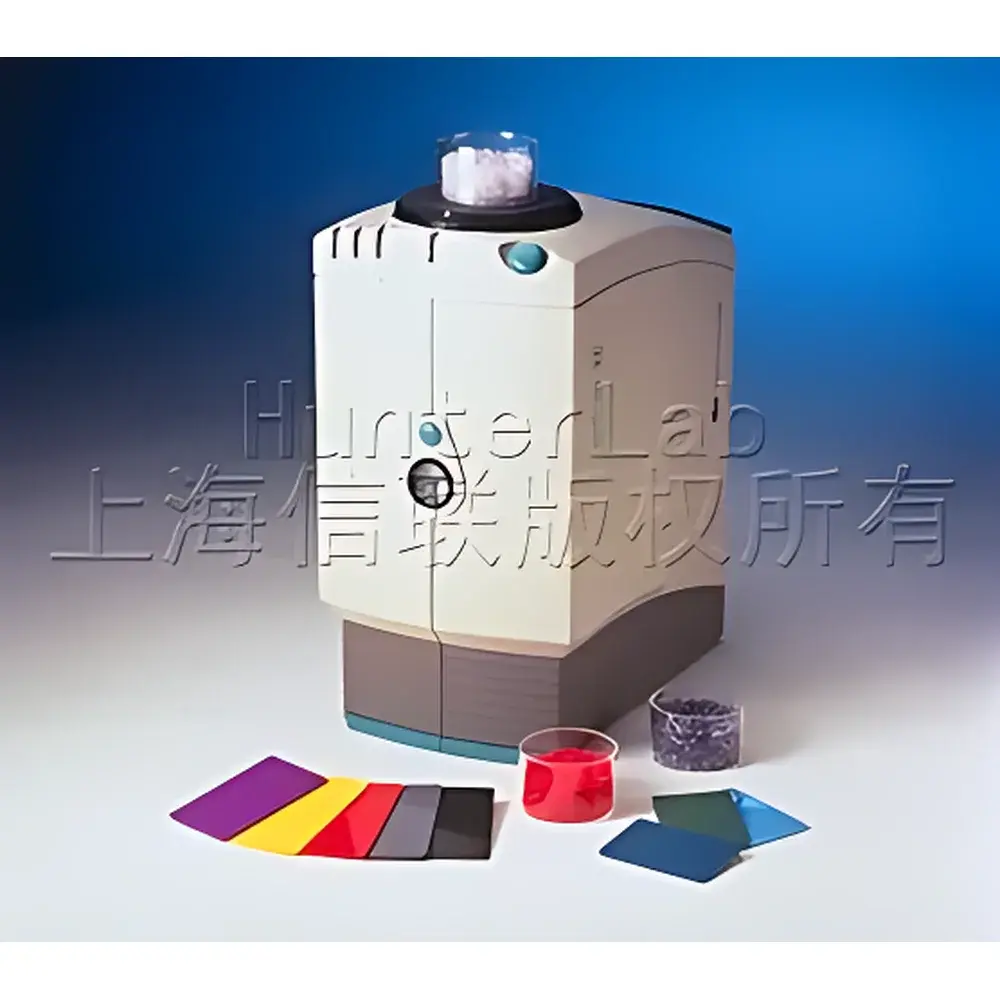
HunterLab LabScan XE Desktop Spectrophotometer
| Brand | HunterLab |
|---|---|
| Origin | USA |
| Manufacturer Type | Authorized Distributor |
| Origin Category | Imported |
| Model | LabScan XE |
| Product Type | Spectrophotometric Color Difference Meter |
| Instrument Type | Benchtop |
| Optical Geometry | 0°/45° Integrating Sphere |
| Light Source | Pulsed Xenon Lamp |
| Spectral Range | 400–700 nm |
| Repeatability | ΔE*ab ≤ 0.09 |
Overview
The HunterLab LabScan XE is a high-precision benchtop spectrophotometer engineered for objective, traceable color measurement across diverse industrial and laboratory applications. It operates on the 0°/45° optical geometry principle—standardized by CIE and widely adopted in paint, plastics, textiles, food, and pharmaceutical quality control—where a collimated light beam illuminates the sample at 0°, and reflected light is collected from 15 discrete positions distributed uniformly at 45° via fiber-optic sampling. This configuration minimizes directional bias from surface texture or gloss, delivering robust color data aligned with visual perception under standardized illuminants (e.g., D65). The instrument employs a pulsed xenon lamp with integrated UV-filtering capability (cut-off at 420 nm), enabling precise control of ultraviolet content to match both daylight-simulating and UV-inclusive measurement conditions required by ASTM D2244, ISO 11664, and USP . With over 1 billion flash cycles rated lamp life and a 256-element silicon photodiode array coupled to a precision diffraction grating, the LabScan XE ensures long-term spectral stability and low-noise spectral acquisition across its full 400–700 nm range at 10 nm intervals.
Key Features
- Benchtop form factor with integrated power supply—no external transformer or bulky accessories required.
- 0°/45° optical design with 15-point fiber-optic collection for high geometric repeatability and reduced angular sensitivity to sample topography.
- Automated UV control: dual-mode filtering (fixed 420 nm cutoff + optional variable UV compensation) compliant with ISO 13655 for M0/M1/M2 measurement modes.
- Variable Sample Illumination (VSI) option supports five interchangeable aperture sizes (3 mm to 44 mm), enabling consistent measurement of small features, textured surfaces, powders, and translucent liquids without reconfiguration.
- Front- or top-access sample port accommodates solids, granules, pastes, gels, and clear-to-hazy liquids—eliminating need for custom holders in routine QC workflows.
- On-unit measurement trigger located adjacent to the sample port enables rapid, hands-free operation without PC dependency for pass/fail checks.
Sample Compatibility & Compliance
The LabScan XE accommodates opaque, translucent, and transparent samples—including films, coatings, molded parts, ground pigments, and liquid dispersions—without requiring dilution or substrate backing in most cases. Its large 44 mm measurement area (standard) and VSI option ensure representative averaging across heterogeneous or coarse-textured materials. The instrument meets critical regulatory and industry standards: ASTM E308 (computation of CIE tristimulus values), ISO 7724-1 (instrumental colorimetry), ISO 11664-4 (CIE colorimetric observers), and FDA 21 CFR Part 11-ready when paired with HunterLab’s EasyMatch QC software (audit trail, electronic signatures, user access levels). All measurements are traceable to NIST-certified standards, supporting GLP/GMP validation protocols in regulated environments.
Software & Data Management
The LabScan XE integrates seamlessly with HunterLab’s EasyMatch QC v5.x software suite, providing comprehensive data management capabilities including method templates, tolerance-based pass/fail reporting, SPC charting, batch trending, and automated report generation (PDF/CSV/XLSX). Software supports full 21 CFR Part 11 compliance with role-based permissions, secure audit trails, and electronic signature workflows. Spectral data is stored in vendor-neutral .qtx format, ensuring long-term archival integrity and interoperability with third-party statistical or LIMS platforms. Firmware updates and calibration verification routines are managed directly through the software interface, minimizing downtime during routine maintenance.
Applications
This spectrophotometer is routinely deployed in R&D labs and production QA/QC environments for: quantifying hiding power (contrast ratio) per ASTM D2805 and ISO 6504; evaluating opacity and whiteness in paper, coatings, and cosmetics; monitoring batch-to-batch color consistency in polymer extrusion and ink formulation; validating color stability under accelerated aging (QUV, xenon arc); and supporting formulation correction via ΔE*ab, CMC(2:1), or DE2000 tolerancing. Its ability to measure both reflectance (0–150%) and spectral transmittance (with optional transmission accessory) makes it suitable for dual-mode pigment dispersion analysis and film clarity assessment.
FAQ
What is the difference between 0°/45° and d/8° geometries in color measurement?
0°/45° geometry isolates directional reflectance, minimizing influence from surface gloss and texture—ideal for appearance-critical flat or structured surfaces. d/8° uses diffuse illumination and spherical collection, better suited for textured or matte materials where total reflectance matters.
Can the LabScan XE measure color on curved or irregular surfaces?
Yes—its 15-point 45° fiber optic collector averages reflectance across multiple angles, reducing sensitivity to local curvature or minor misalignment compared to single-angle instruments.
Is UV calibration required before each measurement?
No—the built-in UV filter system is factory-aligned and stabilized; UV compensation is applied automatically based on selected illuminant mode (M0/M1/M2), verified during annual calibration.
Does the instrument support non-standard illuminants or custom observer functions?
Yes—EasyMatch QC allows user-defined illuminants (via spectral power distribution files) and custom 10° or 2° observer weighting functions, extending compliance beyond standard CIE recommendations.
How is instrument performance validated over time?
HunterLab provides NIST-traceable ceramic calibration tiles and software-driven verification routines that assess photometric linearity, wavelength accuracy, and repeatability—fully documented for internal audit or regulatory inspection.



