
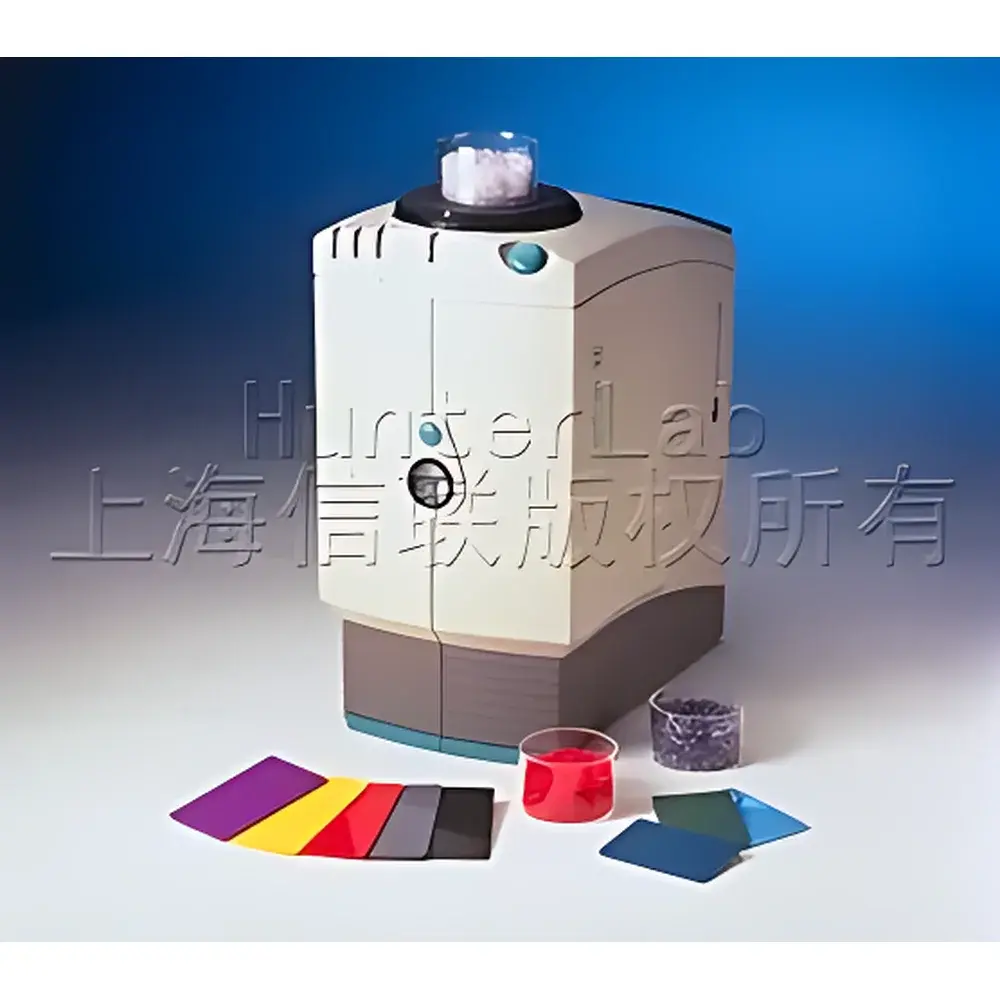
HunterLab LabScan XE Yellowness Index Meter
| Brand | HunterLab |
|---|---|
| Origin | USA |
| Manufacturer Type | Authorized Distributor |
| Product Origin | Imported |
| Model | LabScan XE |
| Product Category | Spectrophotometric Colorimeter |
| Instrument Type | Benchtop |
| Optical Geometry | 0°/45° Annular Illumination and Detection |
| Light Source | Pulsed Xenon Lamp |
| Spectral Range | 400–700 nm |
| Repeatability | ΔYI ≤ 0.09 (CIE Yellowness Index, ASTM E313 & ASTM D6290) |
Overview
The HunterLab LabScan XE Yellowness Index Meter is a high-precision benchtop spectrophotometer engineered for objective, repeatable quantification of yellowing in materials across industrial quality control and R&D laboratories. It operates on the principle of spectral reflectance measurement using a calibrated pulsed xenon light source and a 256-element silicon photodiode array detector coupled with a diffraction grating monochromator. The instrument implements the standardized CIE 1931 colorimetric system and calculates yellowness indices per ASTM E313 (for general materials) and ASTM D6290 (specifically for plastics), enabling traceable, inter-laboratory comparable results. Its 0°/45° annular optical geometry—comprising 15 fiber-optic collection points arranged in a ring at 45°—minimizes directional bias caused by surface texture, gloss, or micro-roughness, delivering robust measurements independent of sample orientation or finish. This architecture ensures compliance with ISO/CIE recommendations for non-diffuse, directional reflectance assessment.
Key Features
- Annular 0°/45° optical configuration with 15-point fiber-optic averaging for enhanced geometric insensitivity to surface structure and gloss variation
- Pulsed xenon lamp with integrated UV-absorbing filter (cutoff at 420 nm), enabling controlled UV content for standardized yellowness evaluation per ASTM D6290
- Full spectral acquisition from 400–700 nm at 10 nm intervals, supporting calculation of multiple color indices—including YI (E313, D6290), ΔE*, L*a*b*, L*C*h*, and whiteness—within a single measurement
- Variable Sample Illumination (VSI) option offering five selectable apertures (3 mm to 44 mm) to accommodate diverse sample geometries—from small polymer pellets to large textile swatches—without compromising optical calibration integrity
- Benchtop form factor with rugged mechanical design, compliant with IEC 61000-4 electromagnetic immunity standards and rated for continuous operation in ambient lab environments (10–40°C, 10–90% RH non-condensing)
- Integrated RS-232C serial interface (DB9) for deterministic, low-latency communication with host systems and LIMS integration
Sample Compatibility & Compliance
The LabScan XE accommodates opaque, translucent, and semi-glossy solid samples—including polymers, paper, textiles, pharmaceutical tablets, and coated substrates—without requiring specialized holders for routine analysis. Its large 44 mm standard port eliminates edge effects on oversized specimens, while VSI provides metrological flexibility for heterogeneous or patterned surfaces. The instrument meets essential regulatory and quality framework requirements: data output conforms to ASTM E313-22 and ASTM D6290-21 for yellowness index reporting; spectral data capture supports GLP/GMP audit trails when paired with compliant software; and its hardware-level UV control satisfies USP <661.2> and ISO 105-A02 requirements for plastic packaging stability testing. All firmware and calibration protocols are traceable to NIST-certified standards.
Software & Data Management
The LabScan XE operates with HunterLab’s EasyMatch QC software (v5.x or later), which provides full spectral data logging, multi-user permission controls, and automated report generation compliant with FDA 21 CFR Part 11 (when configured with electronic signature and audit trail modules). Raw reflectance spectra, calculated indices, pass/fail thresholds, and measurement metadata—including operator ID, timestamp, instrument serial number, and calibration history—are stored in encrypted SQLite databases. Export formats include CSV, XML, and PDF, facilitating integration into enterprise QMS platforms such as TrackWise or MasterControl. Software validation packages (IQ/OQ/PQ documentation) are available upon request for regulated environments.
Applications
- Accelerated aging studies: Quantifying yellowing kinetics in polymeric films, adhesives, and medical device housings exposed to UV, heat, or humidity
- Pharmaceutical packaging: Monitoring discoloration of blister foils and HDPE containers during stability trials per ICH Q1A(R2)
- Textile quality assurance: Assessing yellowing resistance of bleached cotton, nylon, and polyester after laundering or chlorine exposure
- Paint & coating R&D: Evaluating UV stabilizer efficacy and binder degradation under QUV accelerated weathering
- Food contact materials: Verifying color stability of PP/PS trays and PET bottles under thermal processing conditions
FAQ
What yellowness index standards does the LabScan XE support?
It calculates YI per ASTM E313 (for general-purpose materials) and ASTM D6290 (optimized for plastics), both using CIE 1931 tristimulus values derived from measured reflectance spectra.
Can the instrument measure small or irregularly shaped samples?
Yes—via the optional Variable Sample Illumination (VSI) module, which provides five aperture sizes (3 mm to 44 mm) and maintains NIST-traceable calibration across all settings.
Is UV content adjustable for different test methods?
The built-in 420 nm UV cutoff filter is fixed, ensuring consistent UV exclusion per ASTM D6290; no manual UV adjustment is required or supported.
How is measurement repeatability verified?
Repeatability (ΔYI ≤ 0.09) is validated using certified white and black ceramic tiles per ASTM E2539, with daily verification recommended using the included calibration tile set.
Does the LabScan XE require annual recalibration?
While the xenon lamp has a rated life of 1 billion flashes, annual factory recalibration is recommended to maintain traceability to NIST standards and ensure long-term spectral accuracy.






