
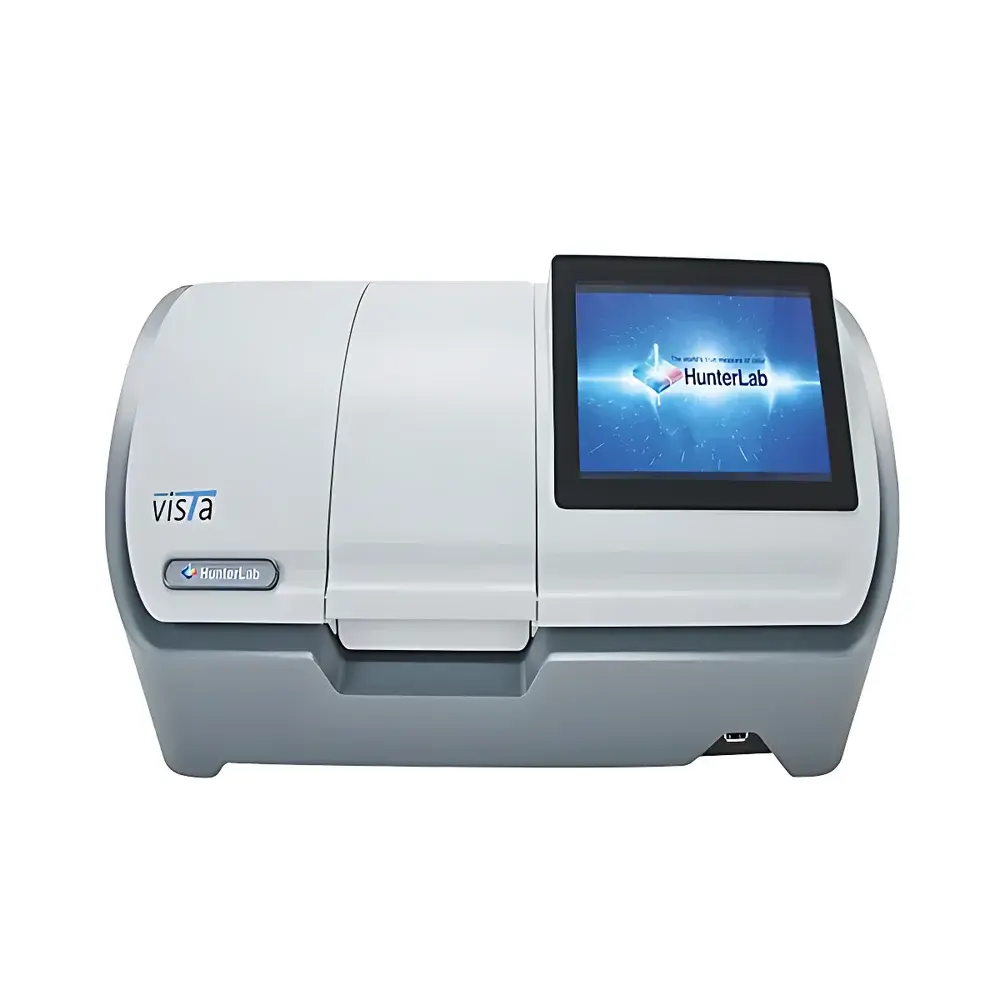
HunterLab Vista Ethylene Glycol Colorimeter
| Brand | HunterLab |
|---|---|
| Origin | USA |
| Model | Vista Ethylene Glycol Colorimeter |
| Instrument Type | Benchtop |
| Optical Geometry | d/8° integrating sphere |
| Light Source | Full-spectrum LED array |
| Spectral Range | 400 nm – 700 nm |
| Repeatability | < 0.02 ΔE* |
| Compliance | ASTM D1003 (haze), ASTM D1209 (APHA), ASTM D1500 (ASTM Color), ASTM D5386 (color measurement of liquids), ISO 11475, ISO 11664 series |
| Color Scales | CIE L*a*b*, Hunter Lab, CIE LCh, CIE Yxy, CIE XYZ |
| Color Difference Metrics | ΔE*, ΔE₀₀ (CIE DE2000), ΔE CMC (2:1), ΔL*a*b*, ΔL*C*h*, ΔYxy, ΔXYZ |
| Color Indices | APHA/Pt-Co, Hazen, ASTM D1500, Saybolt, Gardner, YI E313, YI D1925, ADMI, Lovibond Red (LovR), Lovibond Yellow (LovY), Haze (%) |
Overview
The HunterLab Vista Ethylene Glycol Colorimeter is a purpose-engineered benchtop spectrophotometer designed for high-precision color and optical quality assessment of ethylene glycol and other clear, transparent liquid chemicals. Operating on the principle of diffuse illumination with an 8° viewing geometry (d/8°) and equipped with a full-spectrum LED light source, the instrument delivers stable, drift-free spectral data across the visible range (400–700 nm). Its optical architecture—featuring a precision-machined integrating sphere coated with high-reflectance barium sulfate—ensures uniform illumination and accurate collection of both specular-included and specular-excluded reflectance/transmittance signals. The Vista is not a general-purpose colorimeter; it is calibrated and validated specifically for the narrow refractive index, viscosity, and UV-absorption profile of ethylene glycol solutions, enabling trace-level detection of oxidation byproducts, metal contamination, and thermal degradation indicators through quantitative colorimetric indices.
Key Features
- Integrated haze measurement compliant with ASTM D1003, enabling simultaneous evaluation of color and clarity in a single measurement cycle
- Dual-standard illuminant/observer configurations: D65/10° for daylight simulation and C/2° for legacy specification alignment
- High-stability full-spectrum LED array with <0.1% spectral power deviation over 10,000 hours—eliminating lamp replacement and photometric drift
- Color repeatability of <0.02 ΔE* (30 consecutive readings on homogeneous ethylene glycol standard) and inter-instrument agreement of ΔE* < 0.15 (average) under D65/10° conditions
- 1280 × 800 high-resolution capacitive touchscreen with glove-compatible interface and on-device data review, annotation, and pass/fail flagging
- Robust thermal management system maintaining optical path stability across ambient temperatures from 15°C to 30°C
Sample Compatibility & Compliance
The Vista accommodates standard 10 mm, 20 mm, and 50 mm pathlength cuvettes (quartz or high-transmission optical glass), supporting both transmission and direct liquid-cell measurements. It is validated for use with undiluted ethylene glycol, monoethylene glycol (MEG), diethylene glycol (DEG), triethylene glycol (TEG), and aqueous glycol mixtures up to 99.9% w/w concentration. All reported color indices—including APHA/Pt-Co (ASTM D1209), Hazen (identical to APHA), ASTM D1500 (oil color), Saybolt (ASTM D156), Gardner (ASTM D1544), YI E313 and YI D1925 (ASTM E313, D1925), ADMI (ASTM D5386), Lovibond Red (LovR) and Yellow (LovY)—are computed using NIST-traceable algorithms embedded in firmware. The instrument supports GLP/GMP workflows via audit-trail-enabled user authentication, electronic signatures, and configurable data retention policies aligned with FDA 21 CFR Part 11 requirements.
Software & Data Management
Controlled via EasyMatch QC software (v5.0+), the Vista enables method-driven operation with preconfigured test templates for ethylene glycol QC release, stability studies, and supplier qualification. Measurement data—including raw spectra, derived indices, haze %, transmittance at 450 nm and 700 nm, and operator metadata—are exported in CSV, XML, or PDF formats compatible with LIMS and MES platforms. The software includes statistical process control (SPC) tools, trend analysis with ±3σ limits, and automated report generation meeting ISO/IEC 17025 documentation standards. All firmware updates and calibration verification routines are digitally signed and version-locked to ensure regulatory continuity.
Applications
- Quality control of ethylene glycol feedstock and finished antifreeze/coolant formulations per OEM specifications (e.g., ASTM D3306, SAE J1034)
- Monitoring oxidative stability during accelerated aging studies (ASTM D2570)
- Verification of purification efficacy in reclamation processes for spent glycol streams
- Batch-to-batch consistency assessment in pharmaceutical excipient manufacturing (USP , EP 2.2.57)
- Supplier qualification against color and haze thresholds in petrochemical and HVAC refrigerant supply chains
FAQ
Does the Vista require annual recalibration by HunterLab service engineers?
No—field recalibration is performed using NIST-traceable liquid standards (e.g., APHA 5, 10, 500) and solid ceramic tiles; annual factory verification is recommended but not mandatory for ISO/IEC 17025 compliance.
Can the Vista measure colored solids or powders?
No—it is optimized exclusively for transparent and translucent liquids; solid sample measurement requires a dedicated reflectance accessory not supported on this platform.
Is haze measurement validated per ISO 14782 or only ASTM D1003?
The instrument meets both ASTM D1003 (Method A, 0°/diffuse) and ISO 14782 (transmission haze) specifications; validation reports include uncertainty budgets per GUM (JCGM 100:2008).
What is the minimum sample volume required for a valid reading?
1.5 mL for 10 mm pathlength cuvettes; 3.0 mL for 20 mm; all volumes assume air-filled reference and temperature equilibration to 23 ± 0.5°C.
How does the Vista handle fluorescence interference in aged glycol samples?
The full-spectrum LED source emits no UV component below 400 nm, eliminating excitation of common fluorescent degradation products; spectral smoothing algorithms suppress noise without compromising resolution at 10 nm FWHM.




