
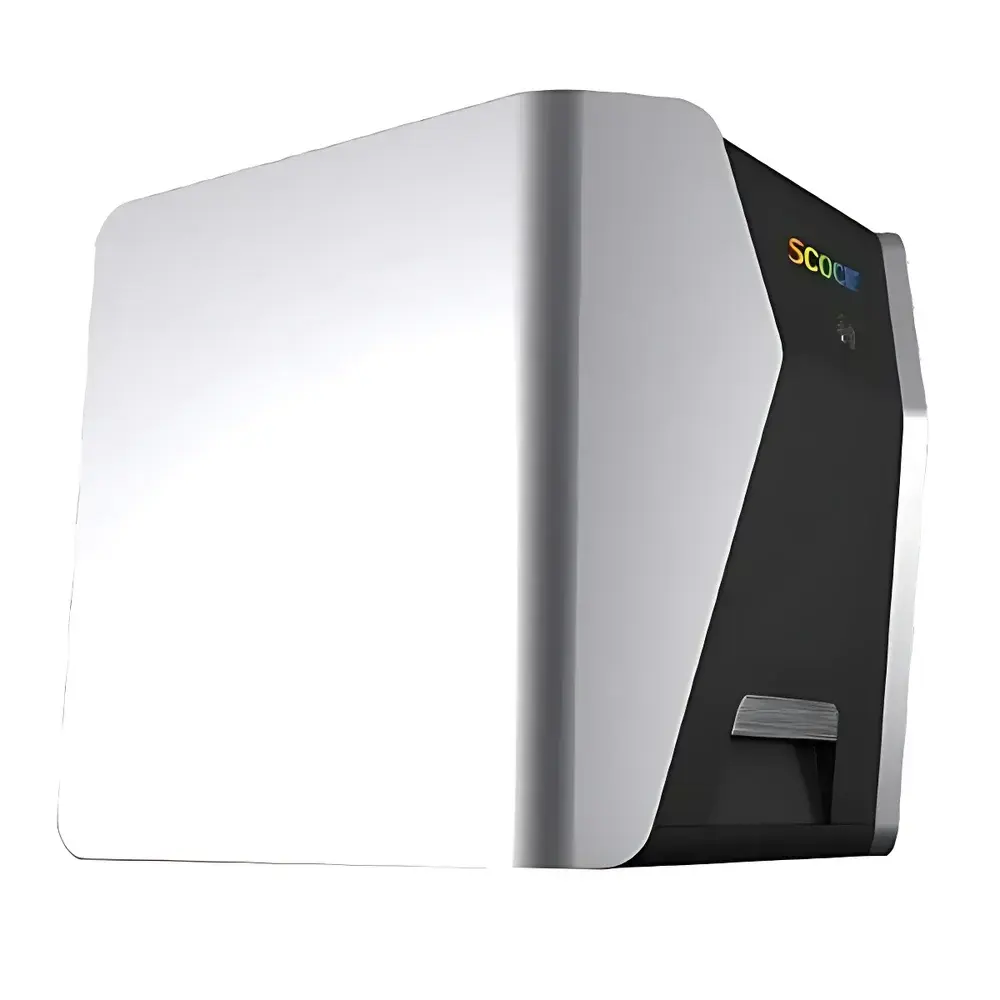
SCOSIE Digieye Digicolor Desktop Spectrophotometric Color Measurement System
| Brand | SCOSIE |
|---|---|
| Origin | Shanghai, China |
| Model | Digicolor |
| Product Type | Spectrophotometric Colorimeter |
| Instrument Type | Benchtop |
| Optical Geometry | 0°/45° Integrating Sphere |
| Illuminant | Standard D65 |
| Spectral Range | 400–700 nm |
| Repeatability | ΔE*ab ≤ 0.03 |
| Color Spaces | CIELAB, CIELCH, CIELUV, Hunter Lab, Munsell |
| Observer Angles | 2° and 10° |
| Color Difference Formulas | CIE L*a*b*, CMC (l:c), CIE94, CIEDE2000 |
| Measurable Parameters | Reflectance/Transmittance Curves, K/S (Color Strength), Whiteness/Yellowness, Opacity, ISO 105-A11 Staining & Color Change Rating, Lightness (L*), Chroma (C*), Hue (h°), Pass/Fail Tolerance Evaluation |
| Data Export Formats | CSV, QTX, TXT, DAT |
| Illuminants for Visual Assessment | D65, A, F11, D50, F02, F07 |
| Warranty | 24 months |
Overview
The SCOSIE Digieye Digicolor is a benchtop spectrophotometric color measurement system engineered for high-fidelity, non-contact digital color and appearance evaluation across heterogeneous, textured, and geometrically complex surfaces. Unlike conventional tristimulus colorimeters constrained by spot-size limitations and sensitivity to surface topography, the Digicolor employs a calibrated multi-spectral imaging architecture combined with an integrated 0°/45° integrating sphere optical path. This configuration ensures compliance with CIE-recommended geometry for diffuse reflectance measurement while enabling spatially resolved color analysis—capturing both average color metrics and regional variation within a single acquisition. The system operates across the full visible spectrum (400–700 nm) under standardized D65 illumination, with spectral data processed in real time using NIST-traceable calibration references. Its measurement principle aligns with CIE Publication 15:2018 and ISO/CIE 11664 series standards, supporting traceable, observer-matched (2° and 10° standard observer) colorimetric computation in CIELAB, CIELCH, CIELUV, Hunter Lab, and Munsell spaces.
Key Features
- Non-contact, spatially resolved color imaging: captures full-field reflectance maps—not just point measurements—enabling assessment of mottling, metamerism, and texture-related appearance effects.
- Benchtop-integrated 0°/45° integrating sphere optics: eliminates directional bias and ensures robust repeatability (ΔE*ab ≤ 0.03) across diverse substrates including fabrics, plastics, ceramics, coatings, and food surfaces.
- Multi-illuminant simulation engine: supports on-screen visual comparison under D65, A, F11, D50, F02, and F07 illuminants per CIE S 014-2/E:2021, facilitating metamerism detection and lighting-condition-specific pass/fail evaluation.
- Comprehensive color difference computation: implements CIE L*a*b*, CMC (l:c), CIE94, and CIEDE2000 algorithms with user-definable tolerances, aligned with ISO 11664-6 and ASTM D2244.
- Quantitative appearance metrics beyond color: calculates K/S (color strength), opacity (ISO 2814), whiteness (CIE/ASTM E313), yellowness index (ASTM E313), ISO 105-A11 staining and color change ratings, and lightfastness-relevant reflectance stability indices.
- FDA 21 CFR Part 11–ready software architecture: includes electronic signatures, audit trails, role-based access control, and immutable data logging for GLP/GMP-regulated environments.
Sample Compatibility & Compliance
The Digicolor accommodates samples up to 300 × 300 mm with no requirement for physical contact, vacuum clamping, or sample cutting—critical for fragile, heat-sensitive, or hygroscopic materials (e.g., textiles, pharmaceutical tablets, fresh produce, historical artifacts). It complies with ISO 7724-1 (general principles), ISO 7724-2 (instrumental requirements), and ISO 13655 (spectral measurement geometry). For textile applications, it satisfies AATCC TM173 and ISO 105-J03 for colorfastness correlation; for packaging and printing, it meets ISO 12233 and ISO 13660 for print quality consistency. All spectral calibrations are performed against NIST SRM 2020 and SRM 1979 reference tiles, with annual recalibration traceability documented per ISO/IEC 17025.
Software & Data Management
The Digicolor Control Suite provides a validated Windows-based interface supporting raw spectral data export (ASCII .csv), proprietary QTX format for cross-platform spectral library exchange, and structured text (.txt/.dat) for ERP/MES integration. Batch reporting includes statistical process control (SPC) charts, trend analysis over time, and automated deviation alerts triggered by configurable tolerance thresholds. Data integrity safeguards include timestamped operator logs, version-controlled method files, and encrypted database storage compliant with EU Annex 11 and FDA 21 CFR Part 11 requirements. Cloud-sync capability (optional) enables centralized color database management across global manufacturing sites.
Applications
The system serves as a primary color verification tool in QC laboratories across regulated and industrial sectors: textile dyeing and finishing (ISO 105-C06 fastness correlation), automotive interior trim (SAE J1545 gloss/color mapping), pharmaceutical tablet coating uniformity (USP appearance testing), food product batch consistency (FDA Food Code §3-202.11), cosmetic formulation development (ISO 8504-2 chromaticity validation), heritage conservation (CIE TC 1-69 spectral aging modeling), and printed electronics (IPC-4552B copper plating color shift monitoring). Its ability to quantify both spectral reflectance and spatial heterogeneity makes it uniquely suited for R&D applications requiring correlation between instrumental output and human visual assessment under multiple lighting conditions.
FAQ
What distinguishes Digicolor from traditional handheld or spot-type colorimeters?
It replaces point sampling with full-field spectral imaging, enabling simultaneous measurement of color uniformity, edge effects, and surface texture influence—capabilities absent in devices relying on single-aperture geometry.
Can Digicolor validate colorfastness per ISO 105 standards?
Yes—its spectral output supports computational derivation of ISO 105-A11 staining and color change ratings when paired with pre- and post-test reflectance datasets.
Is the system suitable for GxP-regulated environments?
Yes—software validation packages, IQ/OQ documentation, and 21 CFR Part 11-compliant audit trails are available upon request.
How is instrument calibration maintained?
Daily user verification uses supplied ceramic tile standards; annual recalibration is performed by SCOSIE-certified engineers with NIST-traceable reference materials and documented uncertainty budgets.
Does Digicolor support custom color tolerance ellipsoids?
Yes—users may define elliptical or rectangular tolerances in CIELAB, CIELCH, or L*C*h° space, with real-time pass/fail overlay on captured images.




