
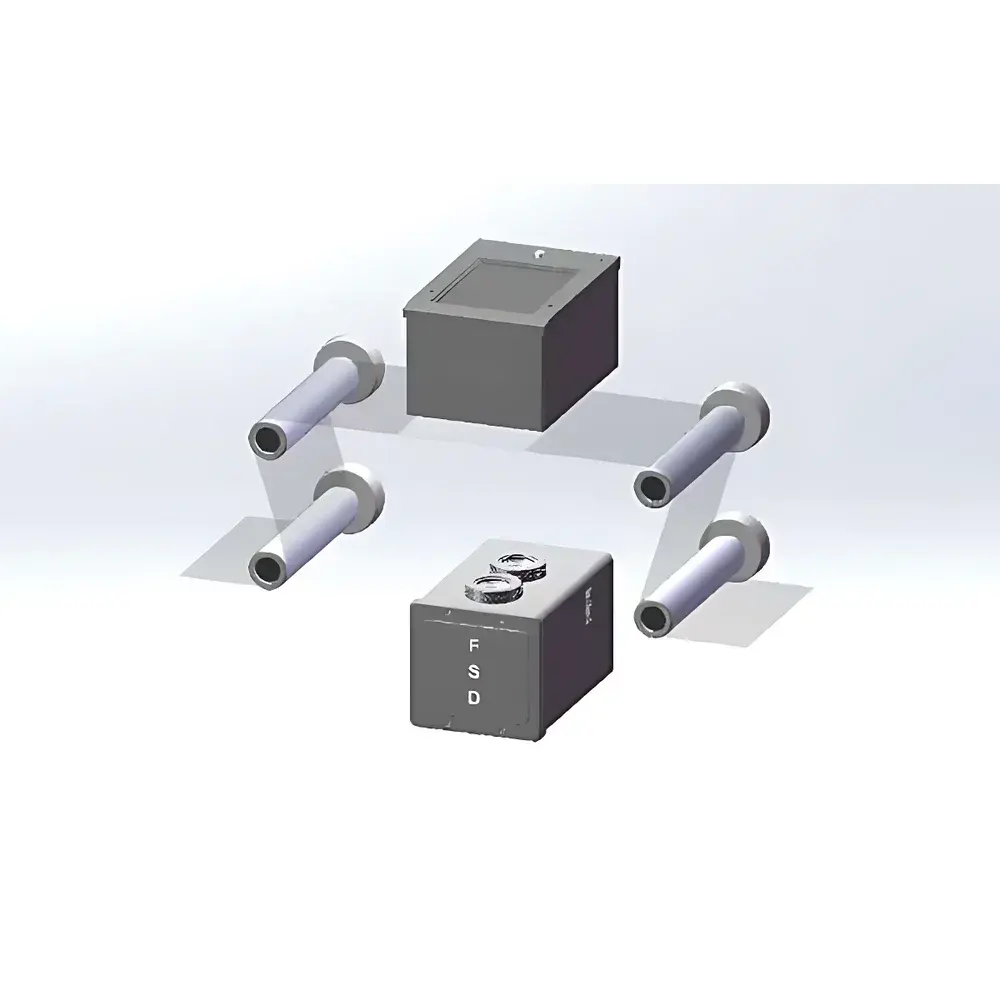
SUNPLUS FSD-200 In-Line Film Surface Inspection System
| Brand | HunterLab |
|---|---|
| Origin | Canada |
| Manufacturer Type | Authorized Distributor |
| Import Status | Imported |
| Model | FSD-200 |
| Price | Upon Request |
| Applicable Film Width | ≤210 mm |
| Minimum Detectable Feature Size | 0.1 mm (adjustable via CCD selection) |
| Spatial Resolution | Up to 30 µm (configurable with higher-resolution CCD) |
| Sensor Type | Area-Scan CCD |
| Maximum Web Speed | 18 m/min |
| Light Source | 30 W LED Cold Illumination |
| Communication Interfaces | RS232 / RS485 / Ethernet / USB |
| Power Supply | 220 VAC, 50 Hz |
| Dimensions (Upper Unit) | 230 × 131 × 108 mm |
| Dimensions (Lower Unit) | 272 × 160 × 252 mm |
| Compliance Standards | GB 6595–1986, ASTM D3351–93, GB/T 4611–2008, GB/T 11115–2009 |
Overview
The SUNPLUS FSD-200 In-Line Film Surface Inspection System is an industrial-grade optical inspection platform engineered for continuous, non-contact surface quality monitoring of polymer films during high-speed extrusion or coating processes. Based on high-contrast, multi-angle LED illumination and area-scan CCD imaging, the system implements real-time machine vision algorithms to detect, localize, classify, and quantify surface anomalies—including fisheyes, stains, embedded impurities, micro-holes, opaque spots, streaks, and localized thickness variations—on both transparent and opaque substrates. Its design adheres to the physical principles of reflective and transmissive optical contrast detection, enabling reliable defect discrimination across diverse resin-based films such as polypropylene (PP), polyethylene (PE), polyvinyl chloride (PVC), and specialty barrier or metallized films. The system operates at production-line speeds up to 18 meters per minute while maintaining sub-30 µm spatial resolution, making it suitable for integration into ISO 9001-certified manufacturing lines and compliant with critical quality control workflows in packaging, medical film, and electronics-grade substrate production.
Key Features
- Real-time defect detection and classification with configurable sensitivity thresholds for size, contrast, and shape morphology
- Simultaneous measurement of film edge position and lateral dimension stability for width consistency verification
- Live image display with digital zoom (2× to 16×), region-of-interest (ROI) marking, and false-color overlay for rapid visual validation
- Modular hardware architecture supporting interchangeable CCD sensors for resolution scaling (down to <0.1 mm target radius)
- Ruggedized mechanical housing rated for industrial environments: IP54-rated enclosure, vibration-damped mounting, and thermal-stable LED illumination
- Multi-protocol communication stack enabling seamless integration with PLCs, SCADA systems, and MES platforms via RS485, Ethernet TCP/IP, or Modbus RTU
- Onboard data logging with timestamped defect records, including X/Y coordinates, pixel area, equivalent diameter, and grayscale intensity metrics
Sample Compatibility & Compliance
The FSD-200 is validated for use with thermoplastic and thermoset films ranging from 12 µm to 500 µm in thickness. It supports both transmission-mode inspection (optimized for transparent films) and reflection-mode operation (for opaque or metallized surfaces), with automatic mode switching based on user-defined material profiles. The system meets requirements outlined in multiple international and national standards, including ASTM D3351–93 (Standard Test Method for Gel Content of Polyolefin Resins), GB/T 11115–2009 (Polyethylene Resins), GB/T 4611–2008 (Determination of Gel Particles in Polypropylene Resins), and GB 6595–1986 (Method for Determining Fish-Eye Count in Polyethylene Films). All inspection reports include traceable metadata (operator ID, shift, line speed, sensor calibration date) and support audit-ready export formats compatible with GLP/GMP documentation protocols.
Software & Data Management
The embedded inspection software provides a Windows-based GUI with dual operational modes: real-time monitoring and offline analysis. Defect data are stored in structured SQLite databases with optional synchronization to network file shares or SQL Server instances. Reporting modules generate customizable PDF or Excel outputs containing statistical summaries (defects/m², cumulative count vs. time), trend charts (SPC control limits applied to defect density), and annotated image exports. Audit trail functionality logs all configuration changes, report generation events, and user login sessions—fully compliant with FDA 21 CFR Part 11 requirements when deployed with electronic signature and role-based access controls. Firmware updates are delivered via secure HTTPS channels and verified using SHA-256 checksums.
Applications
- Quality assurance in blown and cast film extrusion lines for food packaging and agricultural mulch films
- In-process monitoring of medical-grade PVC and polyolefin films used in IV bags and diagnostic devices
- Defect screening of release liners, battery separator films, and flexible printed circuit (FPC) substrates
- Validation of surface cleanliness prior to metallization, lamination, or inkjet printing operations
- Root-cause analysis support through historical defect clustering (e.g., correlation between die lip temperature and fisheye frequency)
- Supplier qualification testing under contractual AQL sampling plans per ISO 2859–1
FAQ
Can the FSD-200 inspect films moving faster than 18 m/min?
Yes—system throughput can be extended to 30 m/min by upgrading to a high-frame-rate CCD and optimizing strobe synchronization; consult technical support for line-specific feasibility assessment.
Is calibration required before each inspection run?
No routine recalibration is needed; the system performs automated dark-field and flat-field correction at startup. NIST-traceable reference targets are provided for periodic verification (recommended every 90 days).
Does the software support custom defect classification rules?
Yes—users may define rule-based classifiers using combinations of area, aspect ratio, solidity, and intensity gradient parameters via the Rule Editor module.
Can the system interface with our existing ERP/MES platform?
Yes—standard OPC UA and RESTful API endpoints are available for bidirectional data exchange, including real-time defect alerts and batch-level summary reports.
What maintenance is required for long-term reliability?
Annual preventive maintenance includes LED luminance verification, lens cleaning protocol validation, and mechanical alignment check; no consumables are required.




