
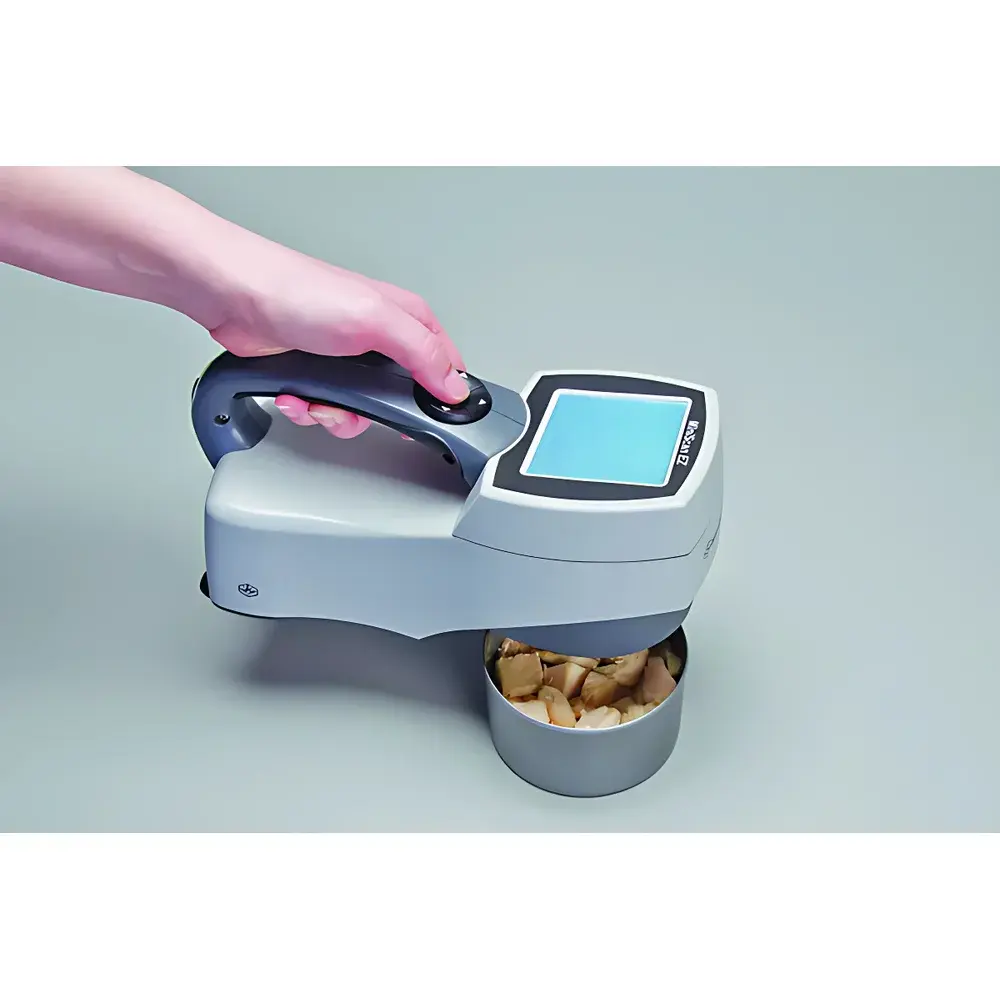
HunterLab MiniScan EZ Carbon Black Tint Strength Analyzer
| Brand | HunterLab |
|---|---|
| Origin | USA |
| Model | MiniScan EZ Carbon Black Tint Strength Analyzer |
| Instrument Type | Benchtop Colorimeter |
| Optical Geometry | 0°/45° Integrating Sphere |
| Light Source | Pulsed Xenon Lamp |
| Spectral Range | 400–700 nm |
| Wavelength Resolution | <3 nm |
| Effective Bandpass | <12 nm (Triangular) |
| Reporting Interval | 10 nm |
| Photometric Range | 0–150% |
| Repeatability | ΔE*ab ≤ 0.05 (mean, CIE Lab) |
| Large Area View (LAV) Aperture | 31.8 mm (45°/0°), 25.0 mm (D/8°) |
| Small Area View (SAV) Aperture | 6.0 mm (45°/0°), 14.3 mm (D/8°) |
| Ultra-Small Area View (VSAV) Aperture | 6.0 mm (D/8°) |
| Display | 6.4 cm × 6.4 cm LCD |
| Operating Orientations | 0°, 90°, 180°, 270° |
| Power | Rechargeable NiCd Battery or 120/220 VAC Adapter |
| Dimensions (W×H×L) | 10.2 × 12.7 × 25.4 cm |
| Weight | 1.3 kg |
Overview
The HunterLab MiniScan EZ Carbon Black Tint Strength Analyzer is a benchtop spectrophotometric color measurement system engineered specifically for quantitative assessment of carbon black tinting strength—a critical quality parameter in pigment dispersion evaluation. Unlike general-purpose colorimeters, this instrument implements a rigorously calibrated 0°/45° optical geometry with an integrating sphere to ensure high angular insensitivity and minimal influence from surface texture, gloss, or directional reflectance anomalies. Its pulsed xenon lamp delivers stable, full-spectrum illumination across the visible range (400–700 nm), enabling precise spectral acquisition without thermal drift or lamp aging artifacts. The system calculates tint strength via ASTM D3265-compliant methodology: measuring the reflectance ratio between a standard carbon black reference paste and a test sample diluted in a standardized white base (e.g., titanium dioxide dispersion), then deriving the relative tinting power using CIE L*a*b* color space transformations. This physical-optical approach ensures traceability to NIST-traceable standards and supports compliance with ISO 7724-1, ASTM E308, and ISO 11664-4.
Key Features
- Proprietary green tile calibration routine—exclusive to the MiniScan EZ platform—enhances long-term photometric stability and reduces inter-instrument variability across multi-site deployments.
- Dual-aperture optical path support: 45°/0° LAV (31.8 mm) and SAV (6.0 mm), plus D/8° configurations (LAV 25.0 mm, SAV 14.3 mm, VSAV 6.0 mm), enabling consistent measurement across heterogeneous surfaces including granular powders, viscous pastes, and molded plastic plaques.
- High-resolution spectral engine with <3 nm wavelength resolution and <12 nm effective bandpass (triangular), meeting the spectral discrimination requirements outlined in CIE Publication 15:2018 for accurate metamerism assessment.
- Robust power architecture: field-replaceable NiCd rechargeable battery (rated for >500,000 flashes) or universal AC adapter (120/220 VAC), eliminating dependency on proprietary battery packs and reducing total cost of ownership over instrument lifetime.
- Rotatable 6.4 cm × 6.4 cm LCD display with four-axis orientation sensing (0°, 90°, 180°, 270°), facilitating ergonomic operation in constrained lab environments or production-line integration.
Sample Compatibility & Compliance
The MiniScan EZ accommodates opaque solids (e.g., injection-molded polymer parts), dry powders (carbon black masterbatches), semi-solid pastes (ink formulations), and homogeneous liquids (dispersions in mineral oil or ethylene glycol). Its 0°/45° geometry minimizes specular component exclusion errors common in glossy or textured samples, while the large-area view option mitigates sampling bias in non-uniform materials. The system conforms to GLP documentation requirements through audit-trail-enabled software logging, supports 21 CFR Part 11 electronic signature readiness when paired with compliant PC-based applications, and meets ISO/IEC 17025 calibration traceability protocols when operated with certified reference tiles (e.g., NIST SRM 2035, 2036). Routine verification follows ASTM D2244 and ISO 13655 for instrumental color difference reporting.
Software & Data Management
Instrument control and data analysis are executed via HunterLab’s EasyMatch QC software (v5.0+), which provides automated tint strength calculation workflows aligned with ASTM D3265 Annex A1. Raw spectral data (10 nm intervals) is exportable in CSV, XML, or CxF/XRGA formats for integration into LIMS or ERP systems. All measurements include embedded metadata: operator ID, timestamp, aperture selection, calibration status, and environmental conditions (if external sensor input enabled). Audit trails record every parameter change, calibration event, and result modification—including user identity and justification fields—satisfying FDA and EU GMP Annex 11 validation requirements. Optional cloud synchronization enables centralized fleet management across global R&D and QC laboratories.
Applications
This analyzer serves as a primary metrology tool in carbon black manufacturing QA labs, where batch-to-batch tint strength consistency directly impacts downstream color matching performance in automotive plastics and packaging films. It is widely deployed in ink formulation facilities for optimizing pigment loading efficiency, in rubber compounding labs for evaluating furnace black dispersion quality, and in pharmaceutical excipient development for quantifying colorant uniformity in tablet coatings. Additional validated use cases include solar absorber coating characterization (per ASTM E903), ceramic glaze development, and food-grade pigment qualification under FDA 21 CFR 73/74 regulatory frameworks.
FAQ
What distinguishes the MiniScan EZ’s 0°/45° geometry from D/8° instruments for carbon black analysis?
The 0°/45° configuration eliminates diffuse reflectance contributions from surface scattering, yielding higher sensitivity to pigment concentration changes in highly absorbing matrices—critical for low-dilution carbon black tint strength assays.
Can the MiniScan EZ validate compliance with ASTM D3265 without third-party software?
Yes—the built-in EasyMatch QC workflow includes preconfigured ASTM D3265 calculation modules with automatic reference/sample ratio derivation, CIELAB delta-E computation, and pass/fail tolerance assignment per user-defined limits.
Is the green tile calibration required before each measurement session?
No—it is performed during initial setup and after major maintenance; daily verification uses standard white and black tiles per ISO 13655:2017 Section 7.3.
Does the instrument support measurement of wet films or uncured coatings?
Yes—provided the sample remains optically stable during the <100 ms xenon flash duration; optional heated sample holders (sold separately) maintain temperature-controlled conditions for rheologically sensitive dispersions.
How is traceability maintained for regulatory audits?
Each unit ships with a factory-issued calibration certificate referencing NIST-traceable standards; software-generated reports embed digital signatures, calibration history, and instrument serial number linkage per 21 CFR Part 11 Subpart B §11.10(a).






