
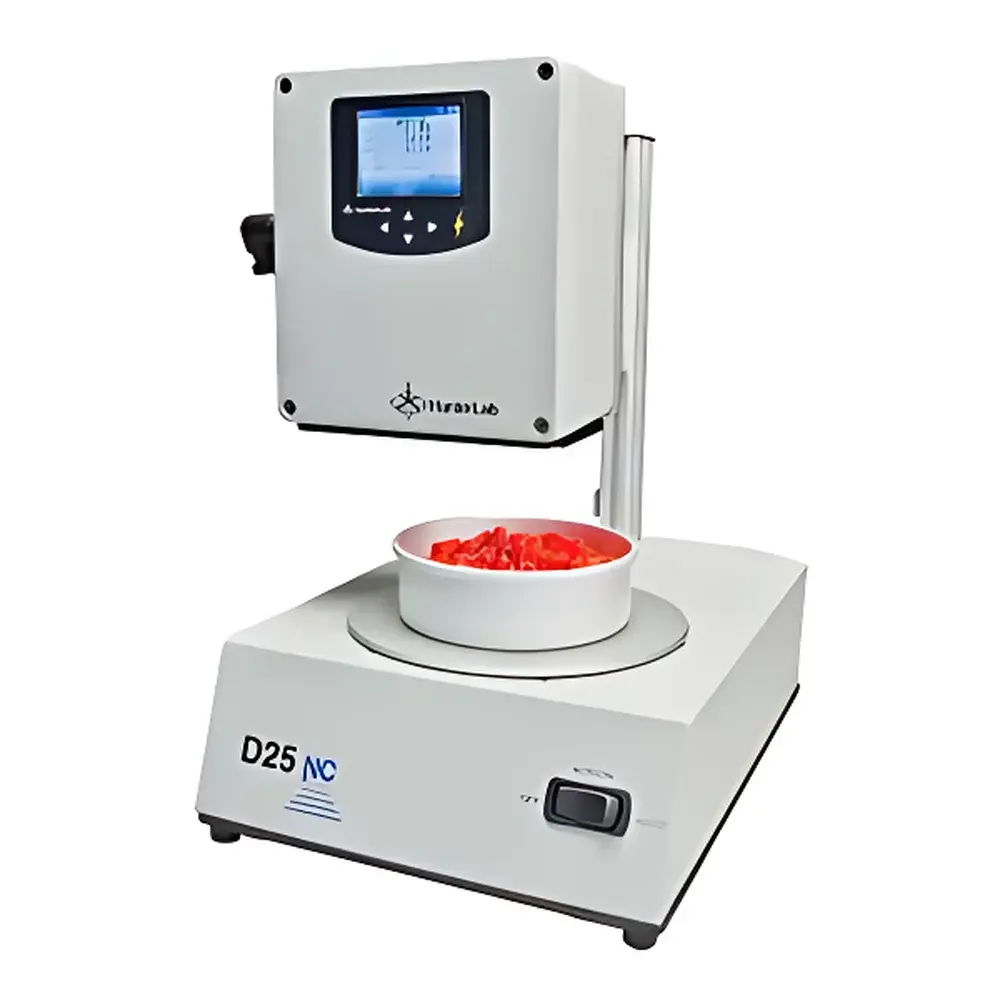
HunterLab D25NC Tomato Colorimeter
| Brand | HunterLab |
|---|---|
| Origin | USA |
| Model | D25NC Tomato Colorimeter |
| Product Type | Spectrophotometric Colorimeter |
| Instrument Type | Benchtop |
| Optical Geometry | d/8° Integrating Sphere |
| Light Source | Long-life LED |
| Spectral Range | 400–700 nm |
| Repeatability | ΔE*ab ≤ 0.03 |
Overview
The HunterLab D25NC Tomato Colorimeter is a purpose-engineered benchtop spectrophotometric color measurement system designed specifically for challenging, non-uniform, and irregularly shaped food and industrial materials—most notably whole or halved tomatoes, but also extending to granular, particulate, textured, and heterogeneous samples such as coffee beans, animal feed, extruded plastics, baked goods, and ground spices. Unlike conventional contact-based colorimeters, the D25NC employs a non-contact d/8° integrating sphere optical architecture with synchronized sample rotation, enabling spatially averaged spectral reflectance acquisition across large surface areas (129 cm²) without physical pressure, compression, or sample homogenization. Its core measurement principle relies on diffuse illumination and hemispherical collection under CIE-standard illuminants (e.g., D65, A), delivering CIELAB (L*, a*, b*), CMC, and ΔE*ab values traceable to NIST-calibrated standards. Engineered for production-floor robustness and laboratory-grade accuracy, the D25NC integrates 60 years of HunterLab’s spectral science heritage into a single, self-contained platform compliant with ISO 11664, ASTM E308, and CIE Publication No. 15.
Key Features
- Non-contact measurement head with precision Z-axis height control—ensures consistent working distance independent of sample topography
- Motorized rotating sample tray (25 measurements per full 360° rotation, up to 5 Hz sampling rate) for statistically representative spatial averaging
- 129 cm² large-area measurement zone—ideal for whole fruits, bulk grains, or irregular composites where small-spot instruments yield non-representative data
- Long-life, thermally stabilized LED light source (400–700 nm) with <0.1 nm/h spectral drift—eliminates lamp replacement cycles and warm-up delays
- Integrated USB host interface supporting direct connection to keyboards, barcode scanners, thermal printers, and host PCs—no external hubs required
- Onboard memory stores up to 250 instrument configurations and 2,000 sample records—enabling standalone operation in GMP or remote environments
- Tool-free modular assembly—optical head, tray mechanism, and housing disassemble in <60 seconds for cleaning or calibration verification
- Low-power design (<12 W typical operating load) suitable for continuous-duty deployment in QC labs or processing lines
Sample Compatibility & Compliance
The D25NC accommodates natural, unprocessed, and minimally prepared samples—including whole tomatoes, diced vegetables, roasted nuts, extruded pellets, powdered spices, and shredded meat products—without grinding, pressing, or pelleting. Its non-contact geometry eliminates surface deformation artifacts common in contact probes, preserving sample integrity for downstream analysis. The system meets ISO/IEC 17025 requirements for method validation when used with certified reference tiles (e.g., NIST SRM 2035). It supports audit-ready data handling per FDA 21 CFR Part 11 when paired with HunterLab EasyMatch QC software (v5.0+), including electronic signatures, user access controls, and immutable audit trails. All firmware and calibration files are digitally signed and version-locked to ensure traceability during GLP/GMP inspections.
Software & Data Management
While fully functional as a stand-alone instrument, the D25NC seamlessly integrates with HunterLab EasyMatch QC software via USB or Ethernet. EasyMatch QC provides real-time SPC charting (X-bar/R, Cp/Cpk), custom pass/fail tolerancing by color difference (ΔE*ab, ΔL*, Δa*, Δb*), multi-instrument fleet management, and automated report generation (PDF, CSV, XML). Raw spectral data (10 nm intervals, 400–700 nm) is exportable for third-party chemometric modeling (e.g., PLS regression for ripeness prediction). The software enforces role-based permissions, session logging, and electronic record retention aligned with ISO 9001 and ICH Q7 guidelines.
Applications
The D25NC delivers quantitative color consistency for raw material intake, in-process monitoring, and finished-product release across agri-food, feed, and polymer sectors. Typical use cases include: objective ripeness grading of tomatoes and peppers; batch-to-batch hue verification of roasted coffee beans; color uniformity assessment of extruded pet food kibble; L* value trending for fried potato products (chips, fries); a* evaluation of cured meat slices; b* monitoring in milled wheat flour; and chromatic dispersion analysis of recycled plastic flakes. Its ability to resolve subtle hue shifts in heterogeneous matrices makes it especially valuable for R&D applications involving natural pigment stability, enzymatic browning, or Maillard reaction kinetics.
FAQ
Does the D25NC require sample preparation such as grinding or pressing?
No—its non-contact, rotating-platform design eliminates the need for homogenization, compression, or slicing. Whole or halved tomatoes, loose grains, and irregular solids are measured as-is.
How is measurement height controlled and verified?
A motorized Z-axis stage maintains a fixed 18 mm working distance via closed-loop position sensing; height calibration is performed using a supplied NIST-traceable spacer gauge.
Can the D25NC be integrated into an existing MES or LIMS environment?
Yes—via EasyMatch QC’s OPC UA and REST API interfaces, color data can be pushed to SAP QM, LabWare LIMS, or custom SCADA systems with configurable metadata tagging.
Is spectral data accessible for advanced analysis?
Yes—full 400–700 nm reflectance spectra (10 nm resolution) are stored onboard and exportable in JDF or ASCII format for PCA, cluster analysis, or machine learning model training.
What maintenance is required beyond routine cleaning?
Annual factory recalibration is recommended; no consumables or lamp replacements are needed due to solid-state LED illumination and sealed optical path design.




