
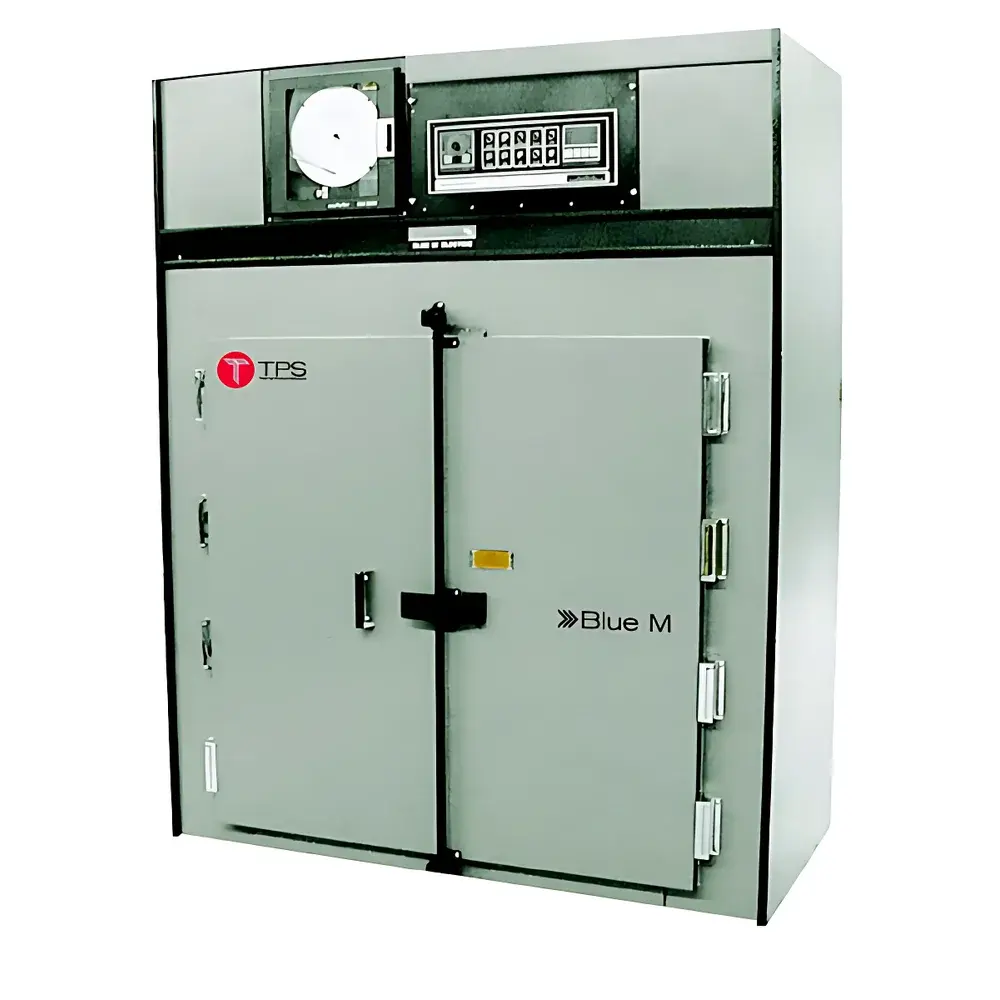
Blue M Embedded Benchtop Oven
| Brand | Blue M |
|---|---|
| Origin | USA |
| Model | Embedded Oven |
| Temperature Range | Ambient +15°C to 300°C |
| Uniformity | ±1% of setpoint |
| Control Accuracy | ±1.0°C |
| Resolution | 0.1°C |
| Power Consumption | 6,600 W (at 125°C, 60 Hz) |
| Heating Method | Forced-air convection |
| Internal Dimensions | 25×25×25 in to 48×25×48 in (63.5×63.5×63.5 cm to 121.9×63.5×121.9 cm) |
| Construction | Reinforced 304 stainless steel interior, welded seam, 4″ fiberglass insulation, porcelain enamel exterior finish |
| Airflow Options | Horizontal or vertical dual-boost configuration |
| Standard Safety | Interlocked door, redundant overtemperature protection, customer power interlock |
| Fan Type | Direct-drive multi-blade centrifugal blower |
| Optional Features | Nitrogen purge, rear service access door, chart recorder (BI-9/BI-9V), floor stand, inlet port |
Overview
The Blue M Embedded Benchtop Oven is an industrial-grade, forced-air convection oven engineered for precision thermal aging, curing, drying, and stress-relief applications in R&D laboratories and production environments. Designed and manufactured in the United States, this embedded oven employs a robust thermal architecture centered on uniform airflow distribution, high-mass thermal stability, and repeatable temperature control across its full operating range—from ambient +15°C up to 300°C. Its core principle relies on calibrated forced convection: a direct-drive, multi-blade centrifugal blower delivers consistent volumetric air exchange while dual-boost airflow channels—configured horizontally or vertically—compensate dynamically for load-induced thermal gradients. This ensures ISO/IEC 17025-aligned process consistency and supports GLP/GMP-compliant thermal validation protocols where reproducibility and traceability are mandatory.
Key Features
- Reinforced structural integrity: 14-gauge cold-rolled steel outer casing with 304 stainless steel welded interior chamber; no rivets or seams compromising containment integrity
- Thermal efficiency optimization: 4-inch (102 mm) thick fiberglass insulation layer minimizes heat loss and stabilizes chamber wall temperatures during extended dwell cycles
- Low-noise, high-reliability airflow system: Direct-coupled centrifugal blower operates at <65 dBA at 1 m—critical for shared lab environments requiring acoustic compliance
- Dual-boost airflow design: Independently adjustable inlet/outlet ducts maintain laminar flow profiles across variable load configurations (e.g., PCB racks, component trays, or bulk material carriers)
- Integrated safety architecture: Dual independent overtemperature limiters (mechanical and electronic), door interlock switch, and customer-side power interlock interface compliant with IEC 61000-6-2 EMC immunity standards
- Surface finish durability: Porcelain enamel exterior coating resists chemical splashes and mechanical abrasion; silicone gasket seal rated for continuous operation at 300°C
Sample Compatibility & Compliance
This oven accommodates diverse sample geometries—including printed circuit boards, semiconductor packages, polymer composites, and metal alloys—without requiring custom fixtures. Internal dimensions span from 9.0 ft³ (25×25×25 in) to 33.3 ft³ (48×25×48 in), supporting standard DIN/ISO tray systems and ASTM E220-compliant thermocouple placement zones. All models meet UL 61010-1 (2nd Ed.) and CSA C22.2 No. 61010-1 safety requirements. Optional nitrogen purge capability enables inert-atmosphere processing per ASTM F1929 (leak detection) and IPC-TM-650 2.6.25 (moisture sensitivity level testing). The oven’s thermal uniformity (±1% of setpoint) satisfies USP dry-heat sterilization validation prerequisites when paired with qualified Class N thermocouples and 21 CFR Part 11–compliant data logging systems.
Software & Data Management
While the standard controller features a programmable digital PID interface with real-time setpoint tracking and alarm history (non-volatile memory), optional integration with Blue M’s BMS-Link™ software suite enables full audit-trail functionality. BMS-Link supports FDA 21 CFR Part 11 user authentication, electronic signatures, and immutable event logs—including door open/close timestamps, temperature deviation alerts, and power interruption records. Data export formats include CSV and PDF reports compliant with ISO 13485 quality management system documentation requirements. Chart recorder compatibility (BI-9/BI-9V) provides analog redundancy for critical validation runs where hybrid analog/digital archiving is mandated by internal SOPs.
Applications
- Electronic component burn-in and thermal cycling per MIL-STD-883 Method 1015 and JEDEC JESD22-A108
- Pre-bake and post-cure of conformal coatings, adhesives, and encapsulants (IPC-A-610, IPC-J-STD-020)
- Moisture removal from hygroscopic materials prior to X-ray fluorescence (XRF) or SEM analysis
- Accelerated aging of battery electrolytes and separator membranes under controlled O₂-free conditions (with nitrogen purge option)
- Residual solvent evaporation from pharmaceutical excipients per USP
- Calibration verification of RTDs and thermistors using fixed-point reference blocks
FAQ
What voltage configurations are supported?
Standard models operate at 208 VAC / 240 VAC / 480 VAC, all three-phase, 60 Hz. Load current ratings scale proportionally (e.g., 14 A @ 480 VAC for the 33.3 ft³ vertical-flow model).
Is the oven suitable for Class 100 cleanroom installation?
Yes—when equipped with HEPA-filtered inlet air and nitrogen purge, it meets ISO 14644-1 Class 5 particulate limits; stainless steel interior eliminates particle shedding.
Can I validate temperature uniformity per ASTM E220?
Absolutely—the chamber geometry supports ≥9 thermocouple probe locations as specified in ASTM E220 Annex A1; Blue M provides a validation support package including probe mapping templates and uncertainty budget worksheets.
What maintenance intervals are recommended for the blower assembly?
The direct-drive centrifugal blower requires no scheduled lubrication; annual inspection of blade balance and bearing runout is advised per manufacturer’s maintenance log (Form BM-OV-MNT-01).



