
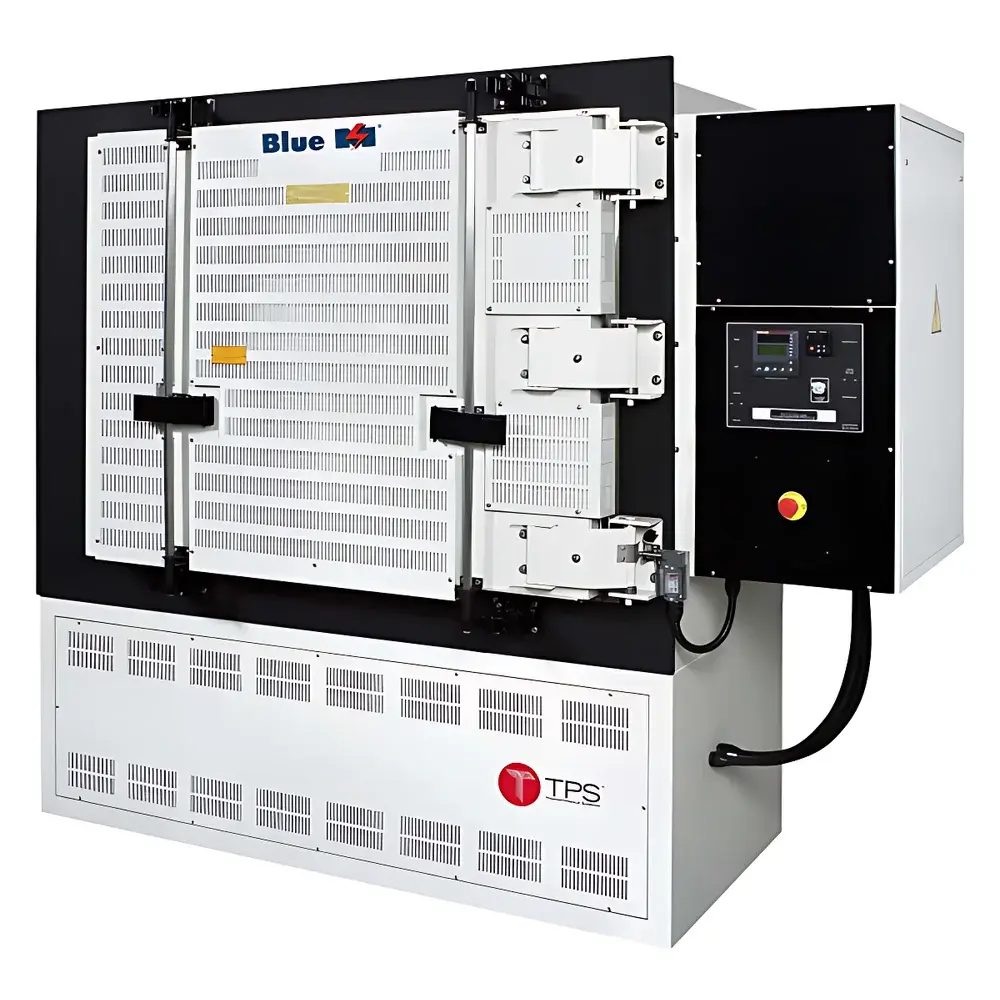
Blue M CW-Series High-Temperature Forced-Air Circulating Oven
| Brand | Blue M |
|---|---|
| Origin | USA |
| Model | CW-Series |
| Max Temperature | 704°C |
| Temperature Uniformity | ±2% of setpoint |
| Control Accuracy | ±0.5°C |
| Resolution | ±0.1°C |
| Heating Method | Forced-air convection with multi-blade centrifugal fan |
| Internal Dimensions | 356×356×356 mm to 1219×610×914 mm |
| Power Rating | Up to 30.0 kW (480 VAC, 3-Phase) |
| Insulation | 152 mm (6") mineral wool |
| Compliance | NFPA 86 Class B |
Overview
The Blue M CW-Series High-Temperature Forced-Air Circulating Oven is an industrial-grade thermal processing system engineered for precision heat treatment applications requiring sustained operation up to 704°C (1299°F). Based on the fundamental principle of forced convection—where a dynamically balanced, high-capacity centrifugal blower circulates heated air uniformly across the chamber—it delivers exceptional thermal uniformity and repeatability under variable load conditions. Unlike natural-convection or static-heating furnaces, the CW-Series employs a unidirectional, adjustable airflow architecture that minimizes thermal stratification and ensures consistent exposure of samples to the set temperature profile. Designed in strict adherence to NFPA 86 Class B safety standards for high-temperature ovens, this series supports critical processes including annealing of metal alloys, stress-relief of welded components, ceramic sintering pre-firing, and polymer cross-linking validation—applications where deviation beyond ±0.5°C control accuracy or ±2% spatial uniformity could compromise material microstructure or process qualification.
Key Features
- Heavy-duty Eterna® heating elements fabricated from low-watt-density nickel-chromium alloy wire, engineered for extended service life and resistance to thermal cycling degradation at temperatures exceeding 700°C.
- Welded and fully sealed internal chamber construction prevents fume infiltration into insulation layers, maintaining long-term thermal integrity and minimizing maintenance intervals.
- Adjustable single-pass airflow system with infinitely variable damper control—enabling precise modulation from full recirculation to 100% fresh-air purge, including programmable ramp-and-soak cooling profiles.
- Robust 6-inch (152 mm) mineral wool insulation combined with double-gasketed, reinforced glass-fiber door seals and integrated safety interlocks that de-energize both heaters and blower upon door opening.
- High-efficiency multi-blade centrifugal fan rated for continuous operation at elevated temperatures, dynamically balanced to ISO 1940 Grade G2.5 and capable of delivering >1,200 CFM (34 m³/min) in larger models.
- Front-panel programmable controller with real-time data logging, alarm history, and configurable setpoint ramps—compatible with optional Ethernet/IP or Modbus TCP interfaces for integration into centralized SCADA or MES environments.
Sample Compatibility & Compliance
The CW-Series accommodates a broad range of sample geometries and material classes—including metallic substrates, refractory ceramics, composite laminates, and coated aerospace components—without compromising thermal fidelity. Internal chamber dimensions span from compact 1.6 ft³ (CW-5580) to industrial-scale 24.0 ft³ (CW-9980), all featuring smooth, weld-seam-free stainless steel liners (304 SS standard, 316 SS optional) resistant to oxidation and scaling. The oven meets NFPA 86 Class B requirements for explosion-resistant construction, including pressure-relief venting (optional electric vacuum-break valve), redundant overtemperature protection (independent limit controller + mechanical high-limit switch), and grounded chassis design compliant with UL 508A and CSA C22.2 No. 14. It supports audit-ready documentation packages aligned with GLP and GMP frameworks, including IQ/OQ protocols, calibration traceability to NIST standards, and 21 CFR Part 11–compliant electronic record functionality when paired with Blue M’s optional DataVault™ software suite.
Software & Data Management
Standard configuration includes a microprocessor-based PID controller with 16-segment programmable ramp/soak capability, real-time temperature trending, and non-volatile alarm event logging. Optional DataVault™ software enables secure, time-stamped data export in CSV or PDF format, user-level access controls (administrator/operator/guest), and automated report generation per ISO/IEC 17025 Annex A.5 requirements. All firmware updates are digitally signed and validated; controller firmware revision history and calibration certificate metadata are embedded within each data file. For regulated laboratories, optional 21 CFR Part 11 modules provide electronic signature enforcement, audit trail encryption (AES-256), and role-based permission hierarchies—fully compatible with LIMS integration via OPC UA or RESTful API endpoints.
Applications
- Metallurgical annealing of stainless steels, tool steels, and titanium alloys per ASTM E112 and AMS 2750E pyrometry requirements.
- Stress-relief heat treatment of large castings and welded assemblies prior to non-destructive testing (NDT), conforming to AWS D1.1 and ASME Section VIII Div. 1 guidelines.
- Pre-sintering and binder burnout cycles for powder metallurgy and MIM components, supporting controlled atmosphere compatibility (N₂, Ar, forming gas).
- Thermal aging studies of polymer composites and elastomers per ISO 188 and ASTM D573 accelerated life testing protocols.
- Calibration and verification of thermocouples, RTDs, and infrared sensors using fixed-point reference blocks traceable to NIST SRM 1750a.
FAQ
What temperature uniformity can be expected across the working chamber at 704°C?
At maximum operating temperature, uniformity is maintained within ±2% of setpoint across the defined work area per NFPA 86 test methodology—verified during factory acceptance testing using nine calibrated Type K thermocouples per ASTM E2203.
Is the oven suitable for inert or reducing atmospheres?
Yes—when equipped with optional gas inlet/outlet ports, purge manifold, and atmosphere monitoring interface, the CW-Series supports nitrogen, argon, hydrogen-nitrogen blends, and vacuum-assisted purging down to 10⁻² torr (with external pump).
How is thermal calibration performed and documented?
Each unit ships with a NIST-traceable calibration certificate covering three points (200°C, 500°C, 700°C); field recalibration follows ASTM E740 procedures using a certified reference thermometer and multi-point mapping protocol.
Can the controller be integrated into a lab-wide automation network?
Yes—standard Modbus RTU over RS-485 is included; optional EtherNet/IP, PROFINET, or MQTT gateways enable seamless connectivity to PLCs, DCS systems, or cloud-based monitoring platforms.
What maintenance intervals are recommended for the blower assembly?
The centrifugal fan requires biannual inspection of bearing preload and belt tension (if belt-driven); direct-drive models feature lifetime-lubricated bearings rated for 30,000 hours at 704°C ambient casing temperature.



