
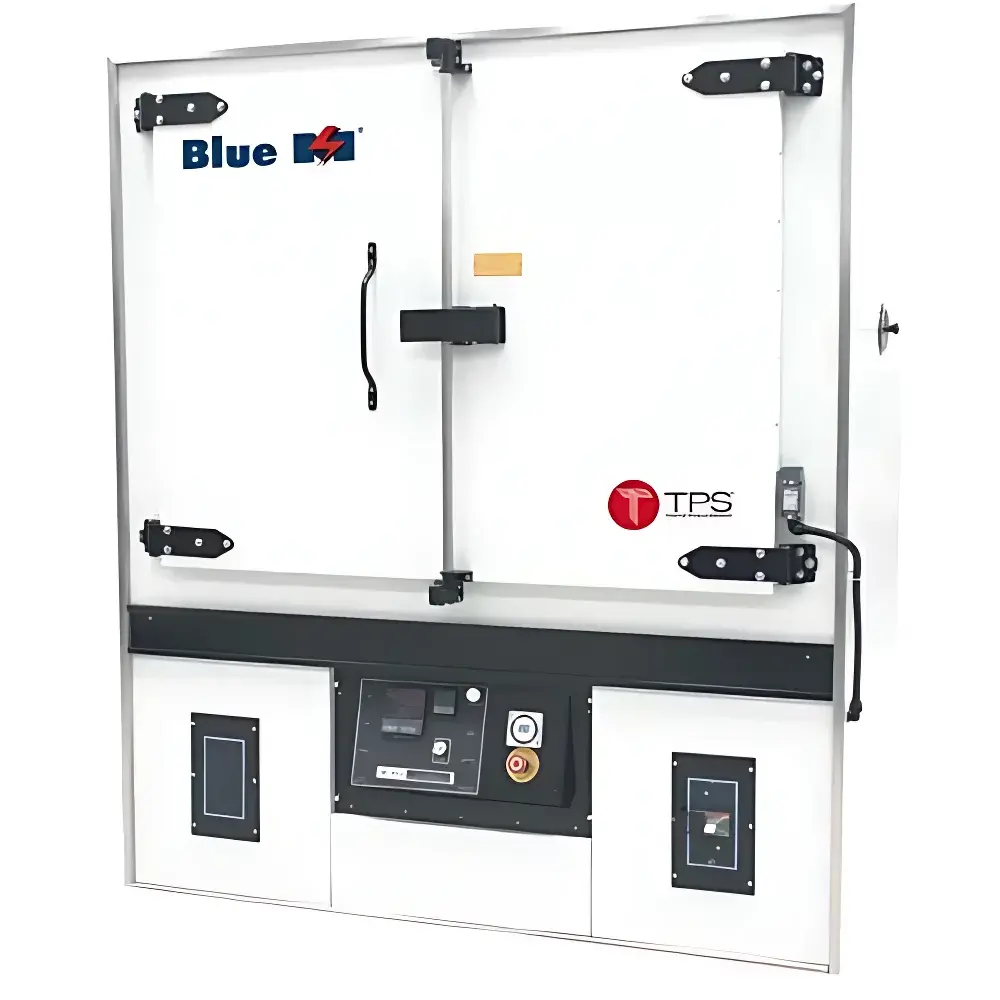
Blue M 146 Series Standard Mechanical Convection Oven
| Brand | Blue M |
|---|---|
| Origin | USA |
| Model | 146 Series Standard Mechanical Convection Oven |
| Temperature Range | Ambient +15°C to 350°C |
| Control Accuracy | ±1.0°C |
| Max Power | 24.0 kW |
| Heating Method | Forced-air circulation |
| Internal Dimensions | 508 × 457 × 508 mm to 1219 × 635 × 940 mm |
| Uniformity | Configurable per application requirements (ASTM E145-compliant validation support available) |
| Construction | 304 stainless steel interior, heavy-gauge cold-rolled steel exterior with white porcelain enamel finish |
| Airflow System | Adjustable single-pass ducted airflow with motorized dampers and direct-drive high-volume centrifugal blower |
| Safety | Independent overtemperature limit controller, GFCI circuit breaker, thermal cutoff switch |
Overview
The Blue M 146 Series Standard Mechanical Convection Oven is a precision-engineered laboratory and light-industrial heating system designed for applications demanding repeatable thermal profiles, uniform heat distribution, and long-term operational reliability. Built upon the foundational principles of forced-air convection—where heated air is actively circulated via a dynamically balanced centrifugal blower—the 146 Series delivers consistent thermal energy transfer across the entire work chamber. Unlike natural convection ovens, its mechanical airflow architecture ensures minimal temperature gradients (<±1.5°C typical at 350°C under load, per ASTM E145 Class II validation protocols), making it suitable for critical processes such as polymer curing, moisture removal, accelerated aging of electronic components, and standardized materials testing (e.g., ASTM D2243, UL 746B, IPC-TM-650). The oven’s structural integrity, corrosion-resistant 304 stainless steel chamber, and dual-wall insulated door with independent overtemperature protection reflect adherence to industrial safety and longevity standards.
Key Features
- High-reliability Blue M Eterna® heating elements: Nickel-chromium alloy wound at low power density to extend service life and minimize hot-spot formation
- Direct-drive, high-volume centrifugal blower: Dynamically balanced multi-blade impeller operating at elevated temperatures; engineered for low acoustic emission and stable airflow across variable load conditions
- Adjustable single-pass airflow system: Motorized inlet and exhaust dampers enable real-time optimization of air residence time and velocity—critical for sensitive samples or heterogeneous loads
- Robust thermal architecture: 50 mm thick fiberglass insulation reduces external surface temperature to <45°C at maximum operating temperature, meeting OSHA 1910.304(b)(3) touch-safety guidelines
- Factory-assembled and individually tested: Each unit undergoes full thermal mapping (9-point sensor array) and functional verification at rated voltage/frequency prior to shipment
- Dual independent temperature control: Primary PID controller with ±0.1°C resolution and secondary independent upper-limit controller (ULC) for fail-safe thermal containment
- Electrical flexibility: Compatible with 208–480 VAC, 1Φ/3Φ, 50/60 Hz configurations; built-in ground-fault circuit interrupter (GFCI) per NEC Article 422.5(A)
Sample Compatibility & Compliance
The 146 Series accommodates diverse sample geometries and thermal mass profiles—from small PCB assemblies to large composite laminates—via five standard cavity configurations (DCI-206 through DC-1406), offering internal volumes from 4.2 to 24.0 ft³ (0.12–0.68 m³). All models comply with ASTM E145–22 “Standard Specification for Gravity-Convection and Forced-Ventilation Ovens” for Class II (mechanical convection) performance classification. The stainless steel interior supports cleaning validation under cGMP Annex 1 and ISO 14644-1 cleanroom-compatible maintenance protocols. Optional IQ/OQ documentation packages are available for laboratories operating under FDA 21 CFR Part 11, ISO/IEC 17025, or GLP environments. Electrical design conforms to UL 61010-1 and CSA C22.2 No. 61010-1 for laboratory equipment safety.
Software & Data Management
While the base 146 Series utilizes an analog/digital hybrid controller with manual setpoint adjustment, optional digital upgrades include the Blue M AccuTrak™ programmable controller (part number ACCU-146), supporting up to 16-step ramp-soak profiles, real-time data logging (RS-485 Modbus RTU), and audit-trail-enabled event recording—including door open/close, overtemperature events, and power interruptions. Logged data export in CSV format enables integration with LIMS or ELN platforms. All controllers retain configuration settings during power loss and support NIST-traceable calibration certificate generation. For regulated environments, the AccuTrak™ module satisfies FDA 21 CFR Part 11 requirements for electronic records and signatures when deployed with user access controls and audit trail activation.
Applications
- ASTM-standardized thermal testing: Cure cycle validation per ASTM D2243 (epoxy resins), moisture content determination per ASTM D4442, and thermal aging per ASTM D573
- Electronics reliability: Burn-in testing of PCBs and semiconductors per IPC-J-STD-020 and JEDEC JESD22-A108
- Materials science: Pre-drying of ceramic green bodies, binder burnout, and solvent evaporation in composite prepreg processing
- Quality assurance: Residual solvent removal from coated medical devices prior to packaging validation
- Regulatory compliance: UL 746B long-term thermal aging of polymeric insulating materials and IEC 60695-10-2 glow-wire test preconditioning
FAQ
What temperature uniformity can be expected across the working chamber?
Typical uniformity is ±1.5°C at 350°C under full-load conditions (per ASTM E145 thermal mapping protocol). Custom uniformity specifications (e.g., ±0.8°C) are achievable with optional airflow tuning and validation support.
Is the oven suitable for use in a Class 1000 cleanroom environment?
Yes—the 304 stainless steel interior, non-shedding insulation, and absence of internal gasket adhesives meet ISO 14644-1 Class 6 particulate requirements when operated with HEPA-filtered intake air (optional accessory).
Can the oven be integrated into a central building management system (BMS)?
With the AccuTrak™ controller upgrade, Modbus RTU output enables BMS connectivity for remote status monitoring, alarm relay outputs, and setpoint synchronization.
Does Blue M provide installation qualification (IQ) and operational qualification (OQ) documentation?
Yes—validated IQ/OQ templates aligned with ISO/IEC 17025 and FDA guidance are available upon request; field validation services are offered globally through authorized partners.
What is the expected service life of the Eterna® heating elements at maximum temperature?
Rated for >15,000 hours continuous operation at 350°C under nominal load conditions, based on accelerated life testing per MIL-HDBK-217F.
Related Products



