
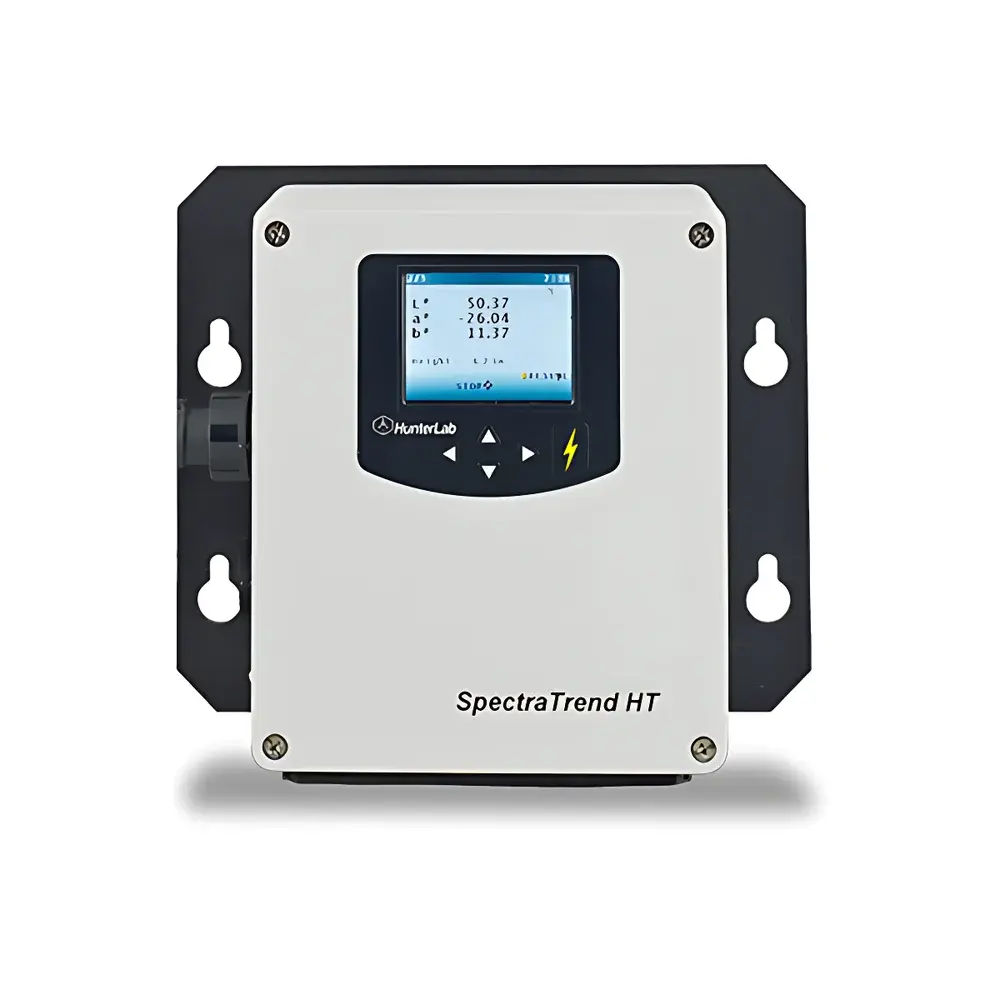
HunterLab SpectraTrend HT Inline Leather Color Measurement System
| Brand | HunterLab |
|---|---|
| Origin | USA |
| Product Type | Spectrophotometric Colorimeter |
| Instrument Type | Inline |
| Optical Geometry | 0/45° Integrating Sphere |
| Light Source | Full-Spectrum Balanced Solid-State LED System |
| Spectral Range | 400–700 nm |
| Repeatability | ΔE*ab ≤ 0.03 |
| Compliance | Designed for LQM, PAT, Six Sigma, and DMAIC Quality Frameworks |
| Data Synchronization | Metrological Traceability to Laboratory-Grade HunterLab Benchtop Instruments (e.g., UltraScan VIS, MiniScan EZ) |
Overview
The HunterLab SpectraTrend HT Inline Leather Color Measurement System is an engineered solution for continuous, non-contact spectral color monitoring directly on moving leather production lines. Based on diffuse reflectance spectroscopy under standardized 0/45° optical geometry, the system captures full-spectrum reflectance data (400–700 nm) at high temporal resolution—enabling real-time detection of chromatic deviations before visual inspection or downstream processing. Unlike manual or spot-check instruments, the SpectraTrend HT integrates into the production environment as a deterministic metrological node: it delivers traceable, laboratory-grade colorimetric values (CIE L*a*b*, ΔE*ab, Yellowness Index, Whiteness Index, etc.) without interrupting line speed or requiring operator intervention. Its solid-state LED illumination ensures photometric stability across thermal and temporal variations, eliminating lamp drift and reducing recalibration frequency—critical for GMP-aligned manufacturing environments where measurement continuity directly impacts batch release decisions.
Key Features
- Full-width automated transverse scanning mechanism with programmable lateral travel, enabling uniform coverage across wide-format leather hides (up to 2.2 m width).
- Integrated height-sensing capability: Simultaneously measures surface topography and spectral reflectance, compensating for substrate undulation and ensuring consistent measurement distance (±0.5 mm tolerance).
- Self-calibrating architecture: Scheduled auto-correction intervals configurable via HMI; eliminates manual calibration dependency and associated safety risks in proximity to moving conveyors.
- Acoustic-optical alarm system: Triggers localized audible and visual alerts upon detection of out-of-spec color deviation (user-defined ΔE*ab thresholds), with timestamped event logging.
- Ruggedized IP65-rated enclosure with heat-dissipating passive cooling—designed for ambient temperatures up to 50°C and humidity levels common in tannery and finishing facilities.
- Real-time spectral data streaming via Ethernet/IP or Modbus TCP to MES/SCADA platforms for closed-loop process feedback and SPC charting.
Sample Compatibility & Compliance
The SpectraTrend HT is validated for use on all major leather substrates—including chrome-tanned, vegetable-tanned, aniline, semi-aniline, and pigmented leathers—regardless of grain structure, surface finish (matte, glossy, embossed), or dyeing method. Its 0/45° geometry minimizes directional bias from texture and gloss, delivering results highly correlated (r² ≥ 0.998) with reference measurements from HunterLab UltraScan VIS benchtop spectrophotometers under ASTM D2244 and ISO 11664-4 conditions. The system supports audit-ready data integrity per FDA 21 CFR Part 11 requirements when deployed with compliant software modules, including electronic signatures, immutable audit trails, and role-based access control. It is routinely specified in leather OEM quality agreements referencing ISO 9001:2015, IATF 16949, and ZDHC MRSL v3.0 compliance workflows.
Software & Data Management
Controlled via SpectraTrend HT Manager—a Windows-based application supporting configuration, diagnostics, and historical trend analysis—the system exports structured CSV and XML datasets compatible with JMP, Minitab, and Python-based statistical process control libraries. All color data are stored with full metadata: timestamp, conveyor speed, measurement position (X/Y coordinates), substrate ID (via optional barcode integration), and environmental sensor readings (ambient temperature/humidity). Version-locked firmware ensures reproducibility across installations; calibration certificates are digitally signed and include NIST-traceable reference standards (BCRA tiles, ceramic tiles SRM 2035). Raw spectral files (.spc) retain full 10-nm interval resolution for retrospective reprocessing using updated color difference formulas (e.g., CIEDE2000, CMC(l:c)).
Applications
- Real-time color consistency verification during drum dyeing, spray coating, and roller coating stages.
- Early detection of batch-to-batch variation in dye lots or pigment dispersion instability.
- Correlation of color shift with process parameters (pH, temperature, dwell time) for root-cause analysis in Six Sigma DMAIC projects.
- Automated pass/fail gating at final inspection stations prior to cutting and grading.
- Long-term trending of color stability across aging, lightfastness, and perspiration resistance testing protocols.
- Supporting Lean Manufacturing initiatives by reducing scrap rates linked to post-production color rejection (typical reduction: 12–18% in Tier-1 automotive leather suppliers).
FAQ
Does the SpectraTrend HT require periodic physical recalibration with standard tiles?
No—its self-referencing LED stability algorithm and internal white/dark reference cycles eliminate routine tile-based recalibration. Physical verification against BCRA Series II tiles is recommended annually or after mechanical shock events.
Can it operate reliably under high-humidity tannery conditions?
Yes—its conformally coated optics, sealed detector housing, and condensation-resistant lens assembly meet IP65 ingress protection and have been field-validated in relative humidity up to 95% non-condensing.
How is measurement data synchronized with lab instruments?
Via shared HunterLab Color iQ engine and identical CIE observer/illuminant settings (10° observer, D65 illuminant); cross-instrument agreement is maintained within ±0.05 ΔE*ab on certified leather standards.
Is third-party SCADA integration supported?
Yes—native support for OPC UA, Modbus TCP, and Ethernet/IP enables direct connection to Siemens PCS7, Rockwell FactoryTalk, and ABB 800xA systems without middleware.
What is the minimum detectable color difference under production-line conditions?
At typical conveyor speeds (0.3–1.2 m/s) and measurement intervals (100–500 ms), the system resolves ΔE*ab ≥ 0.02 with >99.2% confidence (n=5000 repeated measurements on stable substrate).




