
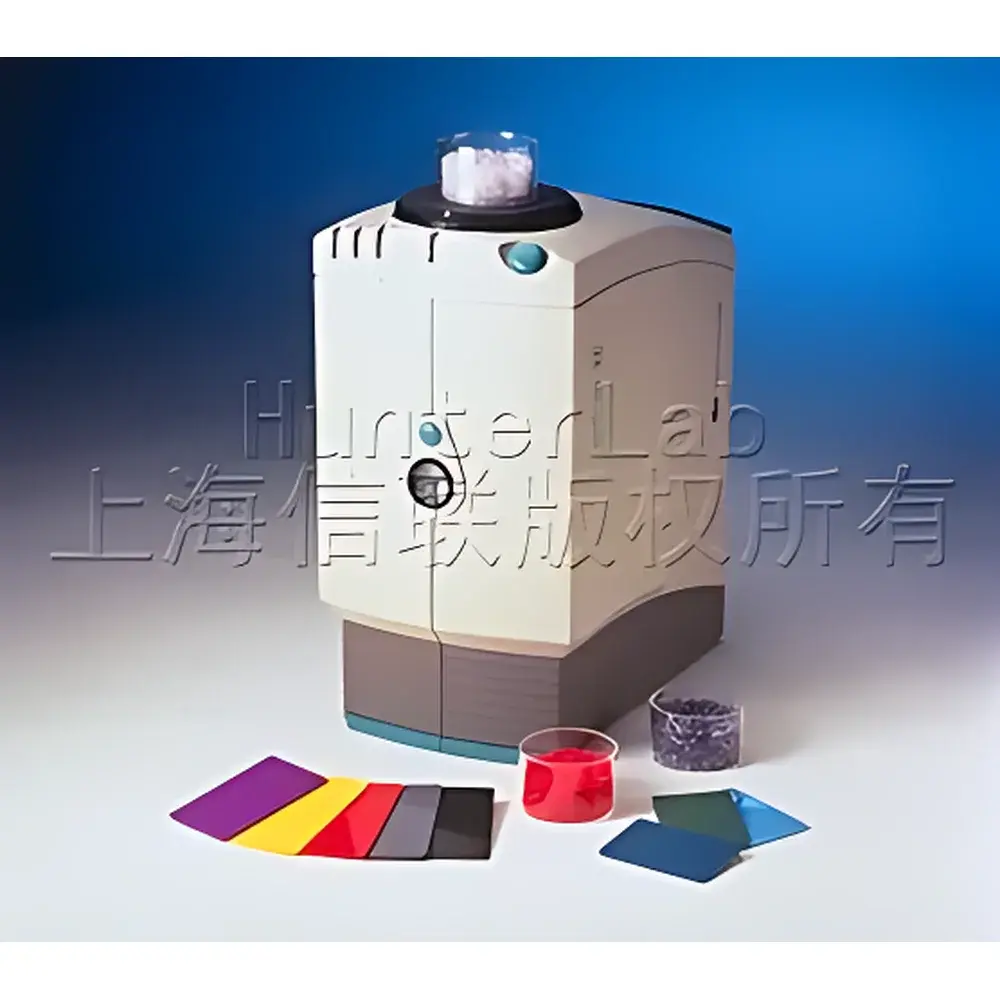
HunterLab LabScan XE Benchtop Spectrophotometer
| Brand | HunterLab |
|---|---|
| Origin | USA |
| Manufacturer Type | Authorized Distributor |
| Product Category | Imported Instrument |
| Model | LabScan XE |
| Product Type | Spectrophotometric Colorimeter |
| Instrument Form Factor | Benchtop |
| Optical Geometry | 0°/45° Integrating Sphere |
| Light Source | Pulsed Xenon Lamp |
| Spectral Range | 400 nm – 700 nm |
| Repeatability (ΔE*ab) | ≤ 0.09 |
Overview
The HunterLab LabScan XE is a high-precision benchtop spectrophotometer engineered for objective, repeatable color measurement across diverse industrial and laboratory environments. It operates on the CIE standard 0°/45° optical geometry—designed to emulate human visual perception under controlled illumination—making it especially suitable for applications where surface texture, gloss, or microstructure significantly influence perceived color. Unlike diffuse/8° or d/0° instruments, the LabScan XE employs a circular 0°/45° configuration with a 360° fiber-optic array comprising 15 discrete collection points. This architecture ensures spatial averaging of reflected light, minimizing directional bias caused by surface anisotropy, directional scattering, or localized specular highlights. The pulsed xenon lamp delivers full-spectrum illumination without thermal drift or spectral aging, enabling stable, flash-based measurements across the visible range (400–700 nm) with no warm-up time required. Its dual-beam optical path continuously compensates for source intensity fluctuations and detector response drift, preserving long-term photometric stability essential for quality control in regulated manufacturing.
Key Features
- Benchtop form factor with integrated electronics—no external power supply or PC required for basic operation
- Adjustable Viewport Sampling Interface (VSI) allowing aperture selection from 3 mm to 44 mm diameter to accommodate irregular, textured, or heterogeneous samples
- Flexible sample orientation: top-view (for powders, pastes, granules), front-view (for liquids in cuvettes or films), or vertical mounting via optional stand
- Dual-beam optical design ensuring real-time compensation for lamp intensity variation and detector sensitivity drift
- On-unit measurement trigger button located adjacent to the sample port—enabling standalone operation without software or computer interface
- Robust mechanical architecture with temperature-stabilized optics and sealed optical chamber for consistent performance in ambient lab or production-floor conditions
Sample Compatibility & Compliance
The LabScan XE accommodates a broad spectrum of physical sample types—including opaque solids (plastics, painted panels, ceramics), translucent films, liquid suspensions, powdered pigments, fibrous textiles, paper stocks, and granular pharmaceuticals—without requiring custom fixtures in most cases. Its maximum 44 mm measurement area supports large-area averaging for coarse-textured or non-uniform materials such as woven fabrics, molded composites, or coarse-ground foodstuffs. The instrument complies with ISO 7724-1 (Colorimetry — Part 1: CIE standard illuminants and observers), ASTM D2244 (Standard Practice for Calculation of Color Tolerances and Color Differences from Instrumentally Measured Color Coordinates), and CIE Publication No. 15:2018 (Colorimetry, 4th Edition). Data integrity meets GLP/GMP documentation requirements when used with compliant software; audit trail, user access control, and electronic signature capabilities are supported via optional HunterLab EasyMatch QC software compliant with FDA 21 CFR Part 11.
Software & Data Management
While functional as a standalone device, the LabScan XE integrates seamlessly with HunterLab’s EasyMatch QC software suite for advanced data analysis, statistical process control (SPC), tolerance setting, batch reporting, and multi-instrument network synchronization. The software supports customizable pass/fail criteria based on ΔL*a*b*, ΔE00, or user-defined color spaces (e.g., L*C*h*, Yxy). All measurement metadata—including date/time stamp, operator ID, sample ID, instrument serial number, calibration history, and environmental sensor readings (if equipped)—are embedded in each data record. Export formats include CSV, XML, PDF reports, and direct database push to SQL or Oracle systems. Firmware updates and spectral calibration verification routines are performed locally or remotely via secure HTTPS protocol, ensuring traceability and version control in regulated environments.
Applications
The LabScan XE serves as a primary color measurement platform in industries where appearance consistency directly impacts brand equity and regulatory compliance. In plastics manufacturing, it verifies pigment dispersion uniformity and batch-to-batch hue stability across injection-molded components. In textile dyeing, it quantifies metamerism between fabric lots illuminated under D65 and A illuminants. In food processing, it monitors browning indices in baked goods or oxidation-related chromatic shifts in edible oils. In pharmaceuticals, it supports USP guidelines for color assessment of tablets and capsules. In coatings and inks, it validates formulation repeatability and detects subtle changes induced by solvent evaporation or pigment flocculation. Its adaptability to variable sample geometry also makes it suitable for R&D labs evaluating novel biomaterials, recycled polymers, or additive-manufactured surfaces.
FAQ
What does “0°/45°” mean in color measurement?
It denotes an illumination/viewing geometry where light strikes the sample at 0° normal incidence and reflected light is collected over a 45° annular ring—mimicking typical viewing conditions and reducing sensitivity to surface gloss effects.
Can the LabScan XE measure transparent or translucent samples?
Yes—when configured with transmission mode accessories (e.g., liquid cell holder or transmission port insert), it measures CIE Y, x, y or CIELAB coordinates of clear liquids, gels, or thin films.
Is calibration traceable to NIST standards?
All factory calibrations use NIST-traceable ceramic tile standards; users receive a Certificate of Calibration with uncertainty values per ISO/IEC 17025 requirements.
How often must the instrument be recalibrated?
Daily zero and white calibration is recommended before critical measurements; full spectral calibration is advised every 6 months or after mechanical shock, lamp replacement, or environmental relocation.
Does the LabScan XE support multiple color spaces and tolerancing methods?
Yes—it calculates and displays results in CIELAB, CIELCh, CIE XYZ, Yxy, Hunter L,a,b, and CMYK (with ICC profile mapping), with ΔE*ab, ΔE00, ΔE94, and user-defined tolerances.



